


Wes Raines heard the kitten before he saw the blood on the wire. The cry came from the drainage swale at the far end of his meadow, thin and rusty as a hinge working loose. Thirty yards uphill, a female bobcat stood beneath a shagbark hickory with her front feet planted wide. Two kittens crowded behind her. A third had flattened itself under a fern. None of them ran.
Orange logging ribbon snapped from the hickory above the mother’s head. Blue paint marked the trunk at Wes’s shoulder. The timber crew was due Monday.
He stopped where the mowed path ended and let the bolt cutters hang against his leg. At sixty-four, after thirty-one years keeping boilers, elevators, and oxygen lines running at a county hospital, he still carried tools whenever he walked his land. His wife, Ellen, used to tease that he could not cross a room without finding something to tighten.
Ellen had been gone seven years. The far meadow was the only part of the place he had not learned to see without her.
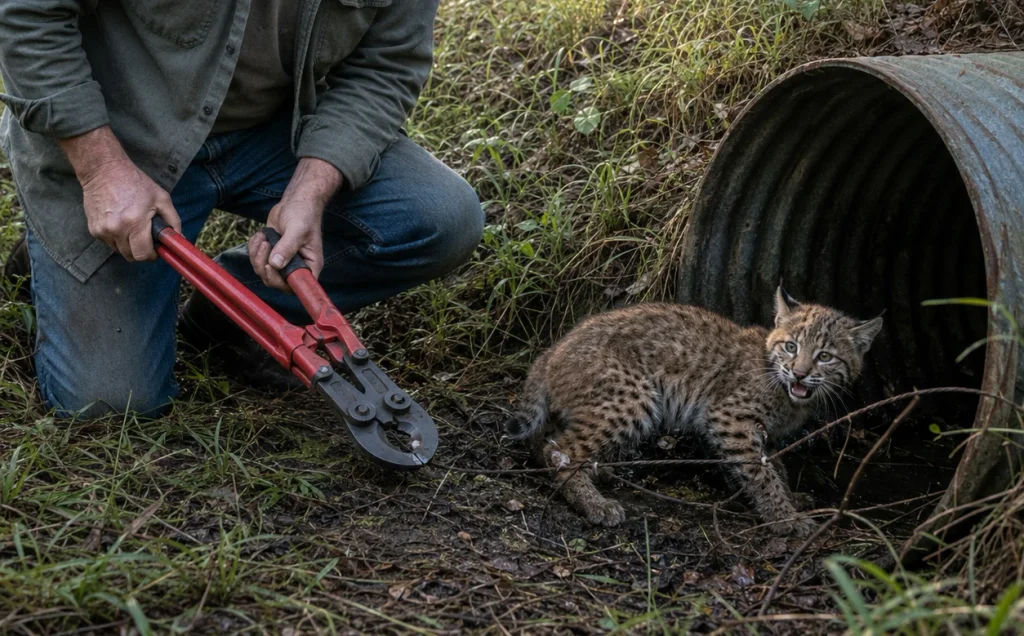
The cry came again. Wes lowered the cutters into the grass and crouched, though his left knee objected. The old spring drain was hidden under blackberry canes at the bottom of the swale. Last November, after leaves clogged the pipe and sent water toward his shed, he had wired a square of salvaged fencing over the opening. He had bent the cut ends inward with pliers and called the job finished.
One of those ends had opened like a hook.
The fourth kitten was wedged between the fence and the mouth of the pipe, one hind foot twisted in a rusted square. It was smaller than the others, but not newborn—perhaps the length of Wes’s forearm, all spotted legs and oversized paws. The fur around its ankle had darkened. Each time it pulled, the wire tightened.
Wes took one step down the bank.
The mother bobcat lowered her body. Her ears went flat, and a sound came from her chest that Wes felt more than heard.
He stepped back.
His phone showed two missed calls from his daughter, Anna, and a voicemail about the final cutting map. He ignored both and searched for the number of the Tennessee Wildlife Resources Agency. The dispatcher told him not to touch the kitten, not to put out food, and not to place himself between the mother and the drain. She took his location and connected him with a licensed wildlife rehabilitator named Delaney Price, who lived forty minutes away.
“Can you see its chest moving?” Delaney asked.
“Fast. It keeps pulling.”
“Then make yourself boring. Back up where the mother can see the kitten without having to come through you. I’ll bring what we need.”
Wes looked at the wire he had installed. “I have cutters.”
“You also have an adult bobcat watching you. Keep the cutters. Lose the idea that this is a one-man repair.”
The answer irritated him because it was sensible. He backed all the way to the tractor shed and sat on an overturned bucket in its open doorway. From there he could see the swale through binoculars.
For the next thirty-seven minutes, the mother moved in short, measured arcs. She approached until the trapped kitten cried, then retreated when it thrashed. Once, she lay flat in the grass and called with a low, rising chirp. The kitten answered, exhausted but immediate.
Wes had seen bobcats on the property before—usually a tawny blur crossing the county road at dusk, or eyes caught briefly in the beam above the creek. During the past three weeks, however, he had seen this female several times at the far edge of the meadow. He had also seen the kittens tumbling over the fallen chestnut where Ellen used to sit and clean dirt from her garden shoes.
He had told no one. Keeping the sight private had felt less like secrecy than preserving a room before somebody else entered it.
Delaney arrived in an aging green SUV with a dented animal carrier strapped in back. She was in her early fifties, narrow-faced and sun-browned, with gray threaded through a braid. She looked first at the mother, then at the kitten, then at Wes’s tools.
“How long?”
“I found her a little before eight.”
“Found her, or heard her?”
“Heard her.”
Delaney nodded as if the distinction mattered. She called the agency dispatcher to confirm her arrival, then opened the rear hatch. From a plastic bin she took leather gauntlets, a heavy towel, a small net, and a sheet of plywood with two handholds cut into it.
“She may charge if we crowd the kitten,” she said. “Usually she won’t. Usually is not a promise. You stay uphill with the board. I handle the animal. If I tell you to drop it, you drop it and walk backward.”
“The wire is fixed to the pipe. You’ll need both hands on the kitten.”
“That’s why you’re here. You cut only where I point.”
It was not the way Wes would have organized the job, which was probably why it worked. Delaney moved into the swale behind the plywood while Wes held its upper edge. The mother slipped into the trees, but her growl followed them. Up close, the kitten smelled of wet leaves and iron.
Delaney covered its head and shoulders with the towel. The small body fought once, hard enough to shake the fencing.
“Top strand,” she said. “Not the one against the leg.”
Wes set the cutters and squeezed. The old wire resisted, then broke with a sound he knew too well—the bright snap of metal holding tension. The kitten twisted. Delaney pinned the towel gently against the earth while he cut the second strand and bent it away.
When the foot came free, the kitten did not run. It sagged into Delaney’s hands.
“Carrier,” she said.
Wes climbed the bank, brought it down, and opened the door. Delaney settled the bundled kitten inside without exposing its face. Only after the latch caught did she lift one corner of the towel. The kitten’s eyes were open, gold-brown and furious, and a thumbprint of pale fur showed behind her right ear. She struck once at the wire door, then pulled the injured foot beneath her body.
That small act of resistance eased something in Wes’s chest.
“Is she going to live?”
“I don’t know yet. She has circulation in the toes, which helps. She’s dehydrated and that cut is dirty. A veterinarian needs to examine her.”
“Her mother is right there.”
“And if the wound is deeper than it looks, putting her down would be the same as leaving her caught. If we can return her, we will. Quickly.”
The mother called from the tree line. Inside the carrier, the kitten lifted its head and made the same wavering trill.
Delaney covered the door. “Let’s get her warm.”
They carried the crate up together. Wes felt the weight shift toward his side and adjusted automatically, matching Delaney’s shorter steps. At the SUV, she set the carrier in a padded space behind the front seats and secured it with two straps.
“I need the exact place you first saw the family,” she said. “If the mother moves the others, we’ll look for the route, not the den. Don’t go poking around for it.”
Wes pointed toward the fallen chestnut beyond the hickory. Its root plate had lifted years ago, leaving a dry pocket beneath the trunk. Three small shapes had vanished there moments earlier.
Delaney followed his hand. Her eyes stopped on the blue paint, then moved to the orange ribbons describing a line through the trees. One ribbon hung directly above the hollow beneath the chestnut.
“What are those marking?”
Wes already knew why she had asked. “A skid road.”
“When?”
“Monday morning.”
The wind turned the nearest ribbon until its bright side disappeared. The blue stripe did not move. It ran across the fallen chestnut, straight over the dark opening where the other three kittens had gone…
To read the rest of the story – CLICK the NEXT button 👇👇👇