


Tessa Rowan had written her limits on the back of an auction envelope so she would have something harder than good intentions to argue with. TWO FEED BUNKS, the list said. WOVEN WIRE IF UNDER $400. NO ANIMALS.
The last line was Harper’s. Her thirteen-year-old daughter had printed it in block letters before leaving for school that morning, then drawn a box around it twice. Tessa had laughed, folded the envelope around a six-hundred-dollar cashier’s check, and promised she was going to the Ellis County liquidation sale for equipment, not trouble. Pen 17 stood between the parking lot and the equipment row.
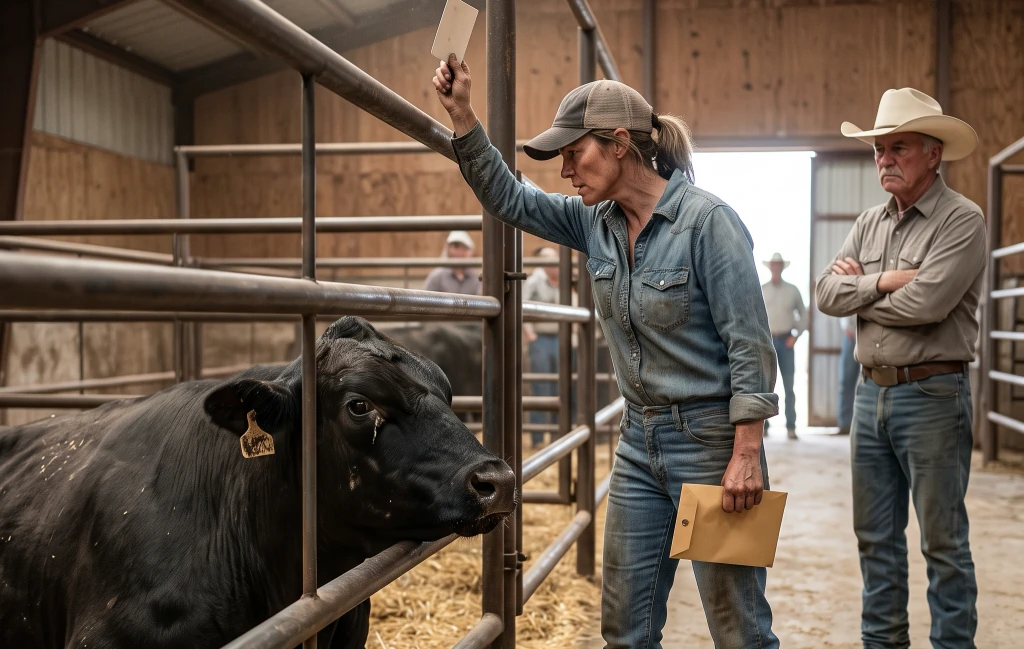
The black bull inside it was down on his chest, front legs folded beneath him. He was not small. Even emptied by hunger, his frame crowded the pipe pen: a long back, a deep cage of ribs, a head built to belong on something close to a ton. But the flesh had gone out of him. Each knob of his spine lifted the hide, and dried mud made gray plates along one shoulder. When a fly settled at the corner of his eye, he gathered enough effort to shake it away.
Tessa stopped with the envelope in her hand. A voice behind her said, “Ma’am, stay outside the rail.”
Dr. Nolan Pierce ducked through the gate carrying a black veterinary bag. He had treated Tessa’s cattle since she bought her first six bred cows, and his gray mustache seemed to have acquired one more white stripe every calving season. He crouched beyond the bull’s reach and waited before touching him.
“Sale barn says he came in with the Herndon dispersal,” he said. “Nobody has records. He walked off the trailer last night, but he hasn’t gotten up today.”
“Fever?”
“A little. Dehydrated. Feet are a mess.” Nolan pressed two fingers against the bull’s gum, then glanced at her. “Don’t build a future from the fact that he’s still breathing.”
“I asked about the fever.”
“And I know the look you get when you stop asking the question you mean.”
At the far end of the alley, a young yard hand slapped a sorting paddle against his boot. The bull lifted his head at the sound. His nostrils widened, but he did not try to rise.
Preston Blackwood came down the alley behind the hand, clean hat above a sun-darkened face. He had already bought twenty-two Herndon heifers that morning, and the auction clerks had begun setting aside whole rows of yellow purchase slips beneath his name. He took one look into Pen 17 and told the hand to put the paddle away.
“If Pierce clears him to stand, give him time,” Preston said. “If he can’t, nobody drags him onto a trailer. Understood?”
The hand nodded and moved on. Preston was capable of that kind of clean decision. He paid his crew on Fridays, kept his water tanks scrubbed, and had once sent three stock trailers into a grass fire without waiting to be asked. None of it made him gentler with people he considered foolish.
He saw the auction envelope in Tessa’s hand.
“You’re here for bunks,” he said.
“That’s the plan.”
“Good plan. Keep it.”
Nolan stood and closed his bag. “I’m giving him fluids. If he rises on his own and stays up, he can go a short distance in a bedded trailer tomorrow. If he doesn’t, the sale will have to make a different decision.”
Preston leaned one forearm on the rail. He studied the bull’s feet, then the sharp line of his hips. “Months of feed, maybe, and no guarantee he breeds when you’re done. That’s assuming he doesn’t die the first week.”
Tessa knew he was not wrong. Her fall calves would not sell for another eleven days. The north well had started coughing sand in August, and the pump reserve sat at eight hundred and forty dollars, which was not enough to replace it but was at least a beginning. She and Harper had spent Sunday pricing used tanks in case the well failed before winter.
The bull moved his jaw once. No cud, only the dry motion of an empty mouth.
“What’s the sale doing with him?” Tessa asked.
“Offering him under a care-only bill of sale,” Nolan said. “Local placement, no slaughter channel. Or they’ll put him down here if he remains nonambulatory.”
Preston exhaled through his nose. “Tess. An animal can be worth saving and still be one you cannot afford to save.”
That was the sentence she should have carried with her to the equipment yard. Instead, she looked at the bull’s ears. The right one drooped, its edge split by an old tear. When Nolan shifted toward the gate, the bull followed him with his eyes. Flat with exhaustion, yes. Not absent.
The auctioneer reached Pen 17 after lunch. By then the bull had taken most of the fluids Nolan gave him and drunk half a shallow tub without lifting his chest from the straw. Five people stopped along the rail, more curious than interested.
“One hundred dollars to an approved local buyer,” the auctioneer called. His usual rhythm had left him. “One hundred, and if I don’t have it, we’ll pass.”
Tessa felt the folded envelope against her palm.
Preston stood two places down. “Don’t make Harper pay for a decision you want to feel good about.”
The words found their mark because he knew exactly where to aim. Tessa raised her bidder card anyway.
No one answered her bid. The auctioneer waited, looked once toward Nolan, and brought the gavel down.
“Sold. One hundred dollars. Pen 17 to Rowan.”
There was a small stir along the rail. Preston did not laugh at first. He looked at Tessa as if he expected her to lower the card and admit it had been an accident.
“You just bought a dead bull,” he said.
“Then you won’t mind that I outbid you.”
His mouth tightened. “I mind watching pride eat hay.”
Tessa walked away before the reply forming in her head could cost more than the bull already had.
He stood at sunset. Nolan called her back from the equipment row, and she reached Pen 17 in time to see the bull push his hindquarters up, pause with both front knees in the straw, then lurch onto all four feet. He stood wide and trembling. The watching yard hands kept quiet without being told.
Tessa bought neither feed bunk. She bought six bags of grass pellets, two bales of soft hay, a rubber water tub, and a bottle of the hoof medication Nolan prescribed. The wire went to a farmer from Russell for three hundred and seventy-five dollars.
The next morning, the bull was still standing. Nolan examined him again before allowing the move. The trip to Tessa’s place took twenty-three minutes with every turn made slowly. She had borrowed her neighbor’s low stock trailer, laid deep shavings over rubber mats, and tied the inner divider open so the bull would not be forced into a narrow compartment. He backed out at her barn rather than turning, one careful foot at a time.
Harper was waiting by the isolation lot in her school jeans and an old FFA jacket. She watched the bull take three uneven steps toward the water, his infected front foot making him swing diagonally.
“He moves like a bishop,” she said.
Tessa looked at her. “A what?”
“In chess. He can’t go straight.”
“He’ll go straight when his foot heals.”
Harper slipped her hands into her jacket pockets. “The name can stay.”
It was not forgiveness, but it was a name. They settled Bishop in the old calving shed, separated from the herd by two fences. Nolan returned after his afternoon calls and worked beneath the white barn light. He found heavy parasites, an abscess in the left front hoof, overgrown horn on the right, and the fever of a secondary infection. He found no obvious injury in the hips or spine. The heart sounded steady. The lungs were clear.
“He’s not dying tonight,” Nolan said. “That is not the same as telling you he’ll recover. No grain. Good grass hay in small amounts, water where he doesn’t have to walk for it, and everything on this schedule. If you try to put weight on him fast, you’ll make him sicker.”
Tessa read the page twice. “What are his chances?”
“Better than they looked yesterday. Worse than you want them to be. Ask me again in three weeks.”
He gave her the bill for the sale exam, fluids, farm call, tests, and medication. The total was seven hundred and twelve dollars. Nolan had cut his mileage and charged only once for the two examinations. There was still no way to make the number fit inside the hundred-dollar story Tessa had brought home.
Harper stood beside the tack-room door, holding the auction envelope. Iodine from Tessa’s fingers had left a brown thumbprint across the words NO ANIMALS.
“The pump money,” Harper said. “That’s what you used, isn’t it?” Tessa set Nolan’s bill on the freezer lid. Harper did not raise her voice. That made the question harder to escape. “Did you know what he might cost us when you raised the paddle…”
To read the rest of the story – CLICK the NEXT button 👇👇👇