


The dog had stopped trying to reach the food. She stood beside a grocery-store dumpster on Alder Bay’s main road with a clear plastic pretzel jar locked over her head. The cracked bottom struck the snow whenever she lowered her muzzle toward a torn paper sack. After three attempts, her front legs folded. She lay down with the jar pointing at the street, watching cars pass through its cloudy sides.
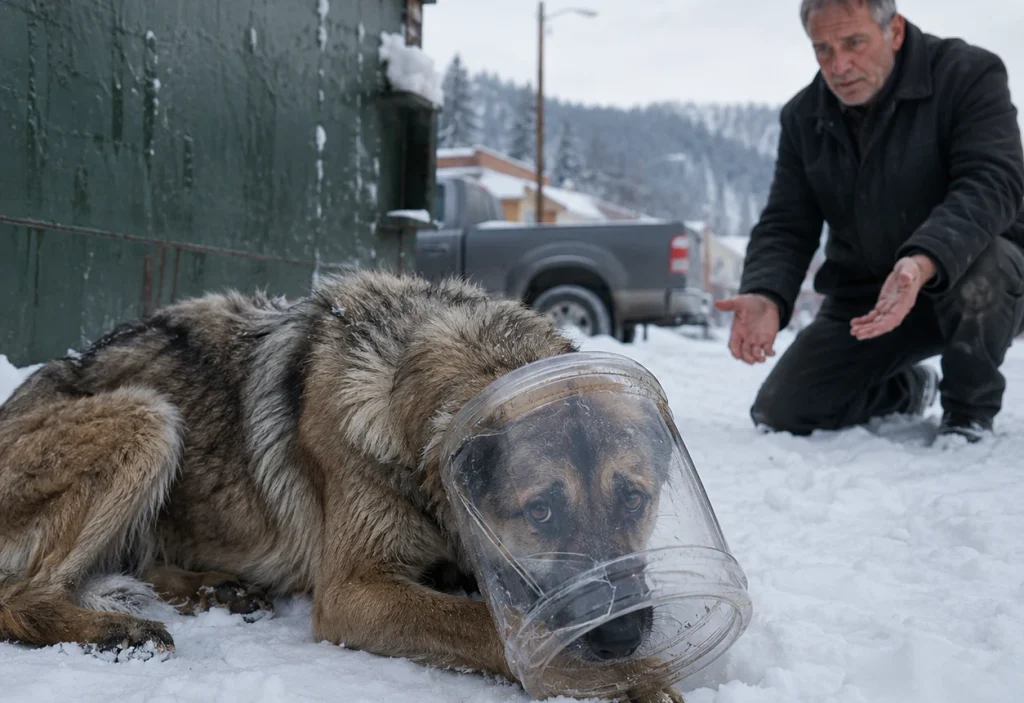
Jonah Reed drove past her once. He made it half a block before braking his truck so hard that the box of deck screws on the passenger floor spilled beneath the seat. A horn sounded behind him. Jonah pulled onto the shoulder, shut off the engine, and watched the dog struggle upright again.
She was a young German shepherd, perhaps ten months old, cream and smoke-gray beneath road grime. The jar’s opening had slipped behind her ears. There was room for air, but not enough for her to pull free, drink, or put her mouth around anything larger than snow.
A man leaving the grocery store saw her and called, “Hey, girl.”
The dog flung herself backward. Plastic scraped pavement. When he lifted both hands to show he meant no harm, she ran between two stone retaining walls and trapped herself in a drift.
Jonah knew the difference between an animal moving away from danger and one moving away from hands. He had spent twenty-four years in the Navy, most of them as a SEAL, learning to notice small distinctions before they became expensive. Retirement had not taken that habit. It had only left him with fewer reasons to use it.
He followed without calling her. At the end of the passage, he lowered himself into the snow, turned one shoulder away, and waited.
Cold soaked through his work pants. The dog clawed at the jar once, then let her paw fall. Her breathing fogged the plastic.
“Nobody’s coming closer,” Jonah said.
One ear shifted under the rim. At fifty-five, Jonah still looked like a man people expected to take charge: six feet two, lean, gray beginning at his temples, his movements stripped of wasted effort. The impression lasted until someone looked at him long enough. Then they saw the fatigue beneath his eyes and the careful way he sometimes stood, as if his bones had become unreliable ground.
His multiple myeloma had been diagnosed eighteen months after his wife, Anna, died. At first he had approached treatment the way he once approached an operation—dates, medication, contingencies. Then he missed a blood draw. He canceled a follow-up and let the clinic’s calls go to voicemail. The disease was not in remission, but neither was Jonah doing much to learn what it was doing.
He did not want to die. But wanting had not made him return the clinic’s calls, refill the calendar, or picture the next winter.
The dog lowered her head. The jar struck the snow, and she made a thin sound inside it.
Jonah opened the small cutting blade on his multitool. He moved one foot closer and stopped when her shoulders tightened. Snow collected on his coat while he let her study the blade, his hand, and the distance between them.
“I can wait longer than you can,” he said. “It’s my least useful skill.”
After several minutes, he touched the outside of the jar. She flinched but did not run. He withdrew, waited again, then began cutting along the existing crack.
The plastic flexed. The dog pulled once, too weak to do more. Jonah widened the split a fraction at a time until the rim loosened behind her ears. With one last bend, the jar opened and dropped into the drift.
She jerked her head left and right, as if freedom might close again. Then she tried to eat snow.
Jonah blocked her gently with his forearm. She went rigid at the contact. He removed his arm at once, returned to the truck, and brought back water in a shallow parts tray he had bought at the hardware store.
The dog was still there. He poured an inch, set it down, and backed away. She crawled rather than walked to it. The sound of her tongue against the tray was quiet, ordinary, and unexpectedly difficult to hear.
Anna used to leave bowls of water at the edge of their property for anything with four legs and bad judgment. In summer, raccoons washed dirt into them. In winter, chickadees perched on the rim. Jonah had complained about frozen bowls, spilled water, and the one skunk that made their porch unusable for a week. He had kept none of those bowls after she died.
When the dog finished drinking, she touched her nose to the ends of his fingers. The contact lasted less than a second. Her legs gave way immediately afterward.
Jonah caught her before her head struck the pavement. She stiffened inside his coat, then stopped fighting. It was not trust. He knew better than to give himself credit for what exhaustion had done. But dusk was coming, and the temperature would fall below zero after dark.
He could call the county shelter. He could place her in the hands of people whose job included abandoned dogs. For two years, Jonah had found competent people to whom almost every difficult thing could be assigned.
He carried her to the truck. At home, he put a folded quilt near the kitchen radiator and set out water and a small bowl of chicken softened with broth. The dog ignored the quilt. She wedged herself beneath the far end of the dining table, where the wall covered her back and the only open path pointed toward the mudroom door.
Jonah sat at the counter and pretended to read a snowblower manual. When he looked directly at her, she froze. When he turned a page, she crept toward the bowl. She ate one piece of chicken, took another, and carried it beneath the table.
“That’s allowed,” he said without looking up.
The next piece went behind the mudroom curtain. The one after that disappeared into Jonah’s left work boot by the door. He lowered the manual.
The dog stopped with food in her mouth. Her body sank, waiting for whatever followed being caught.
Jonah looked away first. “Keep it.”
He went upstairs and found an old blanket for himself; the dog had the warmer one. When he returned, she was nosing at the canvas daypack he had left unzipped on a chair. Jonah used it for lake walks and hospital appointments, back when he still kept the latter. A white oncology envelope lay unopened in the inside pocket.
The dog carried another piece of chicken to the pack. She dropped it inside, went back for a second, then a third.
Jonah stayed in the doorway until she noticed him. Her ears flattened. She backed toward the mudroom, leaving the pack between them.
The bowl was still half full. The room was warm. No one had reached for her food. Yet she had placed half her first meal inside the one thing in the house already prepared to leave…
To read the rest of the story – CLICK the NEXT button 👇👇👇