


The bull came into the sale ring with his head low and one eye fixed on the sawdust, as if he had learned that looking at people only gave them ideas. Maren Hollis saw the ticks first. They crowded the thin skin behind his ears and lay in dark knots along his neck, some flat as seeds, others swollen gray. The auction barn was hot enough to sour breath. Diesel drifted in from the loading alley, the overhead fans chopped at the heat without moving it, and every time the bull took a step, dust found the bare places in his red coat.
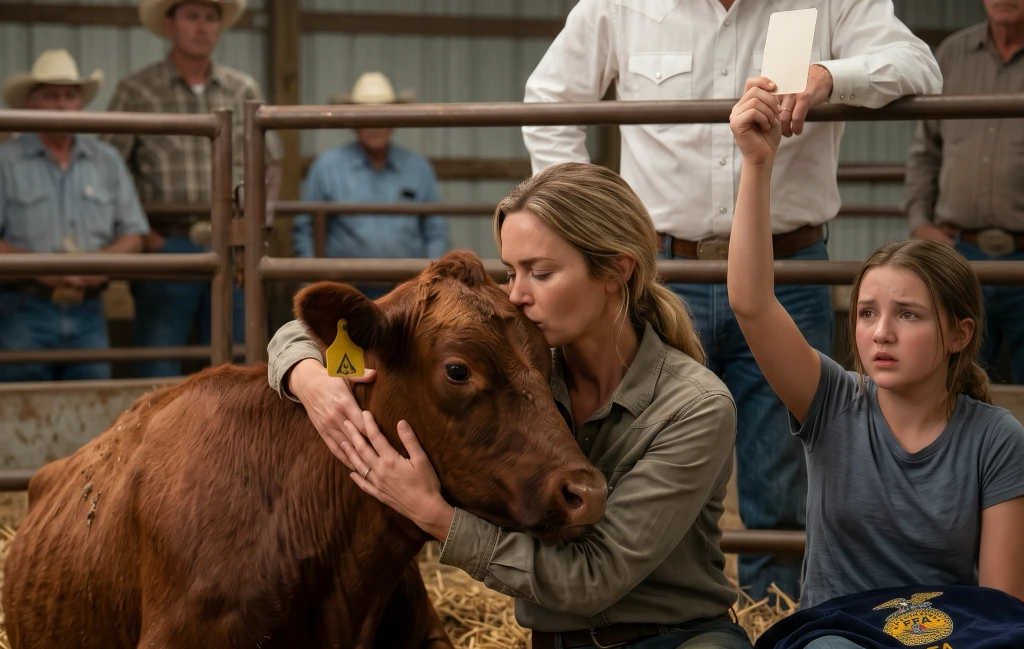
Beside Maren, her fifteen-year-old daughter stopped drawing circles around lot numbers in the catalog.
“Mom.”
“I see him.”
“Then don’t.”
They had come to Dry Creek Auction for two bred cows if the right ones stayed under twenty-four hundred dollars. They had bought neither. The first had a cloudy eye the catalog did not mention, and the second climbed past their ceiling while Maren’s bidding card remained flat against her thigh. On the drive over, she had made Tessa repeat the rule they used whenever money was tight: the number decided, not the wanting.
Now the last animal of the afternoon stood under the ring lights looking half-erased.
The auctioneer cleared his throat. Everett Shaw had sold cattle from that block for nineteen years, and he could make a pen of ordinary heifers sound like mineral rights. He did not try with this one.
“Red Angus bull, age called at three. Selling as-is. Kept separate since arrival. Who’ll start him?”
No one moved.
Three rows above Maren, Preston Carrington leaned toward the aisle. He had already bought forty-seven calves and two heavy bred cows that afternoon. His foreman kept the numbers; Preston barely glanced at them. He ran close to seventeen hundred head north of Harlow, served as president of the county cattlemen’s association, and paid for the navy FFA jackets worn by half the students in Tessa’s chapter—including the one folded over her lap.
He was also the first man that morning to tell Everett not to run the sick bull through a common holding pen. That had been good judgment. The laugh that followed was not.
“Everett, that thing needs a burial permit.”
The men around him broke first. Others joined because Preston’s laughter had the easy shelter of money in it. Even Everett smiled with his mouth before getting control of it.
Maren kept looking at the bull.
His hip bones rose sharply, but his knees did not buckle. His pasterns were upright. There was no swelling around the hocks, no rope of discharge at the nose, no vacant drift in his eye. Under the lost flesh, his chest was deep and his shoulders wider than the rest of him had any right to be.
She had spent four years as an assistant in Silas Boone’s mixed-animal clinic before Tessa was born. Long enough to know the difference between an animal whose body had stopped trying and one still spending what little it had.
The bull turned toward the ringman. His left ear twitched once beneath the weight of the ticks. A cracked yellow tag swung from it, and in one corner Maren caught a stamped mark: a low triangle crossed by a straight line.
Something in her memory shifted.
“Two hundred?” Everett called. “Anybody at two?”
Tessa put two fingers on Maren’s card.
“You said no projects.”
“I said no bottle calves.”
“That’s not better.”
Maren raised the card. “Three-fifty.”
The laughter stopped in uneven pieces. Everett stared as though he wanted to make certain she was not scratching her face, then took the bid.
“Three-fifty. I have three hundred and fifty dollars. Four?”
No one offered four. The gavel came down before Maren had time to feel relief or regret.
Preston turned in his seat. His white shirt had pearl snaps, and the crown of his felt hat was still showroom clean despite eleven years of appearing in photographs beside cattle.
“That’s an expensive way to prove you belong in the room, Maren.”
Tessa went very still beside her.
Maren stood, tucked the catalog under her arm, and stepped past his row without answering. She knew what an argument did in a place like that. By supper, nobody remembered what the woman had said, only that she had become emotional.
At the cashier’s window, she signed the sale slip with a pen chained to the counter. The total, with fees, was $381.50. She looked at the number until it became only ink.
“Which account?” Tessa asked behind her.
“Operating.”
“The operating account is the tractor pump.”
“I know what’s in it.”
“Then why did you make me repeat the rule?”
The clerk slid the receipt through the opening. Maren folded it once and put it in her shirt pocket. “Help me get him loaded.”
The bull balked at the mouth of her narrow stock trailer. He did not charge or fight. He simply planted all four feet and stared into the dim compartment as if darkness had acquired a shape he remembered. Maren asked the loading crew to put away the electric prod. One man rolled his eyes, but Everett, watching from the alley, told him to do it.
They opened the side vents, scattered hay across the floor, and waited. After six minutes, the bull stepped up on his own.
Tessa latched the rear gate. “I’m not naming him.”
“Nobody asked you to.”
“Good.”
On the drive home, the sunset made a copper-colored bar through the trailer slats. It traveled across the bull’s ribs each time the road curved. Maren tried not to turn that into a sign.
Hollis Creek Ranch was forty-six acres south of town, eleven cows, nine calves not yet weaned, one old bay mare, and a mortgage that had outlived every improvement made against it. The creek along the east boundary became a necklace of green pools by August. Mesquite crowded the lower ground. The tractor’s hydraulic pump had been leaking since April, and the feed-room door had to be lifted by the handle before it would close.
It was not a hobby. Maren hated the word because it made work disappear.
She backed the trailer to the quarantine pen a hundred and sixty feet beyond the barn. The pen had its own trough and no shared fence with the cow pasture. It had held sick calves when Maren’s mother ran the place, then rusted empty after her death.
Tessa changed from sneakers into boots without being asked. Together they hung a shade tarp, checked the rails, and laid a shallow line of hay from the trailer to the trough. When Maren opened the gate, the bull stood inside for so long that the flies found them both.
Then he came down one careful step at a time.
His legs trembled when he reached level ground. Tessa looked away, but not before Maren saw her mouth tighten.
Maren removed the nozzle from the hose and let water run quietly into a rubber tub. The bull approached the sound. He lowered his muzzle, flinched when the tub shifted, then drank in long, measured pulls. Water darkened the hair beneath his jaw.
“Copper,” Maren said.
Tessa gave her a look. “You lasted twenty-three miles.”
“I wasn’t asking permission.”
“That part’s clear.”
Silas Boone arrived before seven the next morning in a truck with a veterinary box built into the bed and red dust worked permanently into its seams. He was sixty-four, square through the shoulders, and sparing with comfort. He had once told Maren that hope was useful only after temperature, respiration, and gut sounds had been written down.
He inspected Copper from outside the pen first. Then he pulled on gloves, clipped hair, examined the skin, and collected several ticks into a vial for identification. He listened to the bull’s chest, checked his mouth and eyes, drew blood, and stood back while Copper made one slow circle.
“He’s severely anemic until the lab tells me otherwise,” Boone said. “Dehydrated. Body condition is poor enough that I don’t want you guessing with feed. I also don’t know yet what those ticks may be carrying.”
“No fever,” Maren said.
“No fever this morning. Lungs sound clear. Rumen’s moving. Those are reasons to proceed, not promises.”
Tessa leaned against the far rail with her arms folded. “Can he make it?”
Boone looked at her, not at Maren. “He can. That’s different from saying he will.”
He laid out the plan. Copper would remain isolated until the tests came back and Boone was satisfied there was no transmissible disease concern. Treatment would follow the parasites they identified and the bull’s actual weight, with a scheduled follow-up rather than whatever happened to be on a feed-store shelf. Good grass hay would come in small, frequent amounts. Concentrate would be introduced slowly. Clean water, loose mineral, daily temperature, appetite, manure, and any change in behavior would all be recorded.
“And if he goes down?” Maren asked.
“Call before you try to make him get up.” Boone stripped off his gloves. “A weak bull can hurt himself, and he can hurt you without meaning to.”
At his truck he wrote figures on the back of an invoice: the farm call, laboratory work, treatment, follow-up. Even with the professional courtesy he had already subtracted, the first two weeks would cost more than the animal.
Maren did the arithmetic once. Then again.
The tractor could wait. The feed-room door could wait. The money she had promised to add to Tessa’s savings for the national FFA convention in October could not. The chapter deposit was due Monday, and another student would take the seat if the payment was late.
Boone closed his case. “I can give you a medical plan, Maren. I cannot give you a financial one.”
His truck went up the drive, leaving a low brown cloud behind it. Tessa stayed by the gate, looking at the estimate in her mother’s hand.
“Tell me,” she said, “that you didn’t just spend Indianapolis on that bull…”
To read the rest of the story – CLICK the NEXT button 👇👇👇