


The sound came from beneath Ruth Weller’s porch, wrong for a kitten and too weak for anything the November cold ought to have left alive. At eighty-five, Ruth no longer trusted her eyes at dusk. She trusted sounds: the dry pop of spruce at ten below, the soft labor of her well pump, the difference between sleet on the kitchen window and a branch asking to come down. For thirty-one years she had driven a school bus over the back roads of northern Maine, and she still counted trouble first by what it did to the quiet.
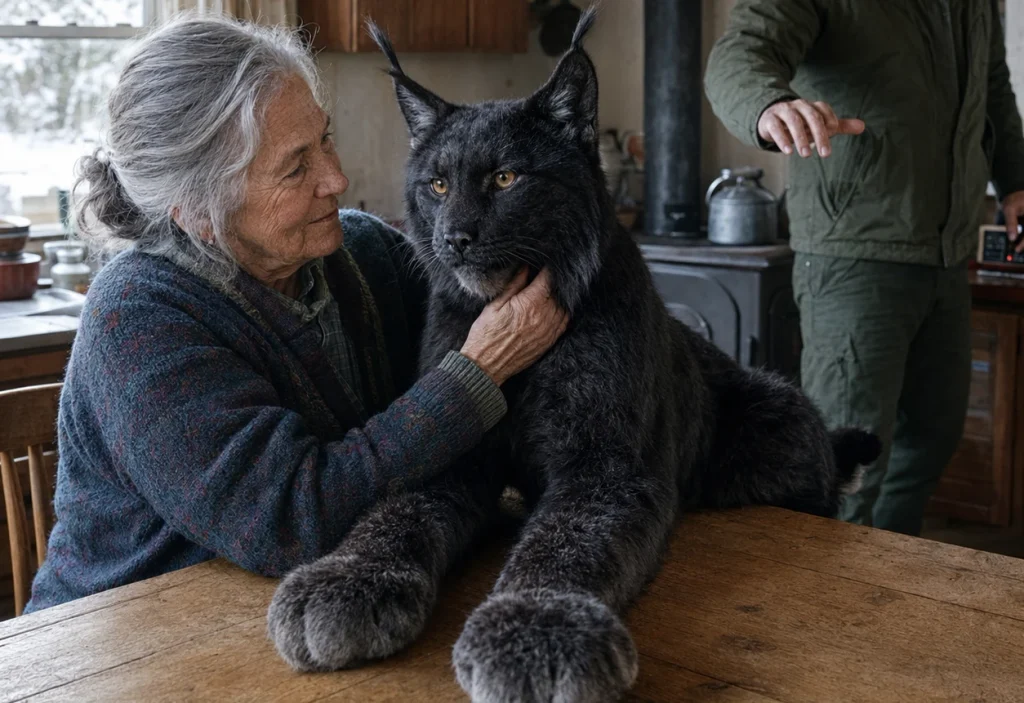
She set down the ash bucket and listened. Wind moved through the black spruces beyond the yard. Then the rough little cry came again from behind the porch lattice.
“All right,” she said. “I heard you.”
The power had gone out before supper, and the storm was erasing Black Spruce Road from the far end inward. Ruth took the flashlight from its nail, lowered herself one step at a time, and knelt in snow that came over the tops of her boots. The beam found two amber points, then a black face pressed into the narrow space beneath the boards.
The animal made no effort to run. When Ruth reached in, her fingers met fur crusted with ice and a body so thin she could feel every rib. Its paws seemed absurdly large. Its tail was scarcely more than a dark knob.
“Somebody lost the fancy end of you,” she murmured.
She eased it out with both hands. It weighed less than Cal’s old toolbox and hung against her without resistance, long hind legs trailing. At the tips of its ears, wet black hair came to points. Ruth noticed, then chose the explanation she wanted: some Maine Coon in the father, perhaps, and a bobtail in the mother.
Inside, she laid the animal in a bushel basket lined with towels and set it several feet from the woodstove. Cal had taught her not to force heat into anything half frozen. She wrapped the small body in his red wool shirt, warmed water, and touched a little to its gums. Much later, when it could lift its head, it swallowed a few shreds of the chicken Ruth had meant to make last three suppers.
The creature did not purr. A low vibration moved through it, more like the old Blue Bird bus idling under Ruth’s seat on winter mornings. She kept one hand on the basket until dawn, feeling that faint engine run.
By morning the road was closed, the telephone line was down, and the black animal had opened its eyes. It watched Ruth cross the kitchen with a steadiness no house kitten had ever possessed.
“You can stare,” she told it, “but you still need a name.”
She called it Tuck because of where she had found it and because the short name felt easy in an empty house. Cal had been gone seven years. Their old tabby had lasted two years after him, and since then no living thing had waited for Ruth on the warm side of the door.
The county plow reached her on the second afternoon. Ray Pike backed the orange truck as far as the woodshed, dropped a sack of salt from the cab, and asked whether she needed anything from town. Ray was fifty-seven and could reverse a plow between two mailboxes without shaving paint from either one. He also had the habit of looking past Ruth while he spoke, as though checking what she might be hiding from herself.
“Heard something crying out here last night,” he said. “Fox, maybe.”
“Wind under the porch.”
Ray looked down. Round tracks, wider than a kitten’s, marked the fresh snow beside Ruth’s boot prints. His eyes followed them to the kitchen door.
“That’s a fair-sized wind.”
Ruth shifted the salt sack between them. “You planning to plow, Raymond, or measure my yard?”
He laughed once and climbed back into the truck. Before he left, he said something had been circling his rabbit hutches two roads over. Ruth waited until the diesel sound disappeared before she opened the door.
She could have called the veterinary clinic that afternoon. The line was working again. Instead, she fed Tuck another strip of chicken and told herself she would call if he failed to improve.
He improved too quickly for that promise to remain comfortable.
Within ten days, Tuck could spring from the floor to the top of the pie safe without touching a shelf. He used the litter pan Ruth improvised from a washbasin, but he buried nothing. The cloth mice she stitched from one of Cal’s worn socks lasted minutes beneath his broad paws. He never meowed. When pleased, he made the deep, mechanical hum; when the snowshoe hares moved at the tree line, he gave a breathy cough and went rigid at the window.
Ruth’s daughter called every Sunday from Bangor. Claire managed a hospital pharmacy and had developed, in Ruth’s opinion, the professional vice of turning every conversation into a list of preventable outcomes.
“Did the power come back?” Claire asked.
“Obviously. The telephone isn’t run by candles.”
“Did Ray clear all the way to the county road?”
“He cleared enough.”
“And you’re wearing the alert button?”
Ruth looked at the little gray pendant still boxed beside the sugar bowl. “I know where it is.”
There was a pause. Claire had learned that pushing made Ruth quieter, not more truthful. “I can come up the weekend after Thanksgiving.”
“Come when you’re not counting the hours back.”
Tuck chose that moment to send a mixing bowl skidding across the floor. Claire heard it.
“What was that?”
“I dropped something.”
The lie left a metallic taste. Ruth ended the call before Claire could inspect it.
By Christmas, Tuck stood nearly to Ruth’s knee when he stretched. He was not heavy—perhaps twenty-two pounds—but his legs made him look larger, and his paws had spread into furred snowshoes. In daylight, his coat was not truly coal black. Silver showed beneath it at the throat and belly, like frost caught under soot. A ruff had thickened along his cheeks, and the points on his ears had become unmistakable tufts.
Ruth had stopped telling herself he was a peculiar house cat. She had not yet begun telling anyone else the truth.
On Christmas Eve, Claire arrived with groceries, a new battery lantern, and the careful brightness she used when she expected a fight. Ruth had baked the dark molasses cookies Claire liked as a child and left them under a towel on the counter; neither woman mentioned them. Claire stamped snow from her boots in the mudroom and saw the gouges around the inner door.
“Mom, what did this?”
“The wood swelled.”
“In four parallel lines?”
Ruth took the grocery bag from her. “You drove three hours to criticize a door?”
Tuck appeared at the end of the hall.
Claire went still. She had grown up in these woods and knew enough not to step backward quickly. The black animal studied her with amber eyes, head slightly lowered. His short tail twitched once. Then he crossed the hall without a sound and placed himself between Ruth and the unfamiliar woman.
“Mom,” Claire said, barely moving her lips. “That is not a cat.”
“He hasn’t bothered you.”
“That isn’t the standard.”
Tuck’s ears flattened at the pressure in Claire’s voice. A low growl rolled from deep in his chest.
Ruth laid her hand against the ruff at his neck. The growl stopped, but Claire’s face changed when she saw how naturally her mother touched him.
“How long has he been in this house?”
“Since the storm.”
“Five weeks?” Claire’s voice cracked on the number. “You let me call every Sunday and never said a word.”
“I knew what you’d do.”
“You don’t know what I’m going to do.”
“You’ll decide I can’t live here. You’ve been waiting for something large enough to prove it.”
Claire flinched, then bent to pick up the bag Ruth had set down. A jar of applesauce had broken inside it. She carried the dripping paper to the sink because cleaning was safer than answering.
“I am going outside,” she said. “Keep him in this room.”
Ruth heard the front door close. Through the window she watched Claire stand beside her car with a phone to her ear, one arm folded tightly across her body. When she came back, she said only that the weather was worsening and she had found a room in town for the night.
“Then leave,” Ruth said.
Claire did. The tire tracks were still sharp in the yard when another vehicle arrived the next morning—a green state truck carrying a man Ruth had once driven to first grade with a frog loose in his lunchbox.
Eli Haines was forty-six now, a district game warden with gray beginning at his temples. He did not smile when Ruth opened the door.
“Claire called you.”
“She asked me to look, not to take anything.” Eli wiped his boots carefully. “Where is it?”
“Where is what?”
He gave her the same patient look he had worn at six when denying ownership of the frog. Before he could answer, Tuck stepped from behind the kitchen table.
Eli’s hand stopped halfway to his radio. He lowered it slowly, keeping his body turned rather than squared toward the animal. Tuck lifted his tufted ears and tasted the air.
“Ruth,” Eli said, “please don’t reach for him.”
Her hand was already resting on the black ruff.
Eli looked from the enormous furred paws to the short, dark-tipped tail. When he spoke again, all the boy had gone out of his voice. “That’s a Canada lynx.” Ruth kept her fingers in Tuck’s coat. “I know…”
To read the rest of the story – CLICK the NEXT button 👇👇👇