


The golden eagle had already folded its wings when Elias Ward’s satellite phone began to ring. He stood at the east window of the field station with his binoculars pressed to his face, watching the bird drop toward Black Ridge. Two young Pallas’s cats flattened themselves against the rock below it, their gray coats so perfectly matched to the granite that only their round amber eyes gave them away. Their mother had vanished into a marmot burrow seconds earlier.
At seventy-two, Elias had learned to brace the binoculars against the window frame when his hands tired. He had not learned to look away once an animal was in danger.
The phone rattled against a stack of plant presses. Elias let it ring once more before reaching for it without lowering the binoculars.
“You told me you were leaving Friday,” his daughter said.
Nora did not say hello when she was frightened. At forty-nine, she had stopped disguising fear as politeness, at least with him.
“I am leaving Friday.”
“The supply truck leaves Friday. That isn’t the same thing. Did you put your name on it?”
The eagle widened one wing, correcting for the crosswind. Black Ridge was three-quarters of a mile from the weathered station in eastern Mongolia, but through the old Zeiss lenses Elias could see the pale feathers at the back of the bird’s head and the lift of fur along the kittens’ spines.
“I have one transect left,” he said.
“Your cardiologist said no more remote winters. You fainted in a grocery store, Dad.”
“I sat down.”
“After you hit the canned tomatoes.”
The eagle fell out of the sky.
Elias forgot the phone. The larger kitten broke left and disappeared between two slabs. The smaller one tried to follow, but its right hind leg jerked backward as if something had seized it. It twisted, clawed at the rock, and lost the half second that would have saved it.
The eagle struck with a hard rush of feathers. Its talons closed, the kitten rolled, and both animals went over the lip of the ridge. The bird rose again almost at once, beating the air with empty feet. The kitten did not reappear.
“Dad?” Nora’s voice had become small and metallic in his hand. “What happened?”
“A young manul went into a split in the ridge.”
“Is it alive?”
“I don’t know.”
He was already reaching for the field radio. Outside, the September light had taken on the greenish cast that came before a steppe storm. A skin of ice trembled in the water bucket beside the door. The station barometer had dropped all morning, but the cats had come out because pikas were gathering grass before the weather turned.
Nora exhaled. She knew better than to ask whether he would go. “Call me after you’ve spoken to Sarnai.”
“It may be nothing.”
“That sentence has never meant nothing when you say it.”
The call ended before he could answer. Elias set the phone down and raised the radio.
Dr. Sarnai Batsaikhan answered from the mobile veterinary camp thirty-eight miles south. Her voice came through broken by static, brisk and unhurried. She had worked with Pallas’s cats for eleven years and trusted neither optimism nor panic.
“Did the eagle carry it?” she asked.
“No. The kitten fell into the west cleft. Twelve, maybe fourteen weeks old.”
“Was the mother close?”
“She went to ground with the other juvenile.”
“Then you watch. Do not climb yet. If the kitten can move, the mother may retrieve it after the eagle leaves.”
Elias knew the rule. Intervention could separate a healthy juvenile from its mother, transfer human scent to a den site, or turn an ordinary predation attempt into a different kind of harm. He recorded the time in the narrow black notebook he carried for animal observations even though he was a botanist, not a wildlife biologist.
For forty minutes, nothing moved on Black Ridge. Snow began as tiny grains that ticked against the window. Elias scanned the burrow mouth, the rock shelf, and the cleft where the kitten had fallen. Once he saw the mother’s head appear. She stared toward the gap, low ears flattened, then withdrew when the eagle circled back.
At fifty-seven minutes, something pale moved deep inside the cleft. Elias adjusted the focus and saw one front paw scraping at the stone. The hindquarters did not follow.
He called Sarnai again, then waited while wind worried the radio signal.
“The mother cannot reach it from above,” he said. “The temperature is twenty-three and falling.”
“You have the hard carrier and the capture blanket?”
“Yes.”
“Harness, not just a rope. Gloves. Cover the carrier completely. No examination unless there is uncontrolled bleeding. Warm, dark, quiet. I can reach you after the front passes.”
“That could be morning.”
“Then keep it alive until morning. And Elias—if your heart starts racing, you turn back. I will not trade one patient for another.”
He said he understood. They both knew understanding and obedience were not the same thing with him.
The first hard gust hit as he crossed the station yard. Snow moved sideways through the brown grass, filling the shallow prints of his boots before he had gone fifty yards. He carried the plastic wildlife carrier against his back, a folded wool blanket inside it, and wore the climbing harness the project used on steep camera sites. Each step drove a cold ache into his knees.
Elias had spent nine field seasons at this station, six of them after Helen died. He knew the ridge by plant communities: feather grass on the south exposure, dwarf sedge in the protected bowls, orange lichen marking the rock that gave way under weight. He followed those signs now, not the view, because the view had disappeared.
At the base of Black Ridge, his pulse stumbled into the quick, uneven rhythm the cardiologist had warned him about. Elias stopped with both hands on his walking pole and counted ten slow breaths. The old habit was to treat his body as inconvenient equipment. This time he waited until the pounding eased before moving again.
He anchored his line around a granite horn above the west cleft and checked it twice. Snow had softened the edges of the split, but the drop was only eight feet. He lowered the covered carrier first, then descended sideways, keeping his weight against the rock.
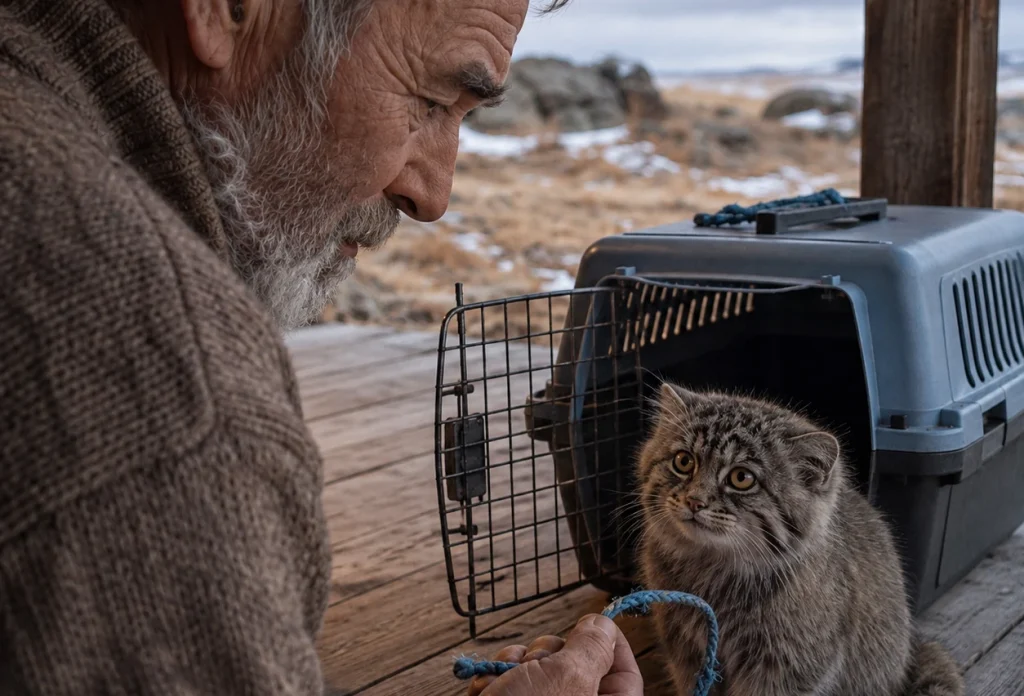
The kitten was wedged beneath a shelf at the bottom. One golden eye followed his headlamp. Blood darkened the fur along its right flank, and the injured hind leg was stretched behind it at an unnatural angle.
When Elias reached with the folded capture blanket, the kitten showed every tooth in its small mouth. The hiss that came out was thin, but it was not a plea. It was a warning from an animal prepared to spend the last of its strength defending the few inches of stone it had left.
“That’s right,” Elias murmured. “Don’t trust me.”
He laid the blanket over the kitten’s head and shoulders, gathered the body without squeezing the chest, and expected the hind leg to come free. It did not. The kitten twisted under the wool, and something pulled tight against the stone.
Elias froze. A length of blue cord ran from the kitten’s ankle into a crack filled with dead grass. He cut it close to the rock, leaving the loop in place so Sarnai could remove it under sedation. Only then did he lift the bundled animal into the carrier.
By the time he climbed out, the ridge had disappeared inside blowing snow. He clipped the carrier to his harness, kept it close to his body, and descended on three points of contact. Twice he sat down because the wind left him no choice. The station lamp, which he had placed in the east window, did not appear until he was almost in the yard.
Inside, he set the carrier behind a screen near the iron stove, far enough away to avoid overheating. He shut the curtains, turned off the ceiling light, and checked only for continued bleeding through the ventilation slots. The kitten struck once at the plastic wall, then went still.
Elias called Sarnai and described what he had seen. She told him not to cut the loop, not to offer food while the animal might need anesthesia, and not to improvise treatment. He repeated her instructions back to her, then hung his wet coat by the stove.
The severed length of blue cord had caught in the carrier handle. Elias pulled it free. One end was faded almost white. The other held a compact double loop around a corroded aluminum tag stamped T-19. For several seconds he could hear only the stove and the kitten’s fast breathing behind the screen.
He knew that tag. He knew the exact way the cord had been doubled so frozen fingers could untie it. He had tied the knot himself…
To read the rest of the story – CLICK the NEXT button 👇👇👇