


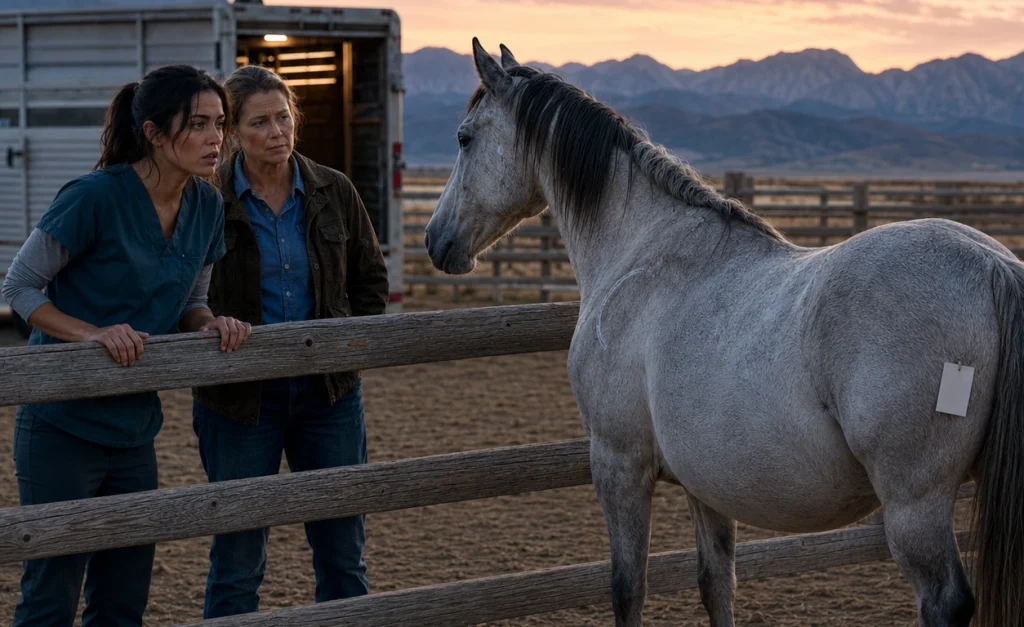
The gray mare stood in the last sale pen with her hip pressed against the boards and a paper lot number pasted above her tail. Every time the auction speaker cracked, she shifted her weight without lifting her feet. Rowan Bell had seen horses freeze that way before. It wasn’t calm. It was an animal saving herself for whatever came through the gate.
Rowan had not come to the High Desert Livestock Exchange to buy a horse. She had promised both her daughter and the blue ledger on the passenger seat. Beneath a gas receipt inside it lay eleven hundred dollars for the deposit on Copper Basin’s leaking barn roof.
She was there to haul an elderly gelding to Cedar Mesa Range Preserve. Mae Calder, who ran the preserve, had already paid the gelding’s purchase price and was waiting two counties east with a quarantine pen. Rowan’s only job was to sign the transport slip, load one quiet horse, and drive away before the loose-horse sale began.
Then the gray mare turned far enough for Rowan to see her belly.
The foal sat low and forward, stretching the mare’s flanks beneath a coat filmed with sweat and sale-yard dust. Her backbone showed anyway. A pale federal freeze mark lay under her mane, and an old crescent scar crossed the front of her right shoulder. She was not actively foaling, but the muscles around her tail had gone slack, and dried wax clung to one teat.
“Ray,” Rowan called to the yard manager. “Who consigned six-fourteen?”
Ray Givens kept walking until she stepped into his path. He was carrying three clipboards and a Styrofoam cup gone soft at the rim. “Private title. Came out of Silver Spur Training, then changed hands. Papers are clean.”
“How close is she?”
“If I knew that, I’d charge for veterinary advice.” He looked past Rowan toward the next alley, where two men were sorting tags for the shipping pens. “Owner says another month. Sale vet says maybe less. She hasn’t let anybody touch her today.”
The mare’s nostrils tightened when a gate clanged. She did not look toward the sound. That bothered Rowan more than a rear or a kick would have.
“She should’ve been pulled from the sale.”
Ray’s expression flattened. “She has water, shade, valid title, and no transport restriction. If you want her pulled, buy her. If you don’t, let me run my yard.”
Ray’s answer was not cruel, which made it harder to dismiss. A private owner had a legal horse, the auction had a legal consignment, and everyone could point to the next person’s choice. By sundown, the mare would belong to whoever raised a number last.
Rowan went back to her truck and called Mae. Through the windshield, heat trembled above the pipe rails.
“Don’t ask me for a second stall,” Mae said. Her voice echoed in a barn aisle. “The bay from Elko coughed this morning. My intake row is locked down until Lena gets results.”
“I’m not asking. I’m thinking out loud.”
“You think out loud right before you do something expensive.”
Rowan rubbed the place between her eyebrows. “She may foal in a shipping pen tonight.”
“Then call the sale vet and every place between Fallon and Salt Lake. But don’t put a near-term mare beside eleven seniors when you don’t have an empty quarantine barn.”
“The south turnout is separate.”
“The south turnout has a roof that leaks and a gate Ben was going to replace.”
Rowan looked at the blue ledger. Ben had been dead eighteen months, but his block printing still labeled the tabs: HAY, VET, REPAIRS, THINGS WE DIDN’T PLAN. Tess had added NO NEW INTAKES in red after the funeral.
“I know what I have,” Rowan said.
Mae’s answer softened. “That’s exactly what worries me.”
Rowan ended the call and sat with both hands on the steering wheel. Her phone showed two unread messages from Tess. The first asked whether the roofer had received his deposit. The second was a photograph of a signed estimate on Tess’s kitchen counter in Reno.
For three months, Tess had been untangling the refuge’s accounts after discovering that Rowan used part of Ben’s life-insurance money for winter hay. She had built spreadsheets, circled late fees, and gone quiet. That morning she had said, “Pay Luis before noon. Just do that one thing when you say you will.”
The auctioneer’s voice rose inside the metal building. Rowan could hear the rhythm even through the truck doors.
She took the roof envelope out of the ledger.
The gray mare entered the ring at 12:41 p.m. Two workers guided her through a narrow alley with sorting paddles held low. She went in sideways, one hind foot dragging before she caught herself. Rowan stood near the back with her bidder card.
The opening bid was eight hundred dollars. No hand went up. The auctioneer dropped to six, then four. A buyer along the rail lifted two fingers at three hundred, his catalog already marked with a column of lot numbers.
Rowan raised her card.
At five hundred, the other bidder shrugged. At six hundred, he looked back at Rowan. She kept the card raised until the auctioneer pointed at her and said, “Sold, six-fifty.”
When the gavel struck, the roof envelope in Rowan’s pocket seemed to gain weight.
After fees and hay, Rowan had three hundred and sixty-eight dollars left in the roof envelope. Mae arranged another driver for the elderly gelding. Rowan called Luis to move the roof date, sent Tess a message that said, Something came up, and turned her phone facedown.
Loading the mare took nearly an hour. Rowan refused the narrow stock chute after the mare struck once at its shadow and backed into the fence. Instead, she asked Ray for four loose panels and built a wide funnel from the pen to the open rear of her trailer. She moved people out of sight, scattered hay just inside, and waited on the fender with her eyes lowered.
“You planning to reason with her?” Ray asked after twenty minutes.
“No. I’m planning to stop giving her reasons to say no.”
The mare’s ears moved toward Rowan’s voice. She tasted the hay at the threshold, withdrew, and tried again. When she finally stepped inside, the trailer barely rocked. Rowan closed the rear gate without touching her.
She drove the fifty miles to Yerington as if she were carrying a bowl filled to its rim. No radio, no hard braking, no phone. In the side mirror, the mare’s gray face appeared and disappeared behind the slats.
Copper Basin Horse Refuge occupied twenty-seven acres where irrigated fields gave way to sage and dry washes. The house and barn sat on a low western rise. Below them were five paddocks, a hay lot, and an old diversion channel that had not carried more than a trickle since Ben dug silt from it nine summers earlier.
Tess’s blue Subaru was parked beside the barn.
Rowan stopped halfway up the drive. Luis’s roofing trailer was gone. Tess stood under the eave with the estimate rolled in one hand, clinic scrubs tucked into dusty boots. At thirty-three, she had Ben’s stillness and Rowan’s dark hair, which made anger hard to read until it was too late.
“Something came up,” Tess said as Rowan climbed down from the cab. “I see.”
“Let me get her settled before we do this.”
“Before we do what? Count the horses or count the money?”
The mare shifted inside the trailer. Tess’s attention snapped toward the sound; irritation gave way to professional focus. She came closer, but stopped outside the arc of the rear gate.
“How pregnant?”
“Close. Sale vet couldn’t say how close.”
“And you transported her without an exam?”
“She was going through the loose sale.”
“That’s not an answer.”
It was, to Rowan. It had been the answer to a hundred decisions since she opened Copper Basin. She started to say so, then saw Tess look at the roof envelope lying open on the passenger seat.
They unloaded the mare into the south turnout, the only field separated from the resident horses by both a lane and a stand of cottonwoods. Its three-sided shelter had fresh straw and a dry western wall, though rain had darkened one ceiling beam. Rowan opened the trailer into the same wide panel funnel she had used at the auction.
The mare backed into daylight, swung toward open ground, and stopped. She did not bolt. She lifted her head into the wind as if measuring how much sky remained around her, then walked to the far fence with the slow care of a horse whose feet hurt.
“No halter?” Tess asked.
“Not yet.”
“How are you planning to examine her?”
“Lena’s on her way. We’ll work it out.”
Tess set the rolled estimate on a fence post and studied the mare. The light had shifted behind the Pine Nut Mountains, laying the paddock in copper and blue. When the mare turned broadside, the crescent scar on her shoulder showed beneath the dust.
Tess gripped the top rail.
“Mom,” she said. The anger had gone out of her voice so completely that Rowan looked over. “Where did you get this horse?”
“High Desert. Lot six-fourteen.”
The mare raised her head at Tess’s words. For the first time since leaving the auction, she took three quick steps away.
Tess stared at the freeze mark under the gray mane, then at the scar. “I know her,” she said. “I was there the day they called her dangerous…”
To read the rest of the story – CLICK the NEXT button 👇👇👇