


The last bull through the Larkin Livestock Exchange had ticks packed behind both ears and a paper lot number pasted crookedly across one hip. He entered the ring late on a July afternoon, after the order buyers had capped their pens and the men in the front rows had begun talking about supper. By then the auctioneer’s chant had gone hoarse, the rafters smelled of hot dust and diesel, and Clara Holt had $612 left in her cattle account.
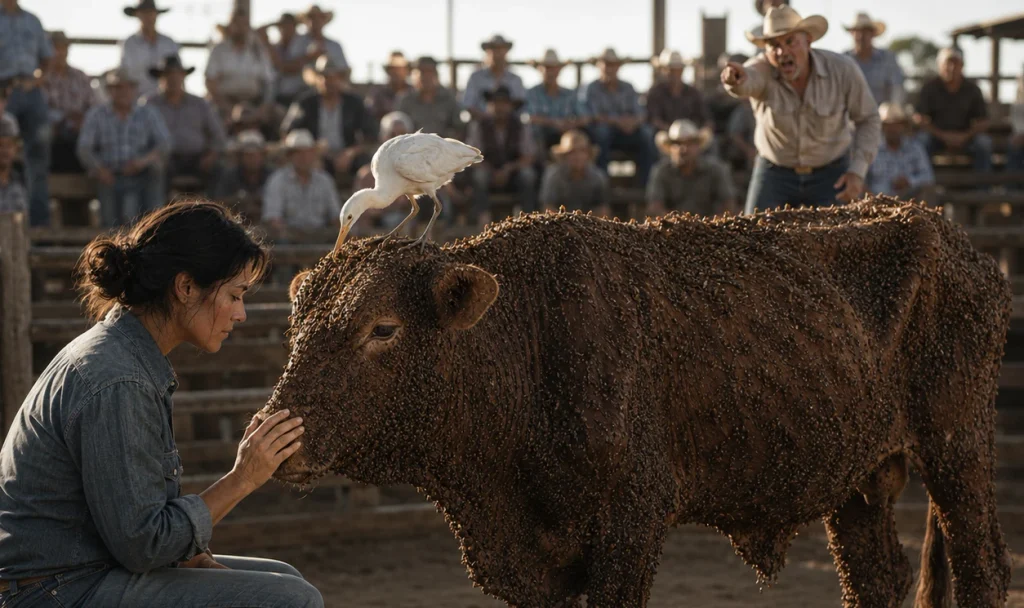
The bull stopped under the lights. His ribs made a ladder under a coat faded almost gray, and the loose skin at his neck was stippled with dark, swollen parasites. When he shook his head, he did it once, as if even irritation cost more energy than he had.
Someone behind Clara said, “Good Lord.”
Graham Rusk laughed from his usual seat on the center aisle. He owned more than eight thousand acres north of Morrow Creek, and men who wanted grazing leases tended to find him funny. “They ought to charge for the hole,” he said. “Save whoever buys him the digging.”
The ringman touched the bull’s flank with the flat of his sorting paddle. The animal took two careful steps, tracked the man’s boots with a clear brown eye, and stopped again. Clara leaned forward.
She had spent six years as Dr. Ben Arnett’s large-animal assistant before Maddy was born. She knew the hollow stare of a cow already leaving its body. This bull was watching. His pasterns were upright, his knees were clean, and the breadth of his chest had not disappeared with the flesh over it.
Then he turned his head. Through the ticks and the torn yellow tag, Clara saw blue ink inside his left ear: two letters and three numbers, blurred by distance. Above them, the plastic bore a little box-shaped brand crossed by a diagonal line.
She had seen that mark before.
“Two hundred, where?” the auctioneer called. No card rose. “One fifty?”
Clara lifted hers at two hundred. The auctioneer blinked, took the bid, and found an order buyer willing to make her pay three hundred and fifty before he dropped out with a shrug.
The gavel struck.
Graham turned in his seat. His smile faded first with surprise, then returned in a more deliberate form. “Holt, if you needed fertilizer that badly, I’d have sent you a truckload.”
Clara slid her card into her shirt pocket. “I have enough of that now.”
The men nearest him laughed, although Graham did not. He had offered twice that year to buy her forty-six acres, which ran along the only reliable reach of Morrow Creek between two of his leased pastures. The numbers had been fair. Clara still did not want his name replacing hers on the deed.
At the cashier’s window, Clara signed the as-is acknowledgment and the line advising veterinary examination and isolation. The clerk looked over her glasses. “You know there isn’t any guarantee he can stand the trailer ride.”
“I know.”
“And no refund if he doesn’t.”
Clara signed again.
Behind the barn, the bull balked at the loading chute. A young hand raised a hotshot, but Graham, passing toward his own trailer, caught the boy’s wrist before the prod touched hide.
“Put that away,” he said. “Open the side panel and give him somewhere to look.”
The boy obeyed. With daylight showing through the chute, the bull climbed into Clara’s stock trailer one slow hoof at a time.
Graham wiped his palm on his jeans. “A dead animal can’t teach you anything, Clara.”
“Then I suppose we’d better keep him alive.”
She drove home with every window open, listening for a fall behind her. The trailer floor rattled at turns, but the bull stayed upright through all nineteen miles.
Holt Creek Farm was too small to deserve the word ranch in Graham’s opinion and too mortgaged to deserve sentiment in Clara’s. Its forty-six acres held fourteen cows, eight spring calves, a swaybacked stock horse Maddy refused to retire, and a narrow band of cottonwoods along Morrow Creek. The tractor leaked hydraulic fluid onto a feed sack Clara kept folded under the pump. The house porch leaned half an inch toward Oklahoma.
Maddy came out carrying a glass of iced tea and stopped when she saw the trailer.
At sixteen, she had Clara’s dark hair and none of her talent for pretending not to be alarmed. “Please tell me that’s not ours.”
“He’s ours.”
“Did he come with the ticks, or were those extra?”
Clara backed to the quarantine pen behind the equipment shed, well away from the herd. “Call Dr. Arnett.”
Maddy did not move. “How much?”
“Three-fifty.”
“That wasn’t what I asked.”
Clara set the parking brake. “Call Ben.”
They unloaded the bull without pushing him. Maddy opened the panel at the end of the chute just as Graham had, though Clara had not told her to, and waited outside his line of sight. The bull found the rectangle of open pasture and came down the ramp.
He drank steadily. Ben told them by phone to keep clean water within reach, not drive him back to it, and record how much he took. Clara rigged shade cloth over the west rail. Maddy filled a shallow tub with grass hay, then stood outside the pen studying the blue tattoo through binoculars.
“BC 417,” she said. “Or BC 4179. What’s Box Canyon?”
“An old red-cattle outfit west of Uvalde.”
Maddy lowered the binoculars. “So that’s why.”
“That’s part of why.”
“What’s the other part?”
Inside the pen, the bull approached the hay and nosed it before taking a cautious mouthful. Clara watched his jaw begin to work.
“He was still in there,” she said.
Ben arrived before seven the next morning in a service truck with twenty years of dust worked into the toolbox seams. He was sixty-four, square-handed, and unimpressed by hope unless it came with a thermometer.
For an hour, he examined the bull from muzzle to feet. He estimated him at a little over a thousand pounds on a frame that ought to carry five hundred more. The anemia was serious. So were the dehydration, skin damage, and parasite burden. His lungs sounded clear, his gut was moving, and he had no fever that morning.
“Bad isn’t the same as finished,” Ben said. “But don’t make a romance out of that sentence. We need bloodwork, fecal testing, careful parasite treatment, and time. He stays isolated until I say otherwise.”
Clara knew enough not to ask for odds. Ben chose treatment according to the bull’s estimated weight and condition, cleaned the worst wounds, drew blood, and wrote a feeding schedule that began with good hay in small, frequent portions. No grain bucket, no homemade dip, no attempt to replace months of neglect in a weekend.
Maddy held the bull’s tail out of the way while Ben worked. When Copper—the name came from the red hair still visible around his eyes—shifted toward her, she did not flinch. She laid her palm against the rail, and he settled when he heard her breathing.
At the truck, Ben gave Clara the first invoice and a conservative estimate for follow-up care. She folded both before Maddy could read them.
“You’re looking at a thousand, maybe more, before we know what you bought,” he said quietly. “And your tractor sounds like a coffee can full of bolts.”
“I know what my tractor sounds like.”
“Then you know I don’t extend credit the way I used to.”
Clara paid the invoice from her phone while he stood there. Her cattle account dropped below two hundred dollars. After he drove away, she went to the kitchen, opened the credit-union app again, and stared at the savings account labeled COLLEGE STATION.
Maddy had earned six hundred and eighty dollars of it washing kennels when Ben needed extra help, helping neighbors work calves, and saving every birthday check since fourteen. Clara had promised to match her. The deposit for a summer veterinary academy was due in November.
She transferred nine hundred and twenty dollars into the cattle account. She told herself the October calf check would put it back.
That evening, Copper ate every strand of hay in his tub. He came to the rail when Maddy carried the next weighed portion, and for the first time his ears lifted instead of sagging sideways. Maddy smiled before she remembered she was angry.
Later that night, Clara found her at the kitchen table with the credit-union app open on her laptop. The room was quiet except for the old refrigerator starting its tired rattle.
Maddy turned the screen around. “You took the academy money, didn’t you…”
To read the rest of the story – CLICK the NEXT button 👇👇👇