


The bark came after the rescue trucks had begun to leave. Owen Vance heard it beneath the grind of diesel engines and the dry rattle of snow against sheet metal: one weak, broken sound from somewhere inside the collapsed edge of Bay Twelve.
He turned toward the warehouse.
Beyond the yellow perimeter tape, half of the old produce building had folded in on itself. Steel roof panels sloped into a tangle of shelving, pallets, brick, and ruptured insulation. Snow had begun to collect along the bent seams. From the county road, the ruin looked still. Up close, it clicked and settled like something breathing through damaged teeth.
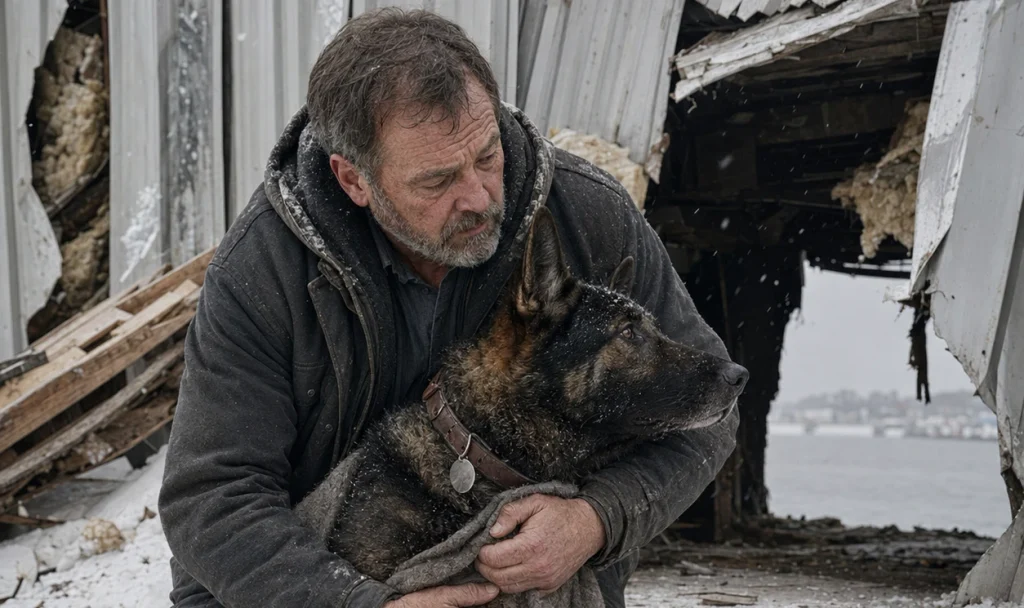
Captain Elise Rourke stood beside the command vehicle, sending her last available crew toward an apartment collapse on the east side of town. She was not abandoning the warehouse. Six hours of thermal scans, listening checks, and canine sweeps had found no sign of a person inside, and four families were still unaccounted for across the river. Disaster had reduced compassion to arithmetic.
Owen understood that arithmetic. At fifty-five, after years as a Navy SEAL and two overseas disaster-response missions, he ran Vance Diesel Repair west of Wenatchee. One of those missions still woke him before dawn with concrete dust in his mouth.
He had not come looking for anyone. The county emergency desk had sent him to recover his trailer-mounted generator from the north fence and tow it to a middle-school warming center once the outer apron was safe.
The authorization was open on his phone. The generator was visible through the fence. Nothing about his task required him to look at Bay Twelve.
Then the bark came again.
Owen raised one hand. “Captain.”
Elise was already climbing into the command truck. She stopped when she saw his face.
“What?”
“Dog. North side of Twelve.”
Miller, the youngest responder still on the ground, lowered the coil of rope he was carrying. All three listened. Wind slid through the broken wall. A loose metal strip tapped twice against a beam.
“I don’t hear it,” Miller said.
“You will.”
Elise studied Owen. She knew who he was; in a valley this size, everyone knew at least the outline of everyone else. Her gaze moved to the generator authorization on his phone, then to the roofline.
“My structural officer cleared the north apron only as far as the generator,” she said. “The bay itself is red-zone. You do not cross the chalk marks. You do not touch the load.”
“Understood.”
“That isn’t permission to improvise.”
“Understood.”
The sound came a third time, so faint that it seemed to travel through the ground instead of the air.
Miller looked toward the folded wall. “I heard that.”
Elise shut her eyes for a beat. When she opened them, the captain had returned, pushing the tired woman behind her out of sight.
She radioed dispatch and requested animal rescue support. The answer arrived in fragments: county resources committed, veterinary response delayed, no unit available before nightfall. Elise asked whether one responder could remain. The apartment call came back with a trapped-child confirmation.
There was no arithmetic left to do.
She handed Miller a can of orange marking paint. “Mark the sound point from the safe edge. Log it. Photograph the roof angle before we pull out.”
Miller did so, then looked at Owen. “The log means somebody comes back.”
“When?”
Miller did not answer.
Elise did. “When a team is free.”
The bark did not come again.
As the last truck rolled toward the east side, Elise remained at the open door. “Vance. Inspect your generator, tow it if the apron stays stable, and leave. If you hear movement in the roof, you back away first and call second.”
“Yes, ma’am.”
She held his gaze a moment longer, as if measuring whether the answer meant what it should. Then she climbed in, and the command vehicle followed the others into the snow.
Owen stood beside the fence until the red lights disappeared.
Years earlier, after an earthquake overseas, a local commander had ended a search at dawn. Owen had been leading an American support element, not the whole operation. The building had shifted twice. The listening gear had gone quiet. Everyone was exhausted enough to mistake the relief of stopping for certainty.
Owen had looked at a narrow void beneath a collapsed stairwell and felt something resist inside him. He had no evidence, only a pressure behind his ribs. He obeyed the order anyway.
Two days later, a supplemental report suggested that one person had survived beyond the official search window.
The report never claimed Owen could have reached her. It named no one. He still spent twelve years hearing the silence that followed the order to stop.
He opened the north gate with the warehouse manager’s code and stayed on the cleared apron. The generator waited twenty yards ahead. Its fuel line was intact; he could have coupled it to his truck in minutes.
Instead, he followed Miller’s orange mark with his eyes.
The sound point lay short of the red chalk line, where exterior siding had peeled from a concrete curb beneath an intact perimeter column. Owen photographed the stable snow and roof angle and sent the images to dispatch.
“Civilian Vance,” the dispatcher said when she came on the line. “You are authorized for generator recovery only.”
“I know.”
“Captain Rourke’s notes say possible animal under the north exterior pocket. Animal Services has been notified.”
“They gave you an arrival time?”
Silence answered before she did. “No.”
Owen crouched on the safe side of the chalk and pressed his bare fingertips to the concrete curb. At first he felt only cold.
Then something scratched once beneath the metal.
He described the pocket to dispatch. He described the intact column, the curb, the loose siding, and the distance from the main roof load. He did not say he knew buildings because he had crawled through broken ones. He gave facts.
The dispatcher transferred him to the county building engineer working remotely from Elise’s photographs. The engineer made him repeat every measurement. At last she said, “You may remove loose exterior debris that is not load-bearing. No lifting structural members. No entry. If anything changes, retreat.”
It was only permission to clear what had already detached. It was enough.
He brought a folding shovel, two cribbing blocks, a flashlight, and a small hydraulic jack from his truck. He did not place the jack beneath the roof. He used it to hold a loose skin of siding that wanted to fall back over the opening while he removed snow, insulation, and fragments of a broken pallet by hand.
He worked slowly. Every few minutes he stopped and listened.
The warehouse creaked. Wind moved through the rafters. Sirens faded somewhere across town.
“I’m here,” Owen said into the dark gap.
No answer.
He cleared another strip of insulation. The opening widened to the size of a mailbox slot. His flashlight found burlap, a tipped crate, and a patch of black fur.
Two amber-brown eyes opened behind it.
The German Shepherd did not bark. He had spent what little strength he possessed making sure somebody stopped.
“Easy,” Owen whispered. “I see you.”
The dog’s chest moved in shallow, guarded breaths. A collapsed crate had formed a pocket around him, while the loose wall panel pinned the burlap at his shoulder. Owen could reach the obstruction without crossing the chalk line, but he could not pull the dog straight out. The opening was too narrow, and panic could bring the siding down.
He offered the back of his hand first. The Shepherd watched him, then touched Owen’s knuckles with a cold nose.
The contact lasted less than a second.
Something in Owen’s chest, held rigid for twelve years, moved.
“Wait,” he said softly. “Let me do the work.”
The Shepherd stilled at the command.
Trained, Owen thought. Not a stray. Somebody’s working dog.
He cut the trapped burlap, slid a loop of rope beneath the dog’s chest as a support, and eased the siding an inch higher against the nonstructural curb. He never touched the roof. He never entered the bay. He kept dispatch on speaker beside him, reporting each change.
“Come,” he said when the path was clear.
The dog pushed once and failed.
Owen held the rope steady. “Again.”
Front paws appeared first, then shoulders. The Shepherd dragged himself through the opening in a rush of dust and loose snow and collapsed against Owen’s knees.
Owen caught him with both arms.
For several seconds, the dog’s head rested against his chest. Owen felt the shudder of each breath through his work shirt. The Shepherd was large, black and gold beneath the gray dust, with an old leather collar around his neck.
“You made it,” Owen said, and heard his own voice break. “You made it.”
The Shepherd did not look toward the road. He looked back into Bay Twelve.
A low sound gathered in his throat—not a growl, not quite a whine. Warning and grief occupied the same note.
Owen followed his gaze but saw only darkness.
The dog tried to rise. His legs folded.
“No.” Owen wrapped him in the wool emergency blanket from his truck. “You’ve done enough.”
He called dispatch again. This time the report was no longer a possible animal. It was a live recovery requiring veterinary care and official intake. Chelan County Animal Services had no vehicle free, but an officer named Maya Torres took the case remotely, issued an incident number, and instructed Owen to transport the dog directly to Keene Animal Clinic. The emergency desk amended his transport authorization to include the animal and delayed the generator pickup.
Owen photographed the collar in place without removing it. One tag bore the Redline Freight and Relief Logistics logo. A second tag had been cut by hand from dull metal.
The letters were uneven but deep.
F.D. STAYS.
When Owen touched the edge of the tag, the Shepherd laid his muzzle over Owen’s fingers.
Not biting. Protecting.
“All right,” Owen said. “It stays.”
At the clinic, Dr. Marla Keene examined the Shepherd on a blanket on the floor. She found dehydration, cold stress, bruising, and dust irritation but no fracture or internal bleeding. The dog accepted warmed fluids and oxygen with the grave patience of an animal accustomed to being told what to endure.
Maya Torres arrived near midnight in an Animal Services jacket, snow melting on her shoulders. She scanned the dog’s microchip and confirmed Redline as the registered owner. Then she photographed every tag, logged the collar as potential evidence without removing it, and placed the Shepherd under a seventy-two-hour emergency protective hold pending medical stabilization and ownership review.
“The county shelter is on backup power and already over capacity,” Maya said. “Dr. Keene can keep him tonight. After that, if she clears a medical foster, are you willing?”
Owen looked down. The Shepherd had shifted until one paw rested against his boot.
“Yes.”
Maya studied them both. “That makes you temporary custodian. Not owner. No interviews, no social media, no returning him to a claimant without my written release.”
“Understood.”
“You say that like it matters.”
“It does.”
The Redline phone number was printed on the company tag. Maya made the notification herself, with Marla and Owen present. A man answered on the fourth ring.
“Redline operations. Caleb Mercer speaking.”
Maya identified herself and gave the incident number. “Your registered German Shepherd has been recovered alive from the north exterior pocket of Bay Twelve. He is under veterinary care and an Animal Services protective hold.”
There was no question about the dog’s condition. No relief. Only a pause precise enough to sound rehearsed.
Then Caleb asked, “Is he wearing a secondary tag?”
The Shepherd lifted his head at the voice.
Owen watched his body change. The dog’s ears sharpened; his shoulders locked; a low vibration moved through his chest.
Maya’s eyes narrowed. “The collar has been documented and remains in place.”
“Do not remove it,” Caleb said. “That tag and all attached equipment belong to Redline.”
“Any property claim goes through the case file.”
“Officer, you may not understand the liability around an active disaster contract.”
“Mr. Mercer,” Maya replied, “I understand my own authority very well.”
The line went quiet.
Marla crouched beside the Shepherd. “What is his name?” she asked.
Caleb hesitated. “Unit K-Nine Four.”
The dog did not react.
Owenwen looked at the black saddle across his back, the gold at his chest, and the warehouse dust still caught around the old collar. He thought of engines, freight docks, and the generator he had left beside Bay Twelve.
“Diesel,” he said.
One ear turned toward him.
Caleb heard it through the phone. His careful voice hardened.
“Keep the dog contained. Someone from Redline will collect him when the hold expires.”
Diesel pushed unsteadily to his feet and faced the clinic door—the road beyond it leading back toward Bay Twelve.
Owen placed one hand beside, not on, the old collar.
“No,” he said.
He could not yet promise what would happen after seventy-two hours. But the word was the first thing he had given Diesel that sounded like a door closing against the past…
To read the rest of the story – CLICK the NEXT button 👇👇👇