


The laughter started before Emilio Garza lowered his bidding card. Lot 23 had not been allowed into the ring with the other bulls. He stood in an isolation alley behind the Bee County Livestock Exchange, visible to buyers on a grainy overhead monitor and through a double fence beyond the loading chutes. The catalog called him a four-year-old Beefmaster, fourteen hundred pounds, breeding history unverified. The state inspector had already ruled out cattle fever ticks in the samples he examined, but the rest of the notice took most of the screen: severe external parasite burden; local movement only; veterinary follow-up and strict isolation required.
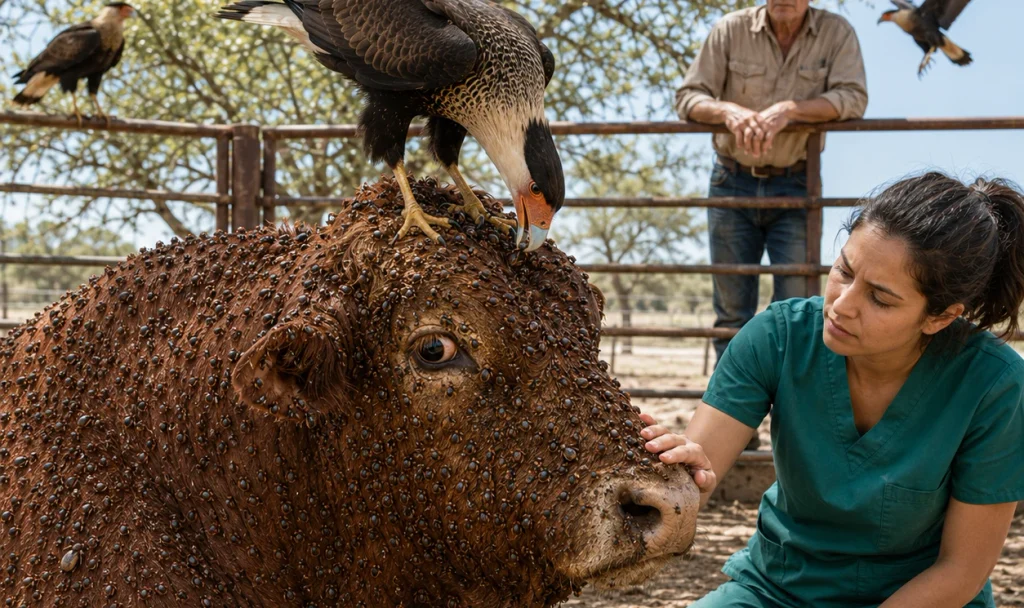
The monitor did not show the worst of it. Emilio had walked around back before the sale and seen the bull from twenty feet away.
Ticks crowded the soft skin behind his ears until the red hair seemed pasted over gray gravel. They nested in the folds of his dewlap, along his belly, and beneath his tail. Some were flat and small. Others had fed until they hung from him like pale beans. Flies worried the raw places where he had rubbed himself against pipe and mesquite.
Yet when a handler raised a sorting stick, the bull did not crowd the man or throw his head. He shifted one deliberate step, keeping his bad side away from the fence, and waited.
Beneath the filth and the tucked-up belly, his feet were square. His back was level. The width through his chest had not disappeared with the weight he had lost. Emilio had spent fifty-two years learning what cattle tried to conceal.
“Opening at fifteen hundred,” the auctioneer said.
No cards moved. “Twelve?”
A paper cup scraped across concrete. Somewhere in the front row, a man said, “You’d spend that on disinfectant.”
The auctioneer dropped to a thousand, then nine hundred. Emilio raised number 117.
For half a second, there was only the hum of the ceiling fans. Then three men laughed at once. It was not vicious laughter. That made it worse. It was the involuntary sound experienced cattlemen made when someone had done a foolish thing in public.
Blake Hadley turned in his seat. He bred sleek, red Beefmasters on six hundred acres in Jim Wells County and wore white shirts to cattle sales without ever seeming to get dirt on the cuffs.
“Emilio,” he called, not quite softly enough, “you bidding on the bull or the veterinary bill?”
More laughter rolled along the benches. Emilio kept his eyes on the screen.
The auctioneer asked for nine-fifty. A young man near the rail lifted two fingers, grinning at his friends. Emilio answered at one thousand. The young man let his hand fall, and the gavel came down.
“Sold. Lot twenty-three to buyer one-seventeen.”
Emilio folded his card and put it in his shirt pocket. He had come to buy a bull because the herd sire at La Parra had failed his spring breeding exam, and the Garzas had thirty-eight days before turnout. A sound bull from a reputable program would have cost five or six thousand dollars—money the ranch did not have after two dry summers, a failed water pump, and the hay bill Linda kept clipped to the refrigerator with a magnet from their daughter’s veterinary clinic.
Linda had given him a hard ceiling of thirty-five hundred. She had also said, very clearly, “Do not bring me home a project because you think you can see something nobody else sees.”
Emilio had spent only a thousand. He suspected that Linda would not admire the economy of it.
Blake found him beside the cashier’s window. Up close, his amusement had given way to concern.
“Tell me you’ve got an empty place to hold him.”
“North trap. Half a mile from the cow herd. Separate water.”
“And separate equipment?”
“Since before you started buying white shirts.”
Blake ignored that. “A load like that doesn’t happen in a week. He may be anemic. He may be carrying something the first inspection didn’t catch. And if one engorged female drops in your good pasture—”
“I heard the sale notice.”
“You heard it and bought him anyway.” Blake looked through the office window toward the isolation alley. “I laughed. I shouldn’t have. But don’t turn being insulted into a reason not to be careful.”
It was the sort of useful sentence Emilio disliked receiving from a man he wanted to dismiss. The paperwork took another hour.
The market veterinarian reviewed the movement conditions with him twice, then watched while the bull was loaded into Emilio’s old gray stock trailer. No electric prod was used. Emilio narrowed the alley with two panels, opened the trailer gate wide, and waited until the bull chose the only clear path.
His hooves rang once on the metal floor. Then he stood with his head low while Emilio latched the divider.
On the drive toward Pettus, Emilio called his wife.
“I bought one.”
“For how much?”
“A thousand.”
There was a pause. “What’s wrong with him?”
“He needs some attention.”
“Emilio.”
“He’s got ticks.”
“How many?”
The road unrolled white beneath the noon heat. In the mirror, the trailer rocked gently behind him.
“Enough that the paperwork has its own staple.”
Linda breathed out through her nose. “I’m calling Ana.”
“I can call my own veterinarian.”
“You have one. She calls you Dad.”
She hung up. La Parra lay where the open pasture began to break into mesquite and thorny huisache.
Emilio’s grandfather, Agustín, had leased the first forty acres in 1948 and bought them five years later with money earned fencing other men’s ranches. The place now covered just over four hundred acres, though drought made it feel smaller every year.
Grass disappeared. Bills did not.
Emilio bypassed the main cattle guard and took a caliche lane to the north trap. He had repaired its double fence that morning, set out dedicated buckets, and run a hose to a trough fed from the house well. Whatever else Ana believed about him, he had not brought a sick bull home carelessly.
The unloading took eleven minutes. The bull reached the end of the trailer, saw the drop, and backed away. Emilio did not climb in behind him. He opened the side vents, scattered cubes down the ramp, and stood where the animal could see an exit without seeing a challenge.
At last the bull stepped down. His hind legs trembled when his weight reached the ground.
Linda had come through the walk gate carrying a pair of rubber boots. At sixty, she still wore her silver hair in the thick braid she had adopted when their children were small and cattle emergencies always seemed to happen before breakfast. She stopped at the outer fence.
“Oh, Emilio.”
The bull crossed to the trough and drank. Water darkened the hair around his mouth. A tick, swollen almost white, dropped from the fold beneath his jaw and landed in the dust.
“He looked bigger on the screen,” Linda said.
“He’ll fill out.”
“That is what you said about the tractor with no transmission.”
“The tractor runs.”
“Because we bought a transmission.” She turned toward him. “I’m not angry about the thousand dollars. I’m angry because you went looking for a breeding bull and came home with an argument.”
He knew which argument she meant. His grandfather’s old one: that the land had answers people stopped seeing when an answer could be bought in a bottle. Agustín had taught Emilio to notice cowbirds under cattle, caracaras on fence posts, dung beetles working fresh manure into the soil. Emilio had repeated those lessons so often that Ana once accused him of using a dead man’s sayings whenever the living women in his family told him something he did not want to hear.
“I came home with an animal,” he said.
“Then let him be an animal. Don’t make him prove your grandfather was right.”
A truck rattled over the cattle guard before Emilio could answer. The blue veterinary box on its bed carried the logo for Mesquite Bend Large Animal Care. Dr. Ana Garza climbed out wearing green scrub pants, work boots, and the expression she usually reserved for owners who had waited three days to call about a one-day emergency.
She was thirty-seven, compact and dark-haired like Linda, with Emilio’s habit of looking at a gate latch before looking at the person beside it. She inspected the separate trough, the boot pan, the distance to the herd, and the dedicated tools leaning against the fence.
“At least you listened to the market vet,” she said.
“I know what quarantine means.”
“Knowing and doing have not always been the same thing around here.”
Linda moved between them with the practiced ease of someone stepping around a rut. “He’s been here fifteen minutes. He drank. He hasn’t eaten.”
Ana went to the outer fence and raised binoculars from her bag. The bull stood under the only mesquite in the trap, head lowered, sides moving faster than they should have in the heat. She watched his gums when he licked his nose. She watched the way he placed his feet.
“We need him in the chute before dark,” she said. “Blood draw, temperature, full exam. I want more specimens identified, and nobody opens a connection to the main pens.”
“I built this trap,” Emilio said.
“Then you know where the weak places are.”
The words landed in more than one place. Four years earlier, Ana had asked him to haul a laboring heifer to her clinic. Emilio had waited because the calf had not looked badly positioned and because Agustín Garza had delivered hundreds of calves with rope, patience, and no surgical suite.
By the time Emilio changed his mind, Ana was able to save the heifer but not the calf. They had never agreed on what that night meant. They had simply stopped speaking about anything that might lead back to it.
The bull folded his front legs and lowered himself into the shade. Dust rose around his ribs. High above the trap, something crossed the sun.
Emilio shaded his eyes. A crested caracara banked over the mesquite, black wings broad against the white sky, neck and tail flashing pale as it turned. Another followed, then three more. They had been around La Parra for years, usually walking the short grass for beetles or watching the highway for roadkill. Emilio had not seen this many together since spring.
The birds circled once. Twice.
Ana lowered her binoculars. “Why are they gathering?”
One caracara dropped to a fence post. Its bare face was orange-red, its dark crest flattened by the wind. It stared at the bull, then at the pale tick in the dust. With a hop, it landed inside the trap and swallowed the tick.
The other birds came down behind it. The first caracara walked toward Lot 23, sprang from the ground, and landed on the bull’s back…
To read the rest of the story – CLICK the NEXT button 👇👇👇