


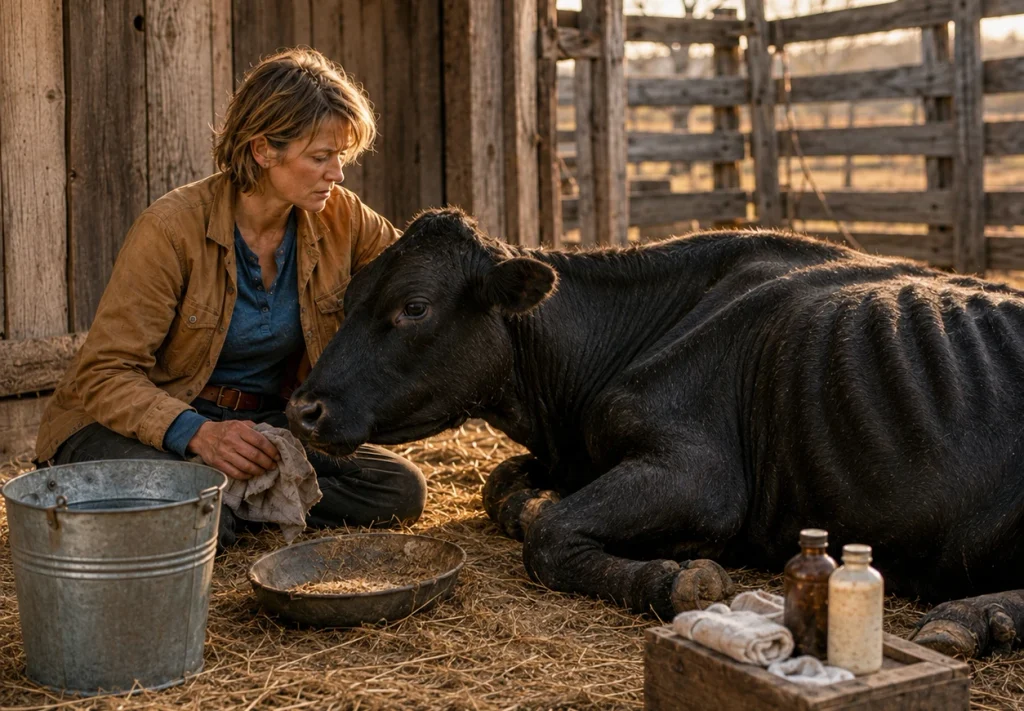
Nell Harper had come to the Cottonwood County sale barn for two mineral feeders and forty used steel posts. By ten that morning, she had bought neither. She stood instead beside pen nineteen, watching an Angus bull push his nose across an empty water pan. The bull was upright, which was the only reason the market could put him through a sale. Even so, he held his front feet wide, as if the packed dirt shifted under him. His backbone made a hard ridge beneath his hide, dried manure clung to his hocks, and one eye had sunk so deep that the lashes seemed too long for it.
Nell had thirty-one cows at home, a mortgage that reset in January, and $4,620 in a savings account labeled PUMP because the well had begun coughing sand every August. She also had Abby beside her, eleven years old and solemnly carrying the bidder card in both hands. Nell had brought her daughter to learn that going to an auction with money did not mean coming home with whatever made you feel sorry for it.
“His tub’s dry,” Abby said.
“I see it.”
Nell caught the attention of a young employee moving cattle down the alley. He glanced into the pen, said somebody would get to it, and kept walking. At the next gate, another hand raised an electric prod toward a balking steer.
“Put that away.”
The order came from Grant Coyle, who stood three rails down in a white straw hat that had never been stepped on. The hand lowered the prod. Grant owned close to six hundred cows west of town, employed four families year-round, and could stop foolishness in a sale barn without raising his voice.
He looked into pen nineteen and frowned. “That bull shouldn’t be here.”
For one second Nell thought he meant the empty water. Then Grant added, “Market vet should’ve made the call before they unloaded him.”
Nell understood. A euthanasia fee, a rendering truck, and no more decisions. It might have been the kindest answer; from where she stood, she had no way to know.
Abby had already found the hose. Nell turned the spigot and let the hot water run against her boot until it cooled, then filled the pan only a few inches. The bull smelled it. He took one unsteady step, stopped to gather himself, and took another.
He drank without lifting his head. Nell shut the spigot before he could take too much at once.
“That doesn’t mean he can be saved,” Grant said.
“I didn’t say it did.”
“You got quarantine space?”
Nell looked at him. Grant knew perfectly well that her south lot shared a fence with the home pasture and that the old horse shed had not held a horse in nine years.
“You bring an intact bull home from a place like this,” he continued, “you keep him separate until he’s tested. You don’t guess. Not with a kid on the place and your whole herd across one wire.”
It was useful advice, offered in a tone designed to make sure everybody within ten feet knew she needed it. Nell felt Abby grow still beside her.
“We’re buying feeders,” Nell said. “Remember?”
Abby lowered the bidder card against her jeans, though Nell had not told her to.
The liquidation cattle came through after lunch. Nell learned from the sale sheet that pen nineteen belonged to a group seized from a failed backgrounding operation two counties north. Most were thin cows and unbred heifers. The bull had no registration certificate, no health history beyond the market’s brief inspection, and no name. He was listed as BLACK BULL, APPROX. 3 YRS, SOLD AS IS.
The auctioneer tried five hundred dollars, then three. The buyers along the rail studied their boots. At one hundred, he stopped his chant and asked whether anybody wanted to start him.
Nell did not remember reaching for the card. She remembered Abby’s fingers tightening around its bottom edge before Nell lifted it from her hands.
“One hundred in the back,” the auctioneer said. “Do I hear one and a quarter?”
Grant turned. Disbelief crossed his face first, then irritation. He did not bid.
The gavel struck wood.
“Sold. Buyer 318.”
For a few seconds the only sound near pen nineteen was the bull working water in his mouth. Then somebody behind Grant laughed.
Grant did not. “Nell, you didn’t buy a bull. You bought the bill for burying one.”
She wanted to tell him that one hundred dollars was hers to lose. The truth was less satisfying. That money had been meant for the posts, and without the posts she could not divide the north pasture before winter. Every choice on a small place leaned against three others.
“Maybe,” she said. “But that call belongs to a veterinarian.”
The bull made the call harder by refusing the loading alley. He would take two steps, see the turn into the trailer, and brace. A sale hand began crowding him from behind until Grant climbed onto the bottom rail.
“Quit pushing his hip. Open the panel and give him a straight line.”
The men shifted the portable gate. Nell backed her borrowed trailer until its tires touched the chute, scattered hay over the gap, and waited. No shouting, no ropes, no prod. After nearly twenty minutes, the bull put one cracked front hoof on the ramp.
Grant held the swing gate steady while he climbed. When the latch finally dropped, he wiped rust from his palm onto his jeans.
“You still have time to have the market vet put him down,” he said.
“And you still have replacement heifers waiting.”
His mouth moved as if he might smile, but didn’t. “I hope you know the difference between stubborn and cruel.”
That stayed with her for all thirty-four miles home.
The old horse shed sat beyond two empty pens and a gate whose chain had rusted into a knot. Nell parked the trailer outside it while Abby filled a clean trough. They closed the lane to the home pasture, wired a second panel across the weak corner, and spread the last of the square-bale straw under the roof.
When Nell opened the trailer, the bull did not move. His sides fluttered. She could smell infection now, sour and warm beneath the heavier odor of manure.
“Call Dr. Alvarez,” Abby said.
“I’m calling.”
Ben Alvarez arrived after dark in the clinic truck, his dinner still packed in foil on the passenger seat. He had treated Harper cattle since Abby was small enough to sleep through a calf pull in the cab. That history did not make him gentle with Nell’s decisions.
He watched the bull before touching him. Then he checked his mouth and eyes, listened to his chest and gut, took his temperature, and crouched over each swollen foot. The examination went slowly because every time the bull shifted, Ben stepped back and gave him room.
“Five hundred pounds under where I’d want him, maybe more,” he said at last. “Severely dehydrated. Heavy parasite burden is likely. Both front feet are infected, and that left sole may have an abscess. His rumen’s barely moving.”
Abby stood outside the panel with her arms folded into her sweatshirt. “Is he dying?”
Ben looked at her before he answered. “He could. But his lungs are clear, his heart sounds better than the rest of him, and he walked onto a trailer today. Those things matter.”
Nell felt hope rise and distrusted it immediately. “What would you do?”
“If he were mine? Bloodwork tonight. Small amounts of water. Good grass hay, no grain, and not all he wants at once. Treat the feet, deal with the parasites in stages, keep him dry, and reassess every day. If he stops trying, or the pain gets ahead of what I can control, we let him go.” Ben closed his case, then opened it again. “It won’t be a hundred-dollar rescue. The first week alone could run fifteen hundred. More if that foot needs work.”
The pump account seemed to appear in Nell’s mind down to the last two digits. She could hear Grant asking whether she knew the difference between stubborn and cruel.
Ben rested one hand on the open treatment drawer. “If you tell me no, I can make this easy on him. If you tell me yes, we start carefully tonight, and you don’t keep going just because you need the choice to have been right.”
Nell looked through the rails. The bull had lowered his head near the hay but had not tried to eat. Abby watched her from the other side of him.
“Start,” Nell said. Ben reached for a syringe. Abby did not move. “Mom,” she said, “what happens to the cows if the well quits…”
To read the rest of the story – CLICK the NEXT button 👇👇👇