


The bobcat came at dusk and sat outside Ben Keller’s glass back door as if it knew he had already been warned about it. Ben stood at the kitchen sink with one hand in the water and the other wrapped around a chipped coffee mug. Beyond the deck, late-October rain had darkened the trunks of the jack pines. The animal should have disappeared the moment he moved. Instead, it held still beneath the porch light, narrow through the hips, one ear ragged at the tip, its yellow-brown eyes fixed on the room behind him.
Three days earlier, a woman at the regional wildlife office had told him not to feed it. Ben had written the advice on the back of an electric bill: keep your distance; remove attractants; call again if the animal limped, staggered, or showed no fear of people. The note lay beside the fruit bowl now, close enough for him to read while the bobcat watched him rinse a soup pot.
“You and I have both received clear instructions,” he said.
The cat’s ears shifted toward his voice. At fifty-nine, Ben had bought the small cedar-sided house outside Kalkaska six weeks after retiring from the county road commission and four months after his divorce became final. He told his younger sister, Maggie, that he wanted quiet; she told him he had always been able to produce quiet by making everyone else leave the room. He had not called her for nine days.
The house sat beyond the turnaround where the county plow stopped. That did not worry Ben. He had spent thirty-four winters reading snow by the way it feathered across pavement. He owned chains, a generator, three shovels, two kerosene heaters, and an unreasonable confidence in his ability to outlast weather.
People were harder.
Weather did not ask what you meant when you said you were fine.
The bobcat looked toward the black line of woods, then back at him. Burrs clung beneath its chest. Its ribs did not show through the thickening coat, but its flanks tucked inward too sharply. Ben thought of machinery run too long without oil: still moving, not yet broken, every sound a warning.
When he opened the refrigerator, the cat vanished before the seal released. Ben waited ten minutes, then carried half a can of tuna to an old stump thirty yards from the porch. He set it down, came back inside, turned off the kitchen light, and told himself that one meal did not constitute a relationship. It was an emergency measure taken by a man with no authority, against competent advice, for reasons he did not intend to examine.
The bobcat returned after dark. It approached in stops and starts, lowering its body whenever wind stirred the brush. At the stump, it seized the tuna and retreated so quickly that the saucer spun in the wet leaves. Ben called Maggie.
“I may have done something you’ll object to,” he said.
“Is the house on fire?”
“No.”
“Did you fall off the roof?”
“Why are those your first choices?”
“Because you only call before ten on a weeknight if blood or property is involved.” Maggie paused. Ben heard cafeteria pans clatter in the background. She managed food service for a middle school near Grand Rapids and seemed to spend half her life stopping adults from misplacing things. “What did you do?”
“Fed a bobcat.”
The pans stopped.
“You did what?”
“It’s thin.”
“So are marathon runners. You don’t leave tuna in the road for them.”
“It wasn’t in the road.”
“That is not the useful part of my sentence, Ben.”
He leaned against the counter and looked at the empty stump. Maggie asked whether he had called anyone who knew what they were doing. He admitted he had. She made him read the instructions from the electric bill.
“Then why did you ignore them?”
“Because the cat was right there.”
Maggie was quiet for a moment. “So was everyone else, before you moved.”
Ben ended the call soon after that, politely enough to make clear that he was angry. For the next two weeks, he did not feed the bobcat again. He did, however, put out a low pan of fresh water near the stump. He checked it each morning and found leaf litter, chickadee feathers, once a drowned beetle, and twice a line of round paw prints in the mud.
The bobcat appeared every few days. Ben saw it crossing the far yard at dawn, slipping between young pines at noon, or sitting beyond the reach of the porch light after sunset. It never came close while he was outdoors. If he opened the back door, the animal folded into the brush so completely that the woods seemed to have invented it and taken it back.
Through glass, the rules changed, and Ben began drinking his first coffee at the small kitchen table instead of in the living room. The bobcat sometimes passed the door while he sat there. Once it stopped and watched him butter toast; another time it lay on the far end of the deck for eleven minutes, front paws crossed, while sleet tapped the roof.
Because silence began to feel discourteous, Ben told it, “County will salt too early tonight. Road’s wet, ground’s warm. Waste of material.”
The bobcat blinked. Ben took that for agreement.
“Finally, somebody around here understands.”
By Thanksgiving, he had named it Walter. He chose the name because the cat’s severe face reminded him of Walter Givens, a road-crew mechanic who had disapproved of every new piece of equipment purchased after 1998. Ben did not know whether the animal was male. Walter had never offered clarification.
The first hard storm arrived in December. Wet snow came sideways from the northwest, loaded the pines, and brought a branch down across Ben’s driveway. Near midnight, while he was checking the generator, he saw Walter crouched against the foundation beneath the shallow porch overhang. Ice had collected along the animal’s whiskers. It did not run until Ben touched the door handle.
The next morning, Ben drove to a hardware store for plywood, rigid insulation, weather stripping, and straw. He built a double-walled box large enough for a bobcat but too small for a coyote to turn comfortably inside. He placed it beneath the far end of the deck, opening toward the woods, then called Nora Bell, a licensed wildlife rehabilitator whose number the regional office had given him.
Nora listened without interrupting. When he finished describing Walter’s coat, movement, appetite, and the shelter, she asked him to send photographs if he could take them without approaching.
“No more tuna,” she said.
“There was one tuna event.”
“No chicken, deli meat, or emergency salmon events either.”
Ben looked at the cooked chicken wrapped in his refrigerator. “Understood.”
“A windbreak in severe weather is one thing. Teaching a wild cat that houses dispense food is another. If it looks unable to hunt, call me before you change the routine.”
Ben disliked hearing his exceptions described as a routine. He remembered it anyway.
For three nights, the shelter remained empty. On the fourth, Ben woke before six, started coffee, and eased back the curtain. Walter’s face filled the dark opening beneath the deck, only the ragged ear and pale fur around the muzzle visible. The cat looked dry, irritated, and alive.
Ben laughed before he could stop himself and sent Maggie a photograph with the message, “Tenant has accepted the unit.” Her reply arrived while he was brushing snow from the steps: “That is a bobcat, Benjamin.” Ben typed, “Correct.” Maggie answered, “You sound proud.”
Ben put the phone away without answering. He was proud, which was foolish. Walter had entered a box because it was out of the wind. Ben had supplied the box. That was the full transaction.
Still, his mornings changed. He checked for tracks before checking the news. He learned the difference between Walter’s direct, economical trail and the busy loops of foxes. He noticed when snow crust would hold a rabbit and when it would break beneath a heavier cat. By January, Walter no longer looked hollow through the flanks. Ben took this as evidence that the animal was hunting well, because Nora had made him promise not to take it as evidence of anything he had done.
He kept that promise for almost two months. In March, thaw water dripped from the gutters in steady metallic beats. Ben sat on the back step in an old canvas coat, eating turkey from a plate balanced on his knee. Walter appeared beside the stump and stopped.
Ben should have gone inside.
Instead, he tore off a strip of meat and held it low beside his boot.
Walter advanced one cautious length at a time. Ten feet. Eight. Five. Close enough now for Ben to see the black outline around each eye and the white thumbprint on the back of the ragged ear. The cat’s shoulders rolled under its coat. Its gaze moved from the turkey to Ben’s face and back again.
Ben’s pulse beat in his fingertips. He kept his arm still.
Walter stretched its neck, took the turkey with exquisite care, and sprang backward. For one bright second, Ben felt something open in him that no conversation had reached in months. The wild animal had crossed the distance. It had trusted his hand.
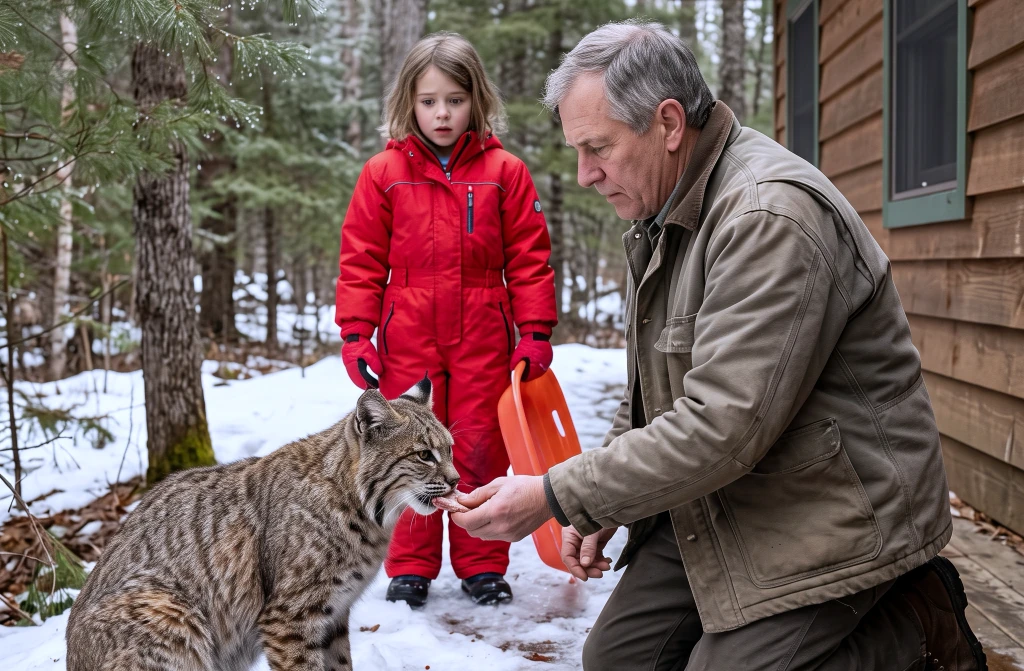
Then a child’s voice behind him said, “Mr. Keller, is that your cat?” Eight-year-old Lucy Harlow stood at the corner of the house in a red snowsuit, dragging a plastic sled by its rope. Walter looked at the child, then at the meat still pinched between Ben’s fingers. The bobcat did not run…
To read the rest of the story – CLICK the NEXT button 👇👇👇