


The first piglet came down the trailer ramp backward, screaming as if Eleanor Quinn had paid nine hundred dollars for the privilege of killing him. He landed on all four feet, spun once, and ran into the old lambing shed. The second followed sideways. By the time the forty-second piglet crossed the threshold, three trucks had slowed on Mill Creek Road and Eleanor’s neighbor Cal Dyer had stopped pretending he wasn’t laughing.
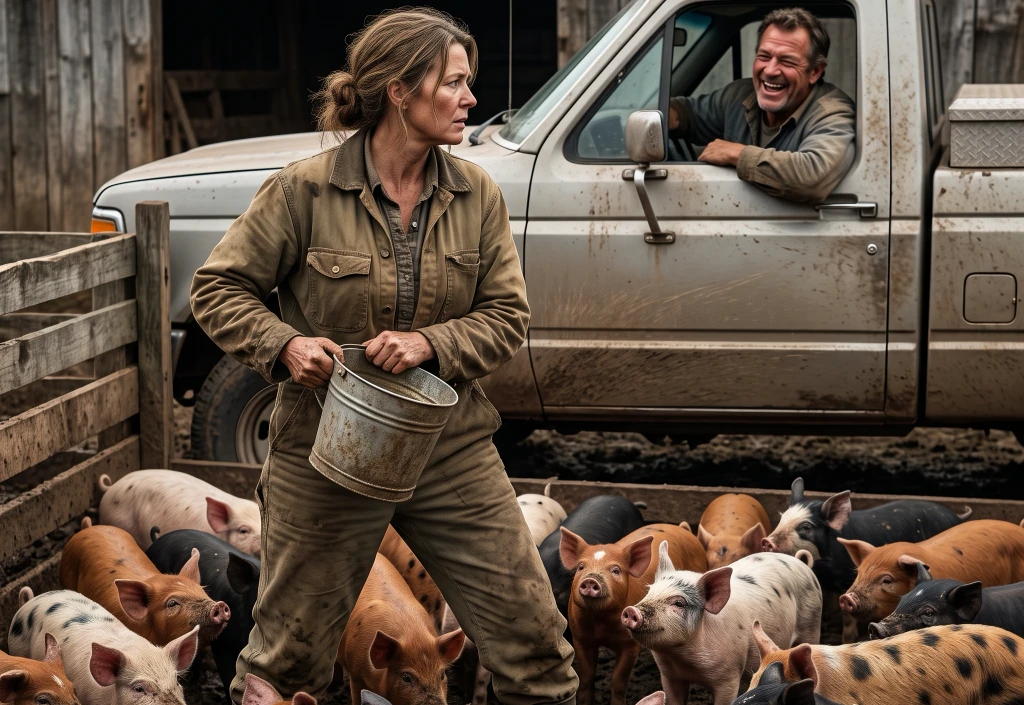
“Those ears weigh more than the rest of them,” he said.
Eleanor latched the shed gate. “They’ll grow into them.”
“Some might.”
Cal had lent her his stock trailer without asking what she meant to haul. At the livestock auction, he had watched her bid on a pen of undersized feeder pigs with narrow backs, rough coats, and the round bellies that often meant worms. He had stopped smiling when the auctioneer pointed at Eleanor and called the lot sold.
Forty-two piglets at twenty dollars apiece, plus fees.
Her husband, Tom, had been dead four months. That morning, nearly every tool from his machine shed had gone across an estate-auction table. The hay rake brought less than expected. The post driver brought more. Eleanor had stood beside their daughter, Kate, recording each price in the brown ledger Tom had used for twenty-three years.
She had withdrawn the pig money before applying the rest to the farm’s operating note.
Kate did not know that yet.
Cal watched one piglet push its nose beneath another’s belly in search of a place to hide. “You call Dr. Haskell?”
“He’s coming at seven.”
“Good. Orchard won’t feed them, you know.”
“I know.”
Cal studied her face. He had lived across the road long enough to recognize which of her answers meant she understood and which meant she had closed a door.
“Your south fence won’t hold hogs,” he said.
“I have electric netting.”
“One roll.”
“I ordered more.”
“With what?”
The question was not cruel. That made it worse.
Eleanor lifted the bucket of water she had carried from the pump and stepped into the shed. “Thank you for the trailer, Cal.”
He rubbed a hand over the back of his neck. “I’ll leave it until morning.”
She waited until his truck had crossed the creek before sitting on the overturned mineral tub near the gate. The piglets had gathered against the far wall, a restless patchwork of red, black, white, and spotted hides. One had a V-shaped notch in his left ear and a white streak above one eye. He watched her while the others watched the door.
Tom had counted livestock twice each morning: once with his eyes and once aloud. Eleanor had teased him about it until the winter an ewe delivered twins in a far corner of the pasture and only one followed her back. After that, she counted too.
Forty-two.
She wrote the number on the first clean page of a pocket notebook.
Kate’s car came too fast down the lane at half past six. Gravel snapped against the wheel wells before she braked beside the shed and stepped out wearing the navy slacks and white blouse she wore to the building-supply office in town.
“Please tell me those belong to Cal.”
“They don’t.”
Kate shut the car door carefully. At thirty-four, she had Tom’s dark eyebrows and Eleanor’s habit of making anger quieter as it deepened.
“How many?”
“Forty-two.”
“What did you pay?”
“Nine hundred forty-five with the buyer’s fee.”
Kate stared through the rails. “From the auction money?”
“Some of it.”
“That money was for the note.”
“Most of it still is.”
“Most isn’t the number Marlene Holt wrote on the bank letter.”
The pig with the notched ear approached the water pan. He planted both front feet in it, drank, then sneezed against Eleanor’s boot.
Kate looked down at him. Her mouth twitched before she caught it.
“Why pigs?”
Eleanor went to the farmhouse and returned with a black composition book. Tom’s name was written across the cover in faded silver marker. The pages held fence measurements, lambing dates, rainfall totals, and ideas he had collected without ever finding time or money to test them.
She opened to a sketch of the south slope. Forty-one circles marked the old apple trees. Between the rows, Tom had drawn arrows and written HOGS AFTER DROP—CLEAR FLOOR, BREAK SOD, MOVE FAST.
“He thought the orchard could be brought back,” Eleanor said.
Kate did not take the notebook. “Dad also thought a bad hydraulic hose could finish one more field.”
“This was researched.”
“By whom?”
“People managed orchards with pigs before either of us was born.”
“They also moved the pigs, Mom. How much fence did you actually order?”
“Enough to begin.”
Kate finally accepted the book. She turned the page, but Dr. Haskell’s truck appeared at the lane before she could read further.
The veterinarian examined the piglets in groups, taking temperatures and checking eyes, gums, joints, and manure. They were underweight and likely carrying parasites, but none showed signs of an immediate contagious illness. He left medication, feeding instructions, and a warning that the orchard could supplement their diet but not replace a balanced ration.
Kate wrote down every word.
By the time he left, the light had faded behind the ridge. Eleanor spread clean straw across the shed floor while Kate scrubbed the water pans. They worked with the old familiarity of women who had cleaned lambing pens together at two in the morning, though neither mentioned the argument waiting between them.
At the gate, Kate looked back at the piglets.
“Don’t turn them out until we have enough fence to rotate them.”
“They need room.”
“They can use the sacrifice lot behind the barn.”
“That ground is bare.”
“That’s why it’s called a sacrifice lot.”
Eleanor stacked the empty buckets. “I heard you.”
Kate held her gaze for a moment. “That isn’t the same as agreeing.”
She left the composition book on the workbench and drove home.
Before dawn, Eleanor carried two buckets of grain through the south gate. The orchard lay below the farmhouse in four sloping acres of broom sedge, honeysuckle, and trees that had not produced a usable crop in six years.
The county agent who visited during Tom’s last summer had called them severely neglected, not dead. Everyone else had chosen the shorter word.
Eleanor ran electric netting around the upper third of the orchard and connected it to the charger. She knew Kate had meant separate groups and smaller paddocks. She also knew the piglets were barely ten weeks old. They did not look capable of harming anything larger than a feed sack.
She opened the shed gate.
For several seconds, nothing happened. Then the notched piglet crept out, nose working. The others followed him across the lane in a loose, squealing line.
They reached the orchard and changed.
Their heads went down. They pushed beneath the matted grass, turning up moist earth in dark crescents. Several attacked a knot of chickweed. Two found beetle grubs beneath a rotting stump and began shouldering each other away from the hole.
Eleanor stood at the fence with Tom’s notebook beneath her arm. She had expected chaos. Instead, she saw appetite acquire direction.
By nine, the notched piglet had uncovered an aluminum tree tag buried near the first row. Eleanor rinsed it at the pump until the stamped word appeared: STAYMAN.
Tom had searched for those tags during their first year on the farm. He had found only three.
She laid the tag on the fence post and looked uphill. Forty-two small bodies moved under the old trees, their backs flashing between grass and shadow. For the first time since the funeral, the south slope did not look like something waiting to be sold.
Kate arrived shortly before noon with six fence posts across her back seat. Eleanor saw her stop at the upper gate and survey the rooted ground.
“You started without me.”
“They’re doing well.”
Kate stepped over the netting after Eleanor disconnected it. The overturned sod was shallow along the open rows, exactly the disturbance Eleanor had imagined. Near the split tree, however, the pigs had clustered in the cool soil beneath the canopy.
Kate’s face changed. She dropped Tom’s notebook and ran. “Cut the power, Mom. Now.” The notched piglet backed away from the split tree with a pale strand of root between his teeth…
To read the rest of the story – CLICK the NEXT button 👇👇👇