


Frank Hensley saw the animal because the eastbound lane of Highway 9 changed color where it lay. At first it looked like a work glove dropped on the pavement—pink-gray against black asphalt, no bigger than Frank’s two fists together. Then it lifted its head into the wash of his headlights, and its mouth opened around a cry so thin he heard it only after he had driven past. He braked hard enough to throw his steel travel mug into the passenger footwell.
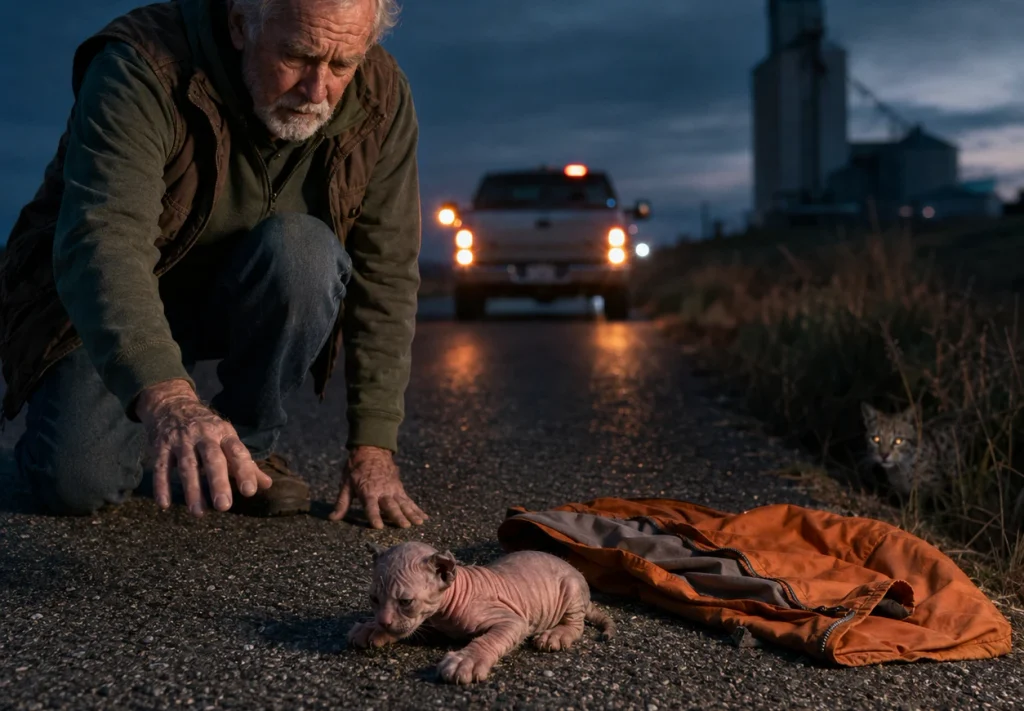
The pickup behind him leaned on its horn. Frank pulled onto the narrow shoulder, checked his mirror, and got out wearing the orange field jacket he had not needed since retiring from the state transportation office eight months earlier. Dawn had barely reached the old grain elevator. Trucks came fast around that curve, their drivers looking toward the feed store sign instead of the dip in the road. Frank stepped into the lane and raised both arms.
The pickup stopped thirty feet short of him. Its driver, Luis Alvarez from the tire shop, shoved open his door.
“You trying to get killed?”
“Block the lane.”
Luis started to answer, saw where Frank was looking, and reached for his hazard lights instead. Up close, the thing in the road looked less understandable. It had four oversized paws, a short tail, folded ears, and skin that showed every small bone beneath it. There was no fur on its face, no whiskers, not even the soft fuzz Frank associated with newborn mice. A shallow scrape crossed one shoulder. Its sides fluttered much too quickly.
He crouched without touching it. Years of inspecting storm damage had trained him to look before he moved anything: point of impact, load path, what had failed and what might fail next. There was no blood around the animal and no mark that suggested a tire had struck it. A trail of damp grit led from the ditch, but passing wheels had broken it into pieces.
The creature pushed against the pavement. Its front legs straightened; the rear ones did not. It made that faint, greedy sound again. Frank took off his field jacket and laid it beside the animal.
“Easy,” he said, though he had spent most of his life disliking the word. Easy was what people said when a situation was not.
He slid one hand beneath the chest and the other under the hindquarters. The animal weighed almost nothing. Its skin was cold despite the heat stored in the road, and its heart knocked against his fingers with the frantic, irregular speed of rain on a metal roof. Luis had come closer but kept his distance. “Is that a cat?”
“I don’t know.”
“Looks burned.”
Frank checked the exposed skin again. No blistering. No soot. “Call the Millbrook clinic. Tell them we’re coming.”
He wrapped the animal in the jacket, leaving its face uncovered, and carried it to his truck. The appointment card tucked above the visor caught his eye as he set the bundle on the passenger seat: BARNES PROPERTY GROUP, 7:00 A.M., PRE-LISTING WALKTHROUGH.
Carol did not know about the walkthrough. She knew they had talked about selling the six acres someday, after she reduced her rehabilitation work and after Frank had learned what retirement was going to be. She did not know he had decided someday needed a date.
The bundle moved. A naked paw worked free and closed around the edge of his jacket. Frank pulled the appointment card down, turned it facedown in the console, and drove toward town.
Dr. Lena Ortiz met him at the side entrance of Millbrook Animal and Wildlife Clinic with a technician and a warmed carrier. Carol had called ahead after Luis called her, which meant she knew Frank had been on Highway 9 before sunrise. She would ask why later. For the moment, Lena took one look into the jacket and stopped asking questions.
“Treatment room two,” she told the technician. “Warm it gradually. Don’t feed yet.”
“Her,” Frank said.
Lena glanced up. “You know that?”
“No.”
“Then let me earn my coffee.”
The clinic occupied a converted feed store, and on wet days the old plank floor still gave off the mineral smell of grain dust. Treatment room two had stainless-steel counters, a bank of drawers with handwritten labels, and an incubator Lena used for fragile wildlife. Frank stood against the wall while she worked.
The animal’s temperature was dangerously low. Its gums were pale and tacky from dehydration. Lena found abrasions but no deep wounds, and nothing that looked like a fresh thermal or chemical injury. Under a magnifying lamp, the skin showed fine scaling and several insect bites, but no obvious pattern of mange.
“How long was she out there?” Lena asked.
“I don’t know. Road surface was sixty-eight degrees in the shaded wheel track, warmer near the centerline.”
The technician looked at him. Frank nodded toward the infrared thermometer clipped to his belt. He had kept carrying it after retirement for reasons he could not defend.
Lena inserted a tiny catheter and began warmed fluids. The animal protested with a rasp that became, for half a second, a surprisingly respectable snarl.
“There you are,” Lena murmured. “Be mad.”
Carol arrived twenty minutes later in jeans, rubber barn boots, and the blue overshirt she wore when she expected to be bitten. At sixty-four, she moved more slowly than she once had, but she never entered a room timidly. She worked the stiffness from two fingers of her left hand before pulling on a pair of gloves, then looked first at the animal, then at the jacket beneath it, and finally at Frank.
“Luis said you picked it up in traffic.”
“There wasn’t time to wait.”
“I wasn’t criticizing you.”
Her eyes held his for one beat longer than the sentence required. Frank knew she had already noticed that his field jacket was clean except for the road dust. He had dressed for a meeting, not a drive.
Lena asked Carol to come closer. As a state-licensed wildlife rehabilitator, Carol had brought injured foxes, squirrels, owls, and once a furious young beaver through that side door. She bent over the table without reaching into the sterile field.
“Sphynx kitten?” she asked.
“That’s what I thought for the first five minutes.” Lena touched the animal’s paw with a gloved finger. “But the proportions are wrong. Look at the width through the metacarpals.”
“Could be a mix.”
“Could be. The tail bothers me.”
The animal’s eyes were partly open now. They were blue-gray and unfocused, the eyes of something still young enough to expect the world to arrive as warmth and milk. Lena examined the mouth, measured the body, and took two quick radiographs while the fluids ran. Frank watched her expression become more guarded rather than more certain.
At eight-fifteen, the animal swallowed a small amount of electrolyte solution. At eight-thirty, she held up her own head. The movement seemed minor until Frank remembered the collapsed hind legs on the highway. He felt the muscles in his shoulders release.
“She’s stronger,” he said.
“A little,” Lena answered. “Don’t spend that strength for her.”
Frank looked at the incubator and understood that the warning had not been about the animal. Carol’s phone buzzed on the counter. She wiped her hand before picking it up, then looked at the screen. Frank saw the Barnes Property Group logo reflected in her glasses. She read the message without opening it. “Your appraiser says he’s sorry you had an emergency and would be happy to reschedule.”
Lena lowered her eyes to the chart. The technician found an urgent reason to carry a tray out of the room. Frank put both hands in his pockets. “It was only a walkthrough.”
“Of our house.”
“Of the property.”
“Thank you. That makes it much better.”
The incubator alarm gave a soft chirp. Lena adjusted the oxygen line, and Carol went silent, but the look she gave Frank did not end. It simply moved somewhere they would have to reach later.
Near noon, Lena called a wildlife veterinarian at the state university and sent photographs that did not include any identifying road location. She scraped for mites, collected fungal samples, and drew enough blood for only the most necessary tests. The animal slept through most of it with one paw tucked beneath her bare chest.
Frank sat on a stool outside the treatment room. He could have gone home. No one had asked him to stay, and Carol had not spoken to him since the message. Yet every time he stood, he remembered the paw closing around his jacket. Shortly after one, Lena came into the hall carrying a radiograph. “I want both of you to see this.”
Carol stood on one side of the illuminated panel and Frank on the other. Lena pointed first to the skull, then the limbs and the abbreviated line of vertebrae in the tail. She explained the age estimate—perhaps seven weeks, certainly not much older—and the features that had made her call the university.
“I can’t confirm species from one film,” she said. “We’ll send a genetic sample. But I know what this isn’t.”
Inside the incubator, the animal woke and placed both front paws against the clear wall. With her ears lifting from their folds and her body finally warm enough to hold itself upright, the shape of her became visible in a way it had not been on the road. Carol moved closer to the glass. Lena looked from the short tail to the broad paws. “That isn’t somebody’s hairless house kitten.” The animal opened her mouth and hissed at all three of them.
“She’s a bobcat,” Lena said…
To read the rest of the story – CLICK the NEXT button 👇👇👇