


When Ray Cole lifted the mower blade from the bench grinder, the flies were louder than the wheel. He kept his gloved hands on the workbench and listened as the stone spun down. The noise beyond his open garage did not fade with it. A thick, restless buzzing hung over the weeds behind his fence, where the collapsed loading shed of the old Garner seed mill leaned toward the abandoned rail spur.
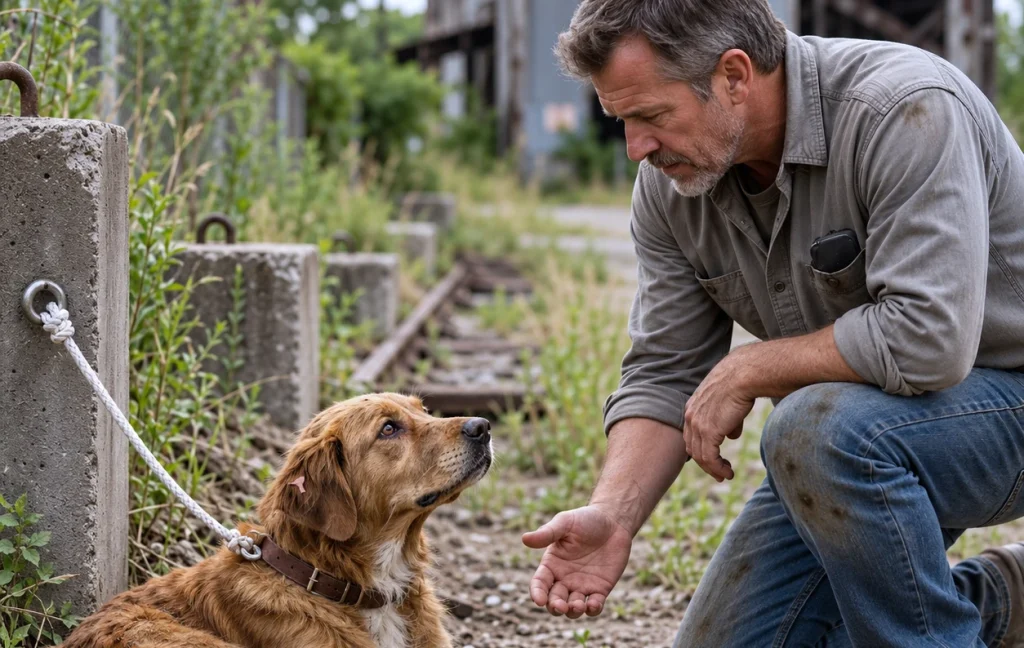
Saturday heat had settled early over Bellwether, Ohio. By late morning, the air in Ray’s garage tasted of iron filings, gasoline, and grass baked onto the underside of mower decks. The county cut the service lane behind the mill only when complaints piled up, and the burdock there stood nearly to his waist.
Ray took off his face shield. Beneath the flies came another sound, so thin he nearly mistook it for metal cooling on the bench.
It came again—a dog’s breath catching before it could become a whine.
He killed the box fan and crossed the yard. The back gate dragged through crabgrass, and seed heads fastened to his jeans as he pushed toward the nearest concrete footing. The buzzing grew dense enough to touch his face.
The dog lay in the shallow drainage cut on the far side.
She was big-boned, with a rust-gold coat, a white blaze down her chest, and one ear split by an old healed tear. Dirt had turned her fur the color of the ditch. Her ribs showed beneath mats along her sides, and a white braided line ran from a bolt in the concrete to the leather collar buried at her neck.
An empty paint pail lay on its side beyond the scraped circle her paws had made. What little water it had held was now a black stain in the dust.
Ray stopped well short of her reach and lowered himself to one knee. “I’m going to come closer.”
The dog opened her eyes. Her tail moved once against the dirt without lifting. She did not bare her teeth or try to retreat, and that frightened him more than either would have.
The line had been threaded twice through a cracked buckle and cinched until the collar disappeared into swollen fur. Flies massed along one wet place under her jaw. When she tried to raise her head, the tether drew tighter and her breath shortened.
Ray backed away without turning. “I’ll be back. Don’t spend anything on me yet.”
In the garage he took a moving blanket from a clean shelf, two bottles of water, a shallow magnetic parts tray, leather gloves, side cutters, and a broad gasket scraper. He called Bellwether Veterinary Clinic as he returned through the gate. The technician who answered told him to offer a few swallows at a time, avoid pulling on the collar, and call again from the ditch if the dog stopped responding.
Ray poured less water into the metal tray than his hands wanted to give. The dog smelled it, licked twice, then dragged one forepaw toward the dish. He slid it closer without shifting the tether.
“There’s a whole bottle,” he told her. “You don’t have to beat it.”
Her tongue scraped the steel. When she stopped, he eased the gasket scraper between the outer loop and her neck. It was the same tool he used to protect a hose or wire while cutting away seized material. With the flat blade shielding her skin, he fitted the side cutters around a few fibers at a time.
Machines had taught Ray not to trust slack. A drive belt could look harmless until weight moved; a spring could wait ten years to spend its force in half a second. He held the free side of the line, felt the load in it, and turned his face away as the first strands snapped.
The dog flinched and pressed her muzzle into the dirt.
“I know. One more.”
The second loop parted. Ray controlled the released end until it fell harmlessly beside his boot. The dog drew a breath that traveled visibly from her throat to her belly, then laid the side of her face against the toe of his work shoe.
He spread the blanket beside her and rolled her onto it instead of trying to lift her under the chest. She weighed far less than her frame promised. Even so, the blanket cut into his palms as he carried her through the weeds in short, careful steps.
He laid her across the back seat of his pickup and propped the parts tray near her muzzle. Before leaving, he returned for the pieces he had cut and sealed them in an empty gasket box. The remaining line and overturned pail stayed where he had found them. Whatever happened next, someone besides him needed to see the place before weather or a mower changed it.
The clinic occupied a low brick storefront between a laundromat and an insurance office. A technician came through the side entrance with a rolling table before Ray had the truck fully in park. Dr. Nina Patel followed, fastening the cuffs of a blue scrub jacket.
“How long has she been down?”
“I don’t know. I heard her maybe twenty-five minutes ago.”
“How much water?”
“Five or six swallows. I stopped her twice.”
“Good.”
They began working before the table cleared the door. Ray followed until someone asked him to stay against the treatment-room wall. He stood there holding the gasket box while they clipped fur, started fluids, drew blood, and exposed the wound beneath the collar.
Dr. Patel used plain language and gave him no comfort she had not earned. The dog was severely dehydrated and overheated. The neck wound was infected and would need cleaning under sedation. Weakness in her hind legs might improve with fluids and rest, or it might not. The next several hours mattered more than guesses.
A technician passed a microchip scanner over the dog’s shoulders. It chirped.
The registration named her Mabel. Her owner was Clara Wynn of Ash Street, but the phone number had been disconnected. The clinic’s own records showed that Clara had died nineteen days earlier. A note added after her last appointment listed a nephew, Gavin Wynn, as the estate contact.
“Mabel,” Dr. Patel said near the dog’s good ear.
The ear twitched.
Ray stepped nearer the table. “That’s you, then.”
Mabel found him with her eyes. Her tail brushed the towel once.
The sound loosened something in Ray’s chest before he had any right to feel relieved. A name meant somebody had once expected this dog to come home. It did not mean that home still existed.
Dr. Patel stripped off her gloves. “She stays here tonight, almost certainly tomorrow night too. I’m also reporting the condition she arrived in. County animal services will decide custody while they locate the estate representative.”
“Can she go back to whoever had her?”
“Not today. Officer Malone will document the site and put the appropriate hold in place. After that, placement is her call.”
Ray looked through the glass panel as a technician settled Mabel under a thin blanket. “If she gets well enough to leave, I can take her.”
Dr. Patel’s expression did not change. “As a medical foster?”
“If they’ll approve me.”
“She may panic around leashes, guard food, wake you all night, or refuse to let you touch her after trusting you in that ditch. This morning doesn’t tell you who she’ll be when she has the strength to object.”
“Tell the officer I still want to be checked.”
In the waiting room, Ray found three messages from his sixteen-year-old son. Noah was supposed to arrive at noon so they could finish rebuilding the front hub on the BMX bike that had occupied two Saturdays and half the garage floor. Since the divorce, most of their time together had acquired a task and a deadline. It was easier to discuss a pitted bearing than why Noah had stopped leaving clothes at the house.
Ray typed: Found a badly hurt dog. At the vet. Bike’s off today. You don’t need to come.
Noah answered: Okay.
Ray set the phone face down.
Lorna Malone from county animal services arrived forty minutes later. She photographed the cut line, sealed it in an evidence bag, and had Ray point to the concrete footing on a property map. While a deputy met her at the mill, she placed Mabel on an emergency protective hold and authorized the clinic to continue treatment. Gavin Wynn would be notified; the ownership question could be addressed after Mabel was stable.
“I want to foster her,” Ray said.
Lorna looked at the grease under his nails and the repair invoices spilling from his jacket pocket. “You work days?”
“Maintenance at Torren Packaging. Seven to three-thirty. I repair small engines here on weekends.”
“Fenced yard?”
“Yes.”
“Other people in the house?”
Ray hesitated. “No.”
She noticed the hesitation and wrote something down. “I’ll inspect tomorrow morning. House, fence, sleeping area, work plan. Don’t put on a performance for me. Make it honest.”
By late afternoon, Mabel’s temperature had begun to come down. Dr. Patel allowed Ray five quiet minutes beside the recovery kennel. He sat on the floor and placed two fingers on the towel outside the bars, asking nothing of her.
The treatment-room door opened behind him. Noah came in wearing a faded Guardians T-shirt and carrying the red shop rag Ray had left beside the grinder.
“Mom drove me,” he said. “Your garage was open.”
He had grown another inch that summer. Ray knew it because the boy’s jeans no longer broke over his sneakers, not because he had watched the change happen. A fresh scrape crossed Noah’s knuckle, probably from the bike chain.
Noah crouched several feet from the kennel. “Is she going to make it?”
“Dr. Patel says she has a chance.”
“What’s her name?”
“Mabel.”
Noah laid one hand palm up on the floor, too far away to trap her into contact. Mabel watched him through heavy lids.
“What happens after this?” he asked.
“The county keeps legal custody for now. I asked if I could foster her when she’s discharged.”
Noah turned his head. “You asked?”
“Yes.” “Already?” Ray looked at the bandage wrapped loosely around Mabel’s neck. “Already.” Mabel moved one forepaw. The tip of a nail came to rest against Noah’s open hand, and he went perfectly still. His face tightened in the same private way it had the morning Laura carried the last of her suitcases to the car. “You asked to bring her home after knowing her one afternoon,” he said. “Why didn’t you ever ask me to stay…”
To read the rest of the story – CLICK the NEXT button 👇👇👇