


Through the glass door of Treatment Three, Rook looked too large to be dying. The glass fogged where Willa breathed against it. The German shepherd filled most of the padded table, all ninety pounds of him stretched beneath a silver warming blanket. His black saddle coat had been clipped in ragged squares for wires and IV lines. An oxygen hood clouded at his muzzle, cleared, then clouded again. Eight months earlier, that same broad chest had stood between ten-year-old Willa Rowan and a man in the woods. Now the blanket moved in small, uneven lifts above his ribs.
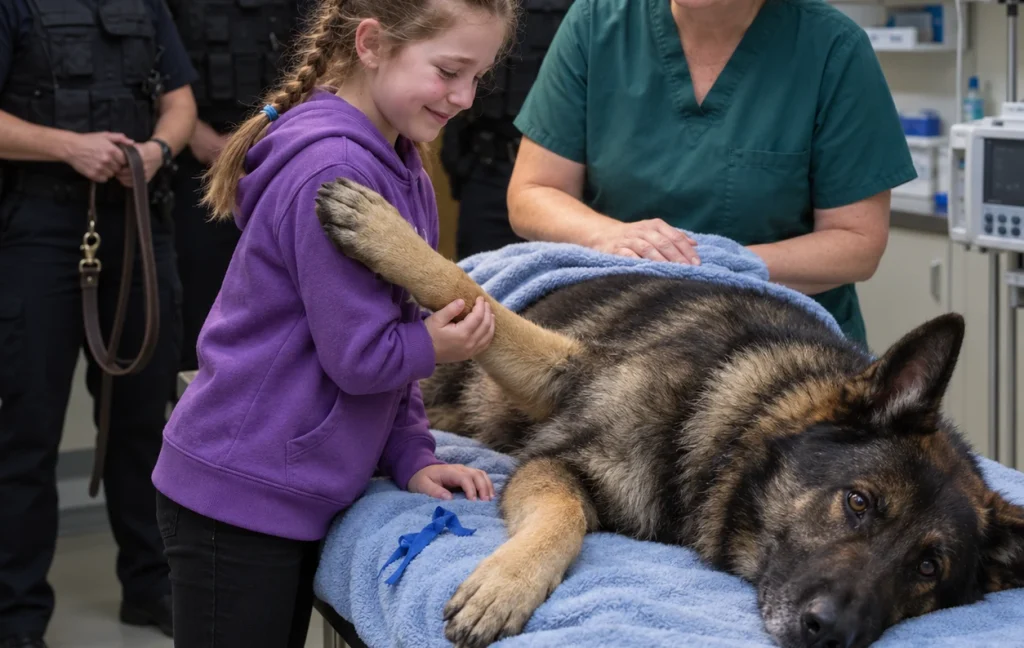
Willa pressed both palms to the glass. She had come straight from breakfast in flannel pajama pants, a winter coat, and one untied sneaker. Her mother had tried to fix the lace in the parking lot, but Willa had pulled away when she saw the police cruisers lined along the curb.
“You said he collapsed,” she said. “Collapsed isn’t the same as dying.”
Officer Daniel Voss stood beside her with dried mud up the back of his uniform pants. Rook’s leather lead was looped around his fist, though the dog was twenty feet away and in no condition to go anywhere. Daniel had been Rook’s handler for seven years. Willa had never seen him without an answer ready.
“No,” he said. “It isn’t.”
“Then why is everybody crying?”
Daniel looked toward the treatment room. Beyond the glass, a technician adjusted the oxygen flow while another read numbers from the monitor to the veterinarian. Captain Elena Ruiz stood near the nurses’ station with her phone lowered at her side. Three Ashford officers occupied a row of plastic chairs, silent in a way police officers rarely were when they had nothing to do.
Willa’s mother, Kate, put a hand on her shoulder. Her father had stayed at the reception desk to give the staff their names and keep the entrance clear. Kate’s hand was warm, but it did not stop Willa from shaking.
“They’re scared,” Kate said. “That’s all you know right now.”
The treatment-room door opened. Dr. Imani Price stepped out, pulled off a pair of gloves, and dropped them into a bin. She was a compact woman with tired eyes and a tiny silver fish pinned to one clog. Willa focused on the fish because the doctor’s face was harder to look at.
“Officer Voss?”
Daniel straightened. “How bad?”
“He’s in shock. His blood pressure is very low, his temperature is up, and he’s having intermittent abnormal heart rhythms. We’ve started fluids, oxygen, pain control, and broad-spectrum antibiotics while we work out the cause.” Dr. Price glanced through the glass. “The first images were limited because he couldn’t tolerate much repositioning. I’m not seeing a ruptured splenic mass or obvious trauma, but there’s something abnormal along the left side of his chest. Fluid, inflamed tissue, possibly both.”
“He was pulling hard ten minutes before he went down,” Daniel said. “We were running a training track on the old rail corridor. He had the scent.”
“Working dogs can compensate until they can’t.”
Daniel flinched at the sentence, almost too slightly to see, but Willa saw it.
“Can he hear me?” she asked.
Dr. Price looked down at her. “He’s sedated, but he may know familiar voices are close.”
“Then I want to go in.”
“Will—” Kate began.
“He came into the woods for me.” Willa kept her eyes on the doctor. “I can walk across one room for him.”
Dr. Price did not offer the soft smile adults used before telling a child no. She looked instead at the monitors, then at Daniel. “Two minutes. One adult. She stays by his head and touches only where I show her.”
Kate started forward, but Willa caught Daniel’s muddy sleeve and tightened her grip.
“Him.”
For a moment Kate’s mouth tightened. Then she nodded. Whatever she feared about the room, Daniel had been there the first time Willa held on to Rook because the ground beneath her no longer felt dependable.
Inside, the air smelled of disinfectant, wet fur, and the metallic chill of oxygen. Willa’s untied lace slapped softly against the floor until a technician crouched and knotted it without saying anything. Dr. Price positioned her near Rook’s head, away from the lines and the shaved patch behind his left foreleg.
Up close, he looked less like the K9 whose photograph hung in the police-station lobby and more like the animal who stole toast from Willa’s plate when Daniel pretended not to notice. Gray had begun to salt the fur around his muzzle. A patch at the edge of his oxygen hood was damp.
Willa put two fingers between his ears. His right ear shifted beneath her hand.
“Rook.”
Daniel let out a breath that sounded scraped raw. “Hey, partner.”
Rook did not respond to him. His eyelids trembled, but they stayed closed.
Willa reached into the pocket of her coat and closed her fingers around a strip of blue ribbon. It had once held her ponytail. On Rook’s first visit to her house after Quarry Ridge, he had stolen it from the coffee table and trotted through three rooms with the end hanging from his teeth. Willa kept it after that. On difficult days, she rubbed its frayed edge between her thumb and forefinger until she could feel where she was.
She laid the ribbon beside his paw. “I brought your terrible snack.”
Rook’s nostrils moved under the hood. His paw flexed once, dragging one blunt nail across the ribbon.
Willa laughed, and the laugh broke halfway out. Daniel turned his face toward the cabinets.
“He remembers,” she said.
“Looks that way.” Dr. Price watched the heart monitor. The rhythm had not become normal, but it had steadied. “Keep talking.”
Willa told Rook that her math quiz had been moved to Friday and that this did not count as a reason to scare the entire town. She told him the squirrel on their back fence had grown too confident. She told him his blue blanket was washed and folded at the foot of her bed, though Kate had said he could not stay until bedtime anymore.
That last part made Daniel look at her. “You knew about that?” Willa asked.
“Your mom and I talked.”
“You both talk about me when I’m not there.”
“Occupational hazard of being ten.”
The old joke did not land. Willa slid her hand beneath Rook’s left paw. It was heavier than she remembered, warm at the pads and limp through the toes.
After the woods, Rook had learned one thing no police manual had taught him. When Willa woke frightened, he would put a paw across her ankle and leave it there until her breathing slowed. Later she taught him a variation: she sat on the floor, tapped her shoulder, and said, “Closer.” Rook would lean against her and drape his foreleg clumsily over her as if he were a ninety-pound child attempting a hug.
She did not say the word now. She knew better than to ask him to move. But Rook’s eyes opened to narrow brown slits, found her face, and held.
His left paw pressed weakly into her palm. “I’m here,” Willa whispered.
He tried to lift that leg, and Dr. Price reached forward. “Easy. Don’t help him yet.”
Rook strained again, the old gesture beginning in his shoulder. His paw rose perhaps an inch. Then his entire body tightened. The monitor quickened. A low sound pushed from his throat, and his head turned sharply toward the left side of his chest.
Willa let go at once. “I hurt him.”
“You didn’t.” Dr. Price moved her hand lightly along his shoulder without pressing. “You showed me where he hurts.”
Rook’s leg settled, but he kept his elbow drawn close. Dr. Price parted the dense fur behind it. There, just beyond the shaved patch, the skin looked faintly thickened around a pale, narrow scar.
Willa stared at it. “He did that Sunday.”
Daniel’s head came around. “Did what?”
“Pulled away when I touched under his harness. I told you he didn’t want to play.”
“You said he was tired.”
“I said he was acting wrong.”
Dr. Price looked from the scar to Daniel. Her voice stayed level, but it lost its gentleness.
“How long has he been protecting that side…”
To read the rest of the story – CLICK the NEXT button 👇👇👇