


The dog in the last run did not charge the gate when Sergeant Jonah Reed came down the concrete aisle. He folded himself into the rear corner instead, all ribs and sable fur, watching Jonah through the gap beneath a raised cot. A red card clipped to the chain link read HANDLER BITE—NO DIRECT CONTACT.
Jonah had seen warning cards before. What held him was the stainless-steel food pan, still full at three in the afternoon, and the crescent of dried blood where the dog’s right front nail had split against the floor.
“He did that when the transfer door slammed,” Lena Ortiz said behind him. She ran the county’s working-dog unit with a veterinary technician’s economy: keys on a retractable cord, hair twisted up with a pen, no wasted motion. “He hasn’t tried to bite anyone here. He tries to get smaller, and people keep calling that unpredictable.”
“His own handler called it unprovoked.”
“His own handler signed a two-page report after six years with the dog. You handled Mack for nine. Could you have fit him into two pages?”
Jonah looked back at the run. The shepherd’s eyes followed the movement of his shoulders rather than his face. Trained dogs watched hands, hips, doors, the places danger and instruction came from.
He had not come to meet Rook. As the only former K-9 handler on the county placement committee who had not worked the incident, Jonah had come to review a file and make a recommendation. The city that owned the dog wanted the matter closed. The county veterinarian would not authorize euthanasia without an independent behavioral opinion, and the other approved assessor was out with pneumonia.
Jonah had planned to read, sign, and leave before evening roll call. Fourteen months after burying Mack beneath the sycamore behind his house, he still avoided the training wing when he could.
“Open the exterior panel,” he said.
Lena did not reach for her keys. “The panel opens into a fenced yard. He’ll still be separated from you. But if this is just so you can say you saw him—”
“It isn’t.”
She studied him for a beat, then operated the panel from the wall. The steel door rose with a rattle. Rook flattened so abruptly that his chin struck the floor. He did not look toward the opening.
Jonah crouched outside the chain link, turned his body sideways, and waited. He offered no command and did not use the dog’s name. Names could be pressure. Eye contact could be pressure. Even kindness, applied because a person needed a result, could become pressure.
The ventilation fan clicked on. Rook’s ears moved independently: one toward the fan, the other toward Jonah. A minute passed, then another. Jonah felt the old ache in his right knee and let it ache. In the adjacent office, a phone rang twice before someone answered it.
Rook slid his muzzle from under the cot. His left ear had a notch near the tip, and a pale scar crossed the bridge of his nose. He smelled the air between them. Jonah kept his palm open on his own thigh.
“The food pan,” he said quietly. “Can you move it closer to the gate without coming in?”
Lena used a long kennel tool to draw the pan forward. The scrape of metal sent Rook backward, but he recovered sooner this time. Jonah took a piece of kibble through the mesh tray and set it on the concrete inside the gate. He did not toss it. A tossed treat could feel like something coming at the dog’s face.
Rook crept forward on bent legs. The limp was slight until he shifted weight off the right front paw. He sniffed the kibble and left it where it lay.
“There you are,” Jonah said, not quite to the dog.
Rook looked at him then. The gaze was direct, brief, and exhausted.
Jonah lowered his open hand beside the chain link, far enough away that Rook would have to choose the distance. He remembered doing the same thing with Mack as a green two-year-old who thought every stranger was a problem to solve. Mack had bumped the palm with his nose and sneezed.
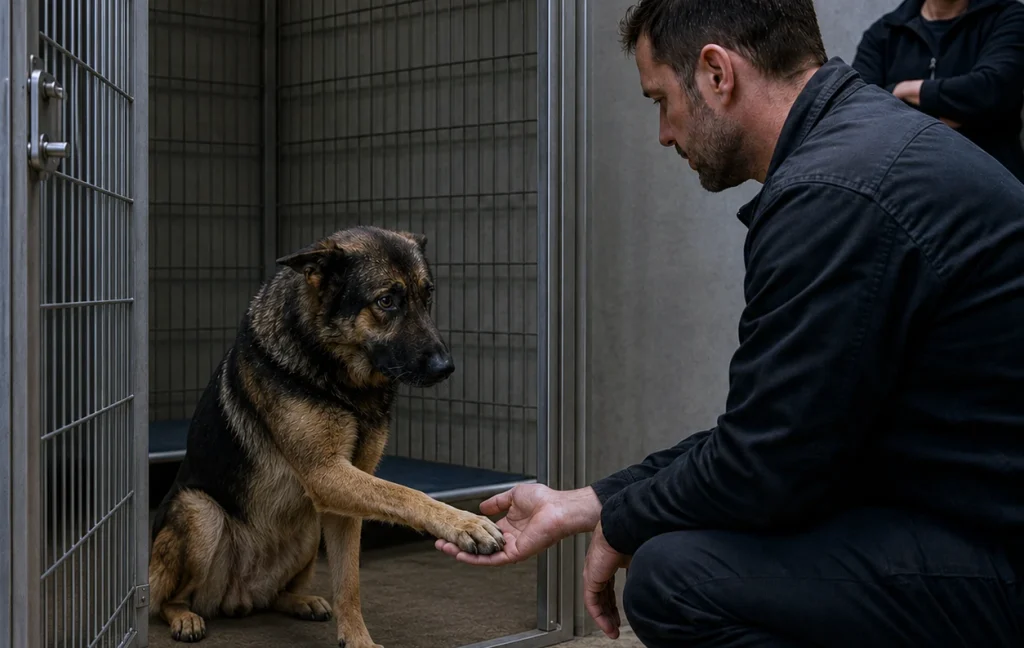
Rook did neither. He came to the fence, lifted his right paw through the low feeding gap, and set it across Jonah’s palm.
The pads were rough and cold. Jonah did not close his fingers. He supported the paw just enough to keep it from slipping through the gap, then lowered it when Rook drew back. The dog remained at the gate.
Behind Jonah, Lena let out a breath.
“Has he done that with you?” he asked.
“He hasn’t come within three feet of me.”
Jonah rose slowly. Rook’s head tracked him, but the dog did not retreat beneath the cot. The untouched piece of kibble still lay between them.
“I won’t sign the disposition today,” Jonah said.
Lena’s keys went still against her hip. “What will you sign?”
“A request for a medical workup and a home observation. Twenty-one days, no public contact, no working exercises. I’m still on the county’s approved emergency-foster roster, and my yard passed inspection in October.”
“Your captain cleared you to bring a bite-case dog home?”
“My captain doesn’t live at my house.”
“That wasn’t my question.”
It was one of the reasons Jonah trusted her. Lena did not confuse determination with permission, especially in men who wore rank on their collars.
He took out his phone and called Captain Ellis in front of her. It required three more calls, a revised risk form, and a teleconference with Dr. Hsu, the county veterinarian. Jonah agreed to a basket muzzle for transport, two secured barriers at home, daily video check-ins, and no attempt to reproduce the circumstances of the bite. The city’s risk manager objected until Dr. Hsu noted that Rook had never received a complete orthopedic examination after arriving at the kennel.
By six, the light beyond the high windows had gone blue. Lena brought a soft rubber basket muzzle and a double-clip lead but stopped outside the run.
“He hasn’t let me fasten one,” she said. “If we force it, the observation is over before it starts.”
Jonah sat down again. This time he placed the muzzle on the floor outside the mesh and fed a strip of boiled chicken through its open end. Rook ignored the first piece. He took the second without touching the rubber rim, then the third with his nose halfway inside.
They worked for forty minutes. No one clapped when Lena finally secured the strap. Rook stood rigid but did not fight it. Jonah opened the run from behind a second barrier, clipped the lead without reaching over the dog’s head, and stepped aside.
Rook came out low to the ground. At the junction where the kennel aisle met the lobby, a deputy’s radio cracked with a burst of dispatch traffic. The shepherd stopped so hard that the leash went taut. His hindquarters folded beneath him.
Jonah shortened nothing. He waited until Rook looked toward him, then moved two steps away from the radio. Rook followed. It was not obedience exactly; it was an agreement about distance.
They were nearly at the side exit when a man rose from the bench beside the vending machines.
He was younger than Jonah had expected, perhaps thirty-eight, with close-cut brown hair and a left arm held slightly away from his body. A surgical scar disappeared beneath his cuff. He carried an orange rubber ball gone gray along one seam.
Rook saw him and stopped.
The dog’s tail tucked. His eyes fixed on the ball, then climbed to the man’s face. For one second his ears came forward, and Jonah saw recognition before fear pulled them flat again.
“Travis Coyle,” the man said. “Easton Falls K-9. Formerly.”
Jonah placed himself beside Rook, not in front of him. “You were his handler.”
“I was told somebody blocked the order.” Travis’s gaze stayed on the dog. His grip worked around the ball as if testing an injured hand. “I wanted to see who.”
“You can see me.”
Travis gave a small nod. He looked neither cruel nor relieved. That disturbed Jonah more than anger would have.
“Did he let you touch him?” Travis asked.
“He chose contact.”
At that, Travis finally met Jonah’s eyes. “Did he put his right paw in your hand?”
Jonah glanced down at Rook. “Yes.”
Travis’s thumb stopped on the split seam of the ball.
“That wasn’t him choosing you,” he said. “That was Rook asking you to stop. The night he bit me, I didn’t…”
To read the rest of the story – CLICK the NEXT button 👇👇👇