


The wind caught the red puppy between Bell’s Market and County Road 14 and knocked all four feet out from under him. The heel of rye bread flew from his mouth, struck the snow crust, and skated almost to Owen Pike’s boot. Owen expected the dog to dive beneath the loading awning. Instead, the puppy crawled into the gust, found the bread, and carried it toward the last streetlight in Morrow Bay.
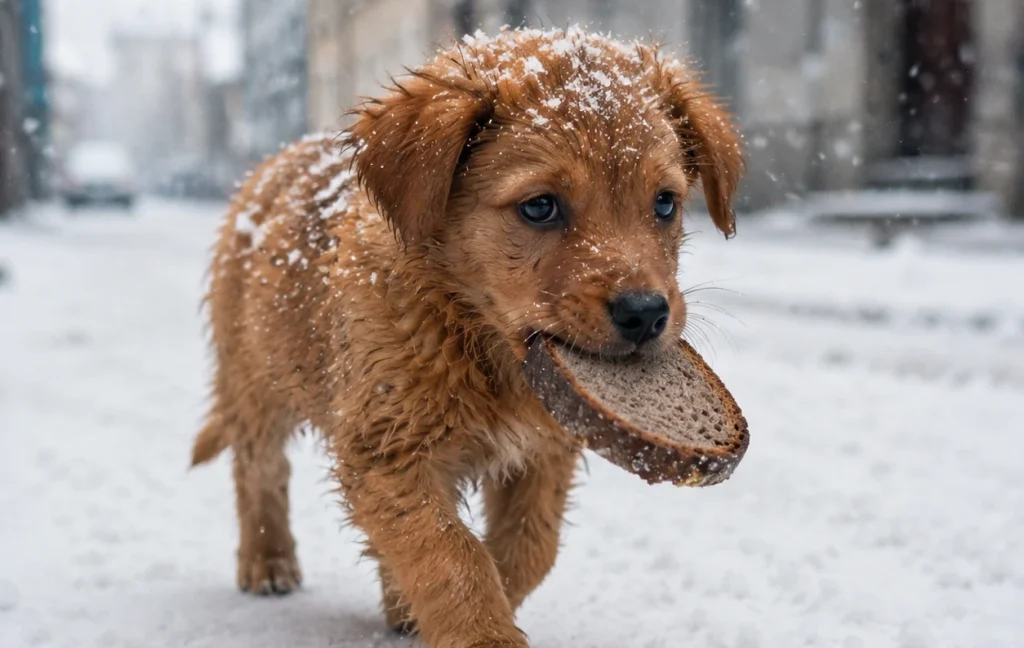
“He did that yesterday too,” Mavis Bell said behind Owen.
She stood in the market doorway with flour on her sleeves and a dish towel tucked through her apron strings. At sixty-two, Mavis still opened the bakery before dawn and regarded any suggestion that she hire help as a personal insult.
Owen watched the puppy’s narrow body disappear and reappear behind blowing snow. “You’ve been feeding him?”
“I’ve been trying. He eats a few bites here, but he won’t leave without something solid enough to carry.”
“Where?”
“If I knew, I’d have gone after him.”
The puppy reached the streetlight and continued east. Beyond that point, the county road followed the Lake Superior shore past a closed campground, several summer cabins, and miles of spruce.
The nearest occupied house was nearly five miles away.
“This is the third morning,” Mavis said. “Same direction every time.”
Owen turned. “Why didn’t you call somebody?”
“I called you yesterday.”
“You said there was a stray behind the store.”
“And you said you’d look.”
He had looked. He had followed the puppy in his truck until windblown snow erased the tracks near the county plow turnaround. When he lost sight of the small red shape, he checked the public map, saw no occupied buildings nearby, and drove back to the lighthouse.
There were hunting camps not shown on county maps. There were people who preferred being left alone. The puppy had moved with purpose, and Owen had chosen to believe purpose meant safety.
Now the barometer was falling hard enough that the needle in the lighthouse office had shifted while he was writing down the reading.
“I’ll look again,” he said.
“Try bringing another person this time.”
Owen pulled his coat tighter. “It’s a dog, Mavis.”
“It’s a dog walking into a winter storm with a loaf of bread.”
“A heel.”
“That distinction should comfort everybody.”
The lighthouse at North Point had not required a keeper in forty years. Its beacon turned automatically, and most of its systems reported problems to a computer in Marquette. The historical society still employed Owen to inspect the tower, clear snow from the service buildings, record storm damage, and keep tourists off the shelf ice.
He had spent twenty-three years in the Coast Guard before taking the caretaker’s job. He knew the shore, the currents, and the noises old structures made when ice tightened around them. He also knew what happened when someone mistook familiarity for control.
Knowing had not stopped him from doing it.
Almost two hours later, Dr. Nora Pike pulled into the market lot in her veterinary SUV. She opened the rear hatch and began unloading four boxes of cat food.
“You planning to help,” she called to Owen, “or are you part of the scenery now?”
He took the heaviest box from her. Nora was forty-one and had inherited her mother’s dark hair, quick hands, and ability to turn a practical question into an accusation merely by waiting for the full answer.
Eighteen months earlier, she had returned to Morrow Bay when the town veterinarian retired unexpectedly. She had signed a one-year lease on the small clinic across from Bell’s Market.
The year had ended six months ago. Nora had not left.
“There’s a puppy,” Mavis told her.
“There’s always a puppy when I deliver cat food.”
“This one packs his own lunch.”
They were still inside when the bell over the front door rattled. The red puppy had returned without the bread.
He stood on the rubber mat, trembling so hard that his legs shifted beneath him. Ice covered his whiskers. When he tried to walk toward the bakery counter, his left hind leg buckled.
Nora set down the box and crouched sideways, leaving him a clear route to the door. “Easy. Nobody’s trapping you.”
The puppy watched her hand. He smelled it, retreated, then allowed her fingers to touch his shoulder.
“He’s about four months old,” she said. “Underweight. Pads are split, but I don’t see deep frostbite.”
She ran one hand over his rib cage and gently extended the injured leg. The puppy flinched but did not bite.
“Strain, most likely. He needs warmth, fluids, and several days without hiking anywhere.”
Mavis placed canned dog food on a saucer. The puppy swallowed three mouthfuls, then turned away and stared toward the bakery door.
“Watch,” Mavis said.
She returned with the dense end of another rye loaf. The puppy struggled upright as soon as he smelled it.
Nora held the bread out flat. He took it carefully and limped toward the entrance.
“That’s not hunger,” she said.
“No,” Owen replied. “Not his.”
Something blue clung to the fur above the puppy’s hip. Nora caught the loose fibers between two fingers. Tangled with them was a short piece of tarred nylon twine.
Owen knew both materials.
The abandoned Dunbar fish camp stood less than two miles beyond the campground. Its net house had been insulated with blue fiberglass, and coils of tarred line still hung from the rafters.
The county owned the condemned property, which sat along the same shoreline service route as North Point. Owen’s winter contract included checking and securing its outbuildings after storms.
On Monday, he had inspected the camp after a hard wind. One of the net-house doors had torn loose from its latch, and he had installed a new hasp and padlock before someone could wander inside.
He remembered paw marks near the north wall. Snow had softened their edges, and he had taken them for fox tracks. His knee hurt that morning. The wind was rising, and he had three other buildings to inspect.
He had never gone inside.
“Dad?”
Nora was watching him.
“The Dunbar place,” Owen said. “That insulation came from the net house.”
Mavis looked toward the windows. “I thought those buildings were condemned.”
“They are.”
The puppy scratched at the door with the bread held between his teeth.
Nora reached for the slip lead in her coat pocket. He backed away, dropped the bread, recovered it, and pushed his nose against the glass.
“He won’t let me restrain him,” she said.
“He doesn’t want to stay.”
“He may collapse if he goes back out.”
Owen opened the door only far enough to block the puppy with his boot. “Then we follow him.”
Before Nora could answer, Ben Kowalski came in carrying a coil of orange survey ribbon. Snow covered his public works jacket, and his beard had frozen white around his mouth.
“If any of you are thinking about driving east, stop thinking,” he said. “The county’s closing the shoreline road before noon.”
Owen pointed at the puppy. “How much snow around Dunbar?”
“Two feet on the trail. More against the buildings.”
“Can your tracked rig make it?”
Ben followed the direction of Owen’s hand. “Why?”
Mavis told him.
Ben’s expression changed when she reached the part about the bread. “Animal control’s south of town with a cattle trailer in a ditch. They won’t get here before the road closes.”
“Then we go without them,” Owen said.
“You don’t go anywhere alone.”
“I wasn’t asking permission.”
“That has never made your ideas safer.”
Nora closed her hand around the slip lead. “We need carriers, a litter, warming packs, radios, and a return time filed with dispatch.”
Ben nodded. “I’ll get the rig.”
Owen looked from one to the other. “We’re losing daylight.”
“We’ll lose eight minutes,” Ben said. “Try to survive them.”
Mavis remained at the market as their base contact. Ben brought the tracked utility vehicle from the municipal garage and loaded snowshoes, shovels, a rescue pulk, a canvas litter, tools, reflective stakes, and two large carriers. Nora added blankets, towels, insulated warming packs, fluids, and her field bag.
They reported their route to county dispatch. Only then did Owen open the market door.
The puppy went out with the bread.
Ben followed slowly in the tracked vehicle while Owen and Nora watched from the rear bench. The dog did not use the center of the road. He moved along the lee sides of drifts, behind empty cabins, and through gaps in the snow fence where the surface had packed hard.
Twice he disappeared. Each time they found him waiting beyond the next turn, head lowered against the wind and the dark heel of bread still clenched in his mouth.
Past the campground, a fallen spruce blocked the service trail. Ben shut down the vehicle and strapped on snowshoes.
From there, they continued on foot with the equipment secured to the pulk. Ben marked each turn with reflective ribbon because their tracks were already filling behind them.
The puppy dropped the bread in a drift. He dug until he found it, adjusted his grip, and went on without taking a bite.
Owen tried to keep the lead. After several hundred yards, his left knee began refusing full weight.
Nora noticed. “Give Ben the pulk line.”
“I don’t have it.”
“You’ve been pulling the side strap.”
“It keeps the load steady.”
“It also lets you pretend you aren’t using it as a handrail.”
Owen released the strap. “Satisfied?”
“No.”
Ahead, the puppy left the trail and forced his way through snow gathered against a stand of cedar. Beyond the trees, the roofline of the Dunbar net house appeared beside the frozen lake.
Wind swept the open ground clean in some places and piled it waist-deep in others. The lake ice boomed beyond the shore, the sound traveling under their feet like a distant impact.
The puppy crossed the clearing and vanished behind the north wall.
They found him at a drainage gap near the foundation. The opening was scarcely wider than his shoulders. He dropped the bread, squeezed halfway through, backed out, then turned his head and tried again.
This time the bread scraped along the wood, but he carried it inside.
Ben cleared snow from the west service door. Its lower hinge had warped, and the swollen wood would not move until he worked a pry bar into the frame.
The main door remained sealed behind a drift. Owen’s new padlock hung from the hasp above it.
After several minutes, the service door opened far enough for Nora to enter sideways. Ben tested the roof supports before allowing Owen to follow.
The net house smelled of old rope, wet timber, and frozen fish oil. Torn nets lay in heaps along the walls. Strips of blue insulation hung from a ceiling panel where the wind had peeled back the plywood.
Nora’s flashlight crossed a rusted stove, an overturned worktable, and two pieces of bread gnawed down to their crusts.
The red puppy stood in the far corner.
A brindled female dog lay on a mound of netting with her body curled around two smaller puppies. One was gray, the other cream-colored. Frost silvered the mother’s muzzle, and one foreleg extended at an unnatural angle beneath a fallen rack.
The red puppy placed the fresh bread against her mouth. He pushed it once with his nose, then pressed himself to her neck.
Nora knelt.
The mother opened one eye.
Her gaze moved first to the bread, then to the three people in the doorway. She tried to pull the two smaller puppies farther beneath her, but her body could no longer obey the effort.
As Owen stepped closer, Nora’s flashlight struck the inside of the main door. Two bright screw points protruded through the wood above the drift.
Owen recognized the angle of the lower one. He had driven it crooked on Monday and decided it was good enough…
To read the rest of the story – CLICK the NEXT button 👇👇👇