


Vera Bell had one arm through her husband’s old coat when the thing beneath the porch cried again. She left the other sleeve hanging and stood with the kitchen door open, letting November blow against her stockinged feet. The sound was small, scraped almost empty. In thirty-one years of driving a school bus, she had learned to hear a child trying not to be sick three seats behind her, a bearing beginning to fail, the particular silence that meant somebody had brought something alive aboard. This sound made her reach for her boots.
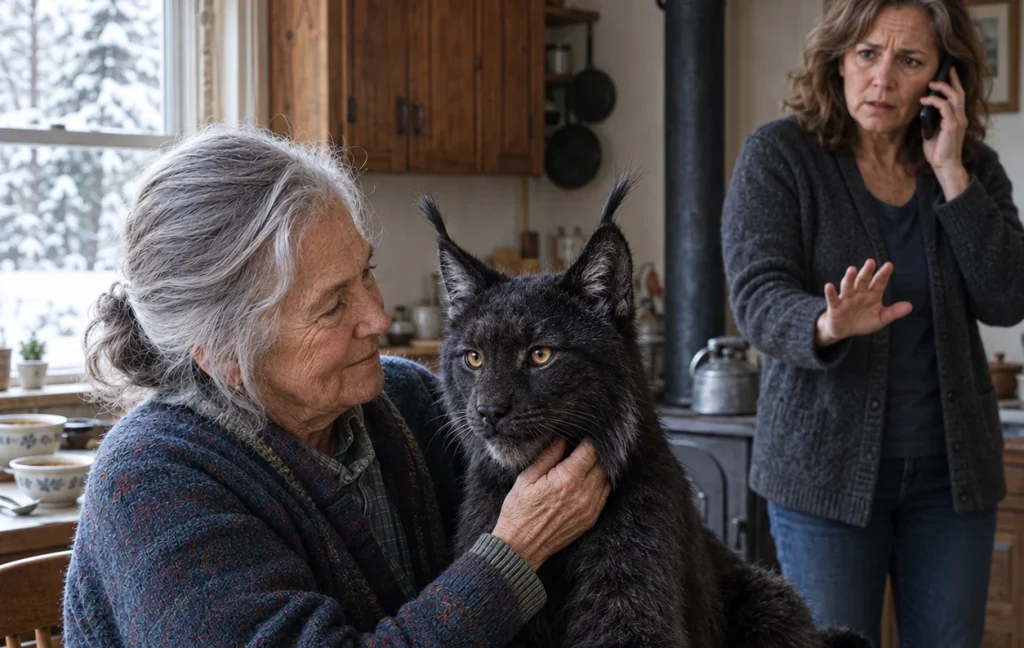
The electricity had been out since midafternoon. Beyond the porch, snow erased the short driveway and the last stretch of Mill Spur Road, which connected her house to the rest of northern Maine. Vera took the battery lantern from the counter. The emergency pendant Hannah had mailed her remained in its unopened box beside it.
At eighty-five, Vera could still get down on her knees. Getting up required something sturdy within reach, and she chose her place beside the porch post before lowering herself.
A black animal lay against the foundation, where the skirting had come loose. She could see an ear, the shine of one eye, a front paw spread flat on the frozen dirt. The paw looked too large for the rest of it.
“Well, come on, then.”
It did not move. Vera waited, holding the light steady, until a tremor passed through its flank.
She pulled the coat off, worked it through the opening, and gathered the animal inside the heavy canvas. It weighed less than she expected. When she drew it toward her, its back legs unfolded a surprising distance, and she had to stop to keep one from catching beneath a board.
The porch post took most of her weight as she stood. By the time she reached the kitchen, her good knee was shaking.
She put the bundle in an empty wood box well away from the stove and turned the lantern toward it. Black fur clung in wet points to a narrow chest. There was almost no tail. Perhaps it had lost part of it; perhaps somebody had paid good money for a cat that looked this peculiar and then let it wander.
Vera tried the telephone. No dial tone, and the cell phone Hannah insisted she keep charged showed no service. She laid both down and went back to the box.
For several hours she did little except exchange damp towels for dry ones and listen. Ned’s coat lay beneath the animal, its torn pocket turned toward her. She had meant to mend that pocket before he died seven years earlier, and afterward had never found a reason to hurry.
Near midnight the animal lifted its head. Vera set a shallow dish of water within reach, then sat back when it recoiled from her hand. Later, it licked the dish without looking away from her.
“That’s yours,” she said. “Nobody’s taking it.”
She stayed in the kitchen chair with her slippers planted on either side of the box. Once, when she dozed, a low, uneven vibration woke her. It came from the coat beneath her hand, faint as the old bus engine felt through the steering wheel before the idle settled.
By morning there was a warm weight tucked against Ned’s sleeve. Vera put her breakfast plate on the table instead of eating over the sink.
Dean Pritchard plowed her driveway the following afternoon. He came in carrying the mail and a sack of grit, holding the torn corner shut with his thumb. Before he took off his gloves, he tightened the loose screw on the porch latch with the driver he kept in his jacket.
“You’ll lose that whole catch if you keep slamming it,” he said.
“Then quit building me a snowbank against the door.”
He grinned. Dean had been clearing her driveway since Ned got sick, and although she paid him, there were things he did that never appeared on the bill. She always gave him the end piece when she baked bread. He liked the crust thick and nearly burned.
She had heard the plow struggling as he raised it outside. “You get that pump looked at?”
“Looked at, sure. Paying for a new one’s another matter.” He flexed his fingers inside his gloves. “It’ll have to get me through a few more jobs.”
From the kitchen came a scrape against the wood box. Dean turned his head.
“Take in another cat?”
“Found him under the porch.”
“Keep him in. Something got at my rabbits last week.” He rubbed his cold hands together. “Chewed a corner right out of the lower hutch. I moved them into the shed.”
Vera promised to be careful. When Dean went to his truck, she checked the latch he had repaired, then phoned Hannah in Bangor.
Her daughter answered on the second ring. “Mom? I’ve been trying since yesterday.”
“The lines were down.”
“I know. I called Dean.”
“Then you know I’m here.”
Hannah let that pass. In the background Vera heard a door closing, followed by the quiet her daughter found in the hospital stairwell when a conversation might take longer than her break allowed.
“Did you stay warm?”
“Yes. Listen, what do they put in cat food now? There’s a hundred kinds.”
“You got a cat?”
The change in Hannah’s voice pleased Vera so much that she described the animal before thinking what she ought to leave out. Thin, black, found in the storm. She did not mention the size of its feet.
“I’ll send some food,” Hannah said. “But you need to have him checked. I can take you both when I come.”
“You’ve got work.”
“I also have a mother with a new cat. Apparently.”
Vera smiled at the telephone. For a few minutes they talked about something besides her balance, her furnace, and whether she had remembered to eat.
She called him Finn. He paid no attention to the name, but he began to lift his head when she tapped a spoon against his dish.
During the first week he slept in the coat and ate cautiously. During the second he climbed onto the broad window ledge above the sink, making the whole distance in one movement that left Vera staring at the floor he had vacated. A dish towel went with him. He caught it beneath a paw before it fell.
Vera laughed so hard she had to lean against the refrigerator. Finn flattened his ears at the noise, and she apologized, still laughing.
She had not heard herself do that in months.
He let her touch his cheek sometimes, when he approached first. His fur was softer beneath the jaw, and silver hairs showed there when the morning light came across the kitchen. Elsewhere he was the deep black of the stovepipe after she polished it, with long ear tufts and a short tail he carried low.
Early in the fourth week, she took Ned’s old field guide from the bookcase. She turned past the bobcat and held the next page close to her glasses.
The color was wrong. The feet were not. Neither were the long hind legs, the heavy cheek fur, or the solid dark tip of the little tail.
Finn stood at the window watching something beneath the young firs. His mouth opened, and a short, breathy sound came out. Vera looked from him to the drawing of the Canada lynx, then put the book back with a grocery receipt marking the page.
That afternoon Hannah called to ask whether the food had arrived.
“He likes it,” Vera said.
“Good. I’m coming Saturday. And I found the blue mixing bowl you wanted. You left it here at Easter.”
Vera could have told her then. Instead, she asked whether the bowl still had its lid.
By the time Hannah arrived, Finn had discovered the back door. Vera had let him out twice, telling herself she was giving him the chance to leave. Both times he returned before dark, and both times she stood waiting with the dish in her hand.
Hannah came carrying the mixing bowl and a grocery bag. She had driven nearly three hours after working late the night before, and there was a red mark across the bridge of her nose where her glasses had rested. Vera had made the potato soup she liked and left out the pepper until Hannah could season her own.
“Smells good,” Hannah said.
“You look tired.”
“I am tired.”
For once neither of them tried to turn the observation into advice. Hannah set down her bags, took two spoons from the drawer, and tasted the soup from the smaller one. She handed the other to Vera without being asked.
Then Finn came down from the window.
Hannah stopped with the spoon halfway to the sink. The animal landed without a thump, glanced at her, and slipped behind Vera’s chair. His shoulder brushed Vera’s calf.
“Mom.”
“Don’t make a fuss.”
Hannah put the spoon down carefully. “Move away from him.”
“He doesn’t like sudden movements.”
“Then move slowly.”
Vera resented how frightened Hannah looked. She resented more the fact that Finn had gone stiff against her leg, responding to a stranger in a room that had belonged to the two of them until a moment ago.
“He’s not going to hurt you.”
“You can’t know that.”
Hannah stepped back into the front hall, giving the animal room. Finn watched her from behind the chair. When she spoke again, her voice was lower.
“That’s a lynx, isn’t it?”
Vera looked toward the stove. “I believe so.”
“You believe so.” Hannah glanced at the open carton of food beside the pantry. “Did you know when I called?”
“He was half dead when I found him.”
“I’m asking about Tuesday.”
Hannah took out her phone and photographed him without coming closer. Finn moved toward the mudroom, and Vera followed, grateful for something to do. Hannah remained in the hall with her coat still buttoned.
“I’m calling the wardens,” she said.
Vera turned. “You haven’t even taken your boots off.”
“I don’t know what else to do.”
“You could sit down. You could eat the lunch I made.”
Hannah looked down at her phone. “I will. After I make this call.”
Through the mudroom glass, Vera could see the firs where Finn spent his afternoons watching the hares. He put a paw against the lower door panel, and she remembered the box in the kitchen, his head too heavy to lift, the first small sound of him getting warm.
In the hall, Hannah was giving their address to someone. Vera lifted the latch. Finn slipped past her boots and ran into the trees…
To read the rest of the story – CLICK the NEXT button 👇👇👇