


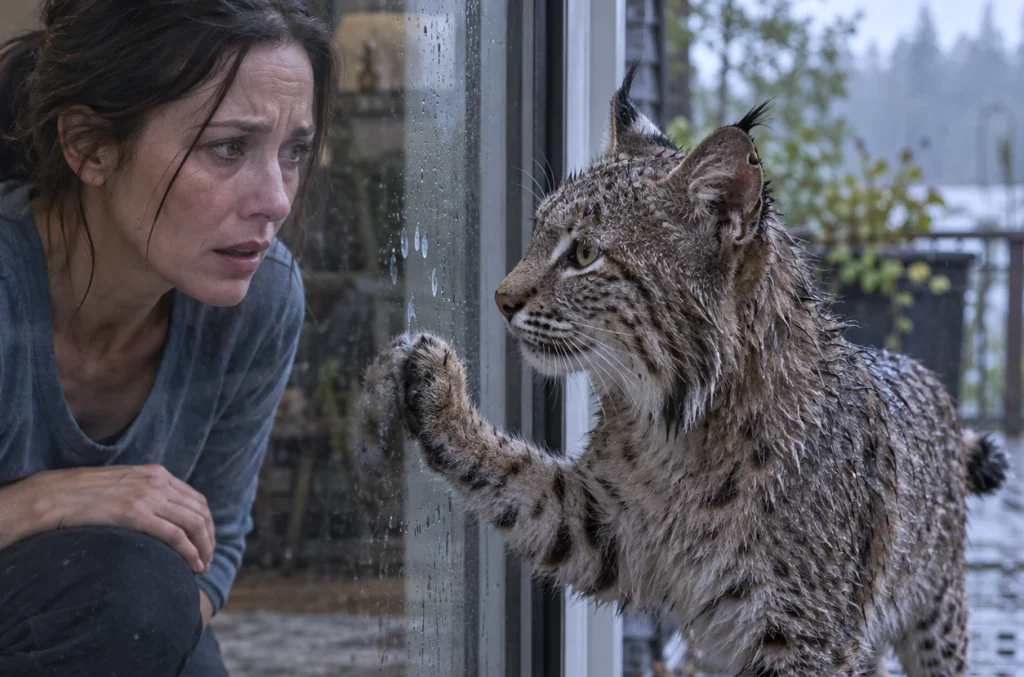
The bobcat knocked while Nora Ellis was cutting another photograph of her son out of a sheet of missing-child flyers. It was Tuesday; Owen had been gone since Saturday afternoon. By the third tap, she was out of her chair, saying his name. Beyond the sliding door stood a wet, spotted animal with its front paw lifted against the glass. A notch divided the tip of its left ear. Above the paw, at the height of a nine-year-old’s shoulder, Owen’s fingerprints remained from Saturday.
Nora had washed the dishes the search volunteers used, emptied their coffee, folded their damp towels.
She had left the glass alone.
Behind her, Cal struggled awake in the armchair. He had fallen asleep sitting forward, elbows on his knees, and one hand had gone numb. He shook it as he came toward her.
“What is it?”
The bobcat lowered its paw. Its nose moved along the seam where the door met the frame, near the corner Nora had scrubbed two weeks earlier. Then it raised its head and looked into the kitchen.
“It’s her,” Nora said.
Cal stopped beside her. “What do you mean, her?”
She wanted another second before answering. Through the glass, the animal seemed close enough to touch, its wet chest fur separated into dark points. It had something to do with Owen; for the first time since Saturday, something had arrived at their house instead of being taken away.
“Nora.”
“He fed it. I caught him feeding it.”
Cal looked at the small square of stone outside the door. A few sunflower hulls had washed down from the empty bird feeder, and the bobcat sniffed among them before turning away.
“When?”
“Two weeks ago. Maybe a little more.”
“And you told the deputy?”
She put the scissors on the table. She placed them carefully, blades together, as though someone might get hurt.
Cal waited. That was harder than if he had started shouting.
It had been an ordinary Thursday evening. Nora was finishing notes for the school occupational therapy team when she heard three taps behind her. Owen stood at the door in his pajamas, holding a saucer with scraps of raw chicken on it.
He had tapped on the glass before opening it. Out near the woodpile, something small and spotted had come upright.
Nora had caught Owen by the back of his shirt and pulled him away so sharply that the saucer broke. Afterward, with him crying at the kitchen table, she had explained about teeth, claws, animals that stopped being afraid of people. She knew how to give a frightened child one instruction at a time; she did it at work every day.
Then he had asked whether Dad would take away his trail camera.
“You stop doing this,” she had told him, “and we won’t need to have that conversation.”
She could still hear the relief in his little intake of breath.
Now Cal said, “Mara asked us what would get him to go past the creek. You were standing next to me.”
“I thought he’d stopped.”
“That wasn’t what she asked.”
On Saturday, she’d nearly told Mara. Then she’d looked at the notebook on the deputy’s knee and imagined the entry: mother knew, father not informed. It sounded like something she might read in a child’s school file, followed by a meeting nobody wanted to attend. She had said she couldn’t think of anything.
On Sunday she’d typed a message to Mara and erased it. Telling her then meant explaining why she’d already let them search a whole night without that detail. On Monday Nora had carried the phone from room to room, answering every call and still not making that one.
Outside, the bobcat passed through the gap beside the garden gate. It paused beneath the salal, one ear turning toward the creek, then slipped into the trees. Nora moved toward the door, but Cal put his hand on the latch.
“Call her. Right now.”
She wanted to say he was holding her in a room while their son was somewhere out there. Instead, she took her phone from beside the stack of flyers and called Deputy Mara Jensen.
Mara listened without interrupting. Nora gave her the feeding, the promise, the animal at the glass. She stopped saying once when she described what she had seen; once was only what she knew about.
“Which way did it leave?” Mara asked.
“Through our gate. Toward the old foot crossing.”
“Don’t follow it. A bobcat coming back for food isn’t a search dog. I’m on the lower road. I’ll be there in a few minutes.”
Nora gripped the edge of the table. “That crossing goes north.”
“I know where it goes. Stay there so you can show me exactly what happened.”
After the call, Cal went upstairs. He returned carrying a green daypack, and for an instant Nora thought it was Owen’s, that their son had somehow come back without them hearing him.
Then she saw it was Cal’s larger pack, the same color. Owen’s was still missing, along with the orange whistle clipped to its chest strap. Cal kept it stocked with a bottle of water, two granola bars, and an emergency blanket, even for short walks.
Cal packed water and two headlamps. His hands worked quickly, checking each light against his palm, and Nora remembered him doing the same thing before taking Owen to watch owls the previous winter. They had come home after midnight with no photographs and an elaborate story about a raccoon stealing a glove.
She had made Cal into the parent who would say no. It had helped her keep quiet.
“I should have told you,” she said.
He zipped the pack. “Get your boots.”
Mara arrived with Luis Ortega, a volunteer search leader whose truck Nora recognized from the school parking lot. He repaired the district’s boilers; she had once spent a fire drill helping him persuade a terrified first grader to leave her weighted blanket inside. Now he stood in Nora’s kitchen wearing a radio and muddy rain gear, looking at the stone outside the glass.
Nora showed them the place where Owen had put the chicken. Beyond the gate, Luis found several fresh rounded prints in the mud and older, less distinct impressions beneath the hedge. Mara asked whether Owen had talked about following the animal.
“He said there was a gray house,” Nora answered. The memory came with a sick, exact clarity: Owen drawing steam above a bowl of soup, asking whether animals had houses the way people did. “A little house where she went. I thought he meant a den.”
Luis glanced at Mara. “Survey cabin?”
“Could be.”
Nora knew the building. It stood beyond the creek on timberland her mother’s family had sold years before; as a child she had been warned away from its rotten floor. She had not been there since before Owen was born.
“The upper road was checked Sunday,” Mara said. “We’ve been through the land trust’s camera cards, too. Nothing showed him. We’ll try the creek approach. You two can show us the foot crossing. Stay behind Luis.”
Cal shouldered the pack before Nora could answer. At the gate, he caught her sleeve and pointed down at a length of wire half buried in the grass. She stepped over it, and he let go.
They did not see the bobcat again. Its prints followed the narrow strip of mud beside the creek, disappearing where roots made a rough stairway through the bank. Luis walked slowly enough to examine the ground; Nora had to keep stopping herself from crowding his back.
Rain dripped from the bill of Cal’s cap. Across the creek, ferns lay flattened beneath a fallen cedar, and the pale underside of a broken branch showed where someone had stripped away a handhold. Nora could picture Owen putting one boot in front of the other along that trunk, pleased with himself for being careful.
Luis crossed first. On the far side, he crouched over a patch of clay and held up one hand.
There was a small boot print beneath the overhang of a root. He photographed it with a scale from his pocket, then asked Cal about Owen’s hiking boots. Cal had bought them; he could describe the tread without seeing the picture.
Mara radioed the location. A team was coming from the logging road above them, and she told it to bring the rescue equipment down to the cabin.
“Is that his?” Nora asked.
“It could be,” Luis said. “Don’t step there.”
She obeyed. Her legs were trembling, and she pressed both palms against a cedar while Cal crossed behind her. He stood close enough that their shoulders touched, but neither looked at the other.
The old cabin was less than ten minutes uphill. Brambles crowded the porch, and a new padlock hung open from the hasp. Through the doorway Nora could see a cot, a camp stove, and a pair of rubber boots standing on newspaper.
On the porch rail lay a red knitted cap.
Nora made a sound that brought Mara around. She reached for the cap, then stopped with her hands above it while Luis photographed where it lay. It was folded, not dropped; someone had placed a stone on top to keep it from blowing away.
When Mara handed it to her, Nora turned the brim inside out. There was the crooked white O her mother had sewn into the wool. The last time Nora had seen that letter, Owen had pulled the cap on backward and complained that Grandma had made it itch.
“Somebody found him,” she said.
“Somebody found his hat,” Mara answered, but she was already moving into the cabin.
The room smelled of damp socks and instant coffee. Beneath a mug on the table lay a sheet torn from a field notebook, weighted so its writing faced the door. Luis lifted the mug and read.
“Boy alive. Below north washout, in the old culvert. Calling back to my whistle. Water coming through. Taking the maintenance path down to him. Phone lost in creek. Send rope team.”
Nora waited for the words to stop moving inside her head. Boy alive. She pressed the cap against her mouth and breathed through wet wool.
Mara took the page to the doorway to read it over her radio. Under the block lettering was a name, Daniel Shaw, and a rough sketch of the path beyond the cabin.
Nora knew that name.
Four months earlier, she had found it on three sealed envelopes beneath the desserts in her mother’s blue recipe box. Around them Vivian Reed had wrapped a strip of paper: For Daniel Shaw, my son, if he contacts you.
Nora had put the box in her locked desk. She had told Cal there was nothing left at her mother’s house that needed sorting.
He saw her looking at the signature. “What?” “Daniel Shaw.” “Who’s Daniel Shaw?” Nora held their son’s cap between them. “I think he’s my brother…”
To read the rest of the story – CLICK the NEXT button 👇👇👇