


Janice Bell had been paid to give the bull three weeks. Before he had all four feet off the trailer, she was afraid someone would use up his last chance in the next thirty seconds. He was coming backward, an enormous cream-colored animal with his head twisted toward the ramp. Each time the diesel engine shook the trailer beneath him, he braced harder against the side. The driver stood beyond the unloading fence, shouting for the bull to move.
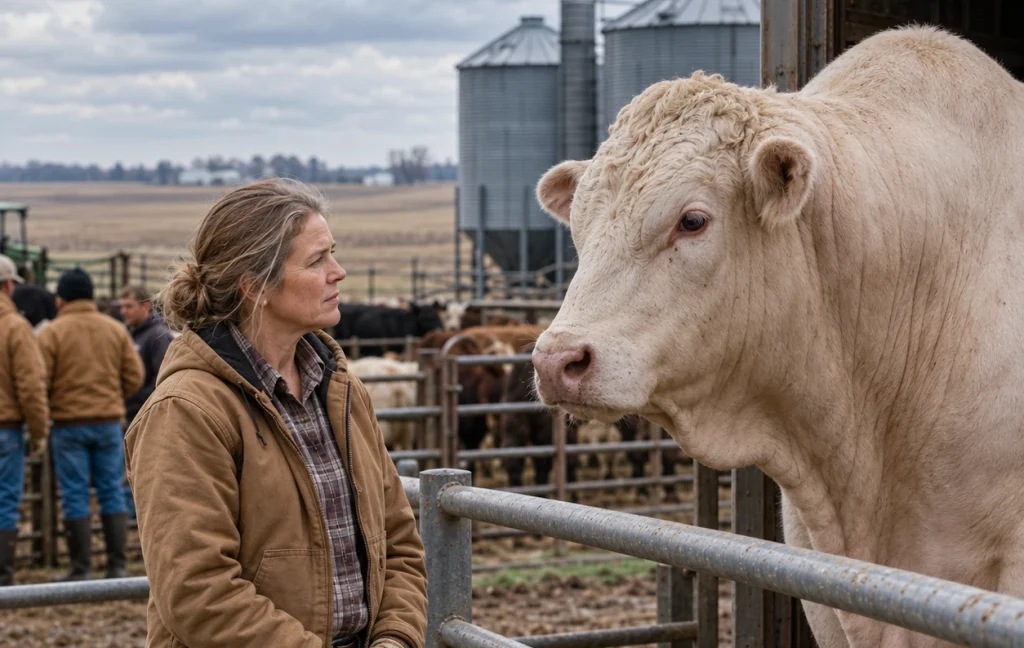
“Shut your truck off,” Janice said.
“He needs to move.”
“Your truck. Off.”
The driver looked toward Graham Talley, who owned the bull and had written the check in Janice’s shirt pocket. Graham nodded once. The engine died, and the animal stopped fighting the floor.
Janice kept her position behind the receiving pen’s heavy rails. She moved a few steps along the outside passage until the bull could see her without wrenching his neck, then stood still. He tested the ramp with a hind foot. Nobody spoke while he brought the other one down.
When he was finally in the pen, the driver closed the trailer gate from the protected side. The bull turned toward the water trough. A strip of dried blood showed beneath his right horn, where he had scraped himself during loading.
“Amos,” said the young man beside Graham. “That’s his name.”
His right wrist was in a brace. He held his jacket against his stomach with his good hand, although it was a cool September Monday.
“Danny Shaw,” Graham told Janice. “He was there when it happened.”
“I was the one it happened to.”
Graham glanced at him, then lowered his eyes to the clipboard. Janice took the jacket from Danny and held it while he worked his good arm into a sleeve; she left the other sleeve hanging rather than try to fit it over the brace.
“You didn’t have to come,” she said.
“Wanted to see where he landed.” Danny watched Amos drink. “Tell whoever feeds him to let him see the bucket first. Don’t reach around a post at him.”
She took the clipboard from Graham and wrote that on the care sheet. Danny noticed and stayed beside her long enough to spell his last name.
Amos was five, a Charolais cross weighing about twenty-three hundred pounds. He had broken through a handling gate at Crosswind Genetics ten days earlier, sending the gate into Danny. Two attempts to load him afterward had ended with damaged equipment and frightened men.
Graham had authorized three weeks of boarding and assessment at Bell Receiving Yard. At the end, Amos needed a workable placement approved by the veterinarians involved. Otherwise, Graham intended to have him put down; he would not send him through an auction and leave the next crew to discover his problems.
Janice had argued with that last sentence on the telephone. Looking at Danny’s swollen fingers, she found less to argue with.
“No breeding promises,” Graham said. “No photographs with somebody’s grandkids. I’ve had enough people tell me he’s a big sweetheart.”
“I didn’t tell you that.”
“You told me you could handle him.”
“I told you I had a pen strong enough to hold him while we found out.”
She had been more confident on the phone.
At fifty-nine, she still disliked the sound of uncertainty in her own voice, especially when money was involved.
The yard sat south of Salina, far enough from the interstate that overnight haulers had begun choosing easier stops. Janice kept four receiving pens open, leased the pasture behind them, and did the work herself with occasional hired help. Graham’s payment would carry the yard through the month when the insurance and property tax both came due.
Beyond the receiving pens stood the old handling alley. A red swing gate was chained against its post, and weeds had rooted along the concrete curb. Janice’s son Luke had died in that alley seven years earlier. Nothing had passed through it since.
Graham looked in that direction without asking. Janice signed the receipt, making sure her hand did not hesitate where he could see it.
After the trucks left, Amos walked the perimeter of his pen. His hide was cream on the ribs and the color of old flour sacks along his shoulders. He examined the trough, nosed a tuft of grass outside the bottom rail, and kept returning to the corner that gave him the widest view of the yard.
Janice went inside to call her daughter. She had already left a message about the assessment, but this time she used the number she generally saved for birthdays and things that could not wait.
“I need you to look at something,” she said when Mara answered.
“Your wrist again?”
“An animal.”
There was a pause. In the background, somebody asked for another towel, and Mara said she would be right there.
“Send me the paperwork. I’ll call when I’m finished.”
“He’s here now.”
“Then you should have called before now.”
Janice looked through the office window at the bull. “Yes,” she said, but Mara had already gone back to work.
Her daughter arrived that afternoon in a dusty clinic truck. Dr. Mara Bell was thirty-seven, with a sunburned part in her hair and a way of taking in a whole work area before touching anything. She parked outside the loading route, checked the gate latches, and only then looked at her mother.
“Your message said temporary boarding.”
“It is.”
“It left out the injured employee.”
“I sent his name with the file.”
“After you signed.”
Janice had set two cups on the office table.
Mara left her bag on the porch bench instead, and Janice pretended she had forgotten about the coffee.
They still spoke. Mara reminded her about appointments; Janice dropped vegetables on her daughter’s back step when the garden produced more than she could use. But Mara had not entered the yard in almost a year, and when she came to the house, she parked facing the road.
Now her eyes reached the red gate. She hooked a thumb beneath the strap of her bag and pulled it tight against her shoulder.
“He won’t go through there,” Janice said.
“I know where your loading dock is.”
“We’ll work that out if we get that far.”
Mara looked at her. “That’s what I’m worried about.”
For a while they watched Amos from the outside walkway. Mara asked about his appetite, his manure, whether he had favored a leg, and how the scrape had looked on arrival. Janice answered without embellishing. This part they could still do together.
A gust lifted the metal lid of the empty feed bin. It dropped with a crack that made Janice’s shoulders jump, but Amos went on pulling hay from the feeder. He did not so much as turn an ear.
“Has he been doing that all day?” Mara asked.
“Not reacting? Yes.”
Mara moved along the walkway until she was outside his view. She spoke at an ordinary volume, then more loudly; Amos kept eating. When she came around the post where he could see her again, he lifted his head immediately.
“He might be hearing very little,” she said.
Janice thought about the driver shouting into the trailer. “That’s why shutting off the truck helped.”
“It stopped the floor moving. We know that part.”
“And Danny told me to show him the bucket.”
“Let’s keep those observations. Don’t make them a diagnosis yet.”
They needed to move him into the adjoining pen to clean beneath the feeder. From the protected side, Janice opened the connecting gate fully and secured it. Mara waited farther along the outside passage, plainly visible beyond the opening, while Janice gave Amos room to approach.
He stopped where sunlight ended beneath the roof. His muzzle lowered, and one forefoot hovered over the change in color. Janice reached for the blue sorting cloth hanging on a hook, then checked herself; waving something behind him would add nothing he could use.
“Bring the hay around,” Mara said. “Let him look.”
They gave him time to examine the opening. When he stepped through, they waited until his hindquarters were clear before closing the gate. There had been no rush, no impact, no one climbing a fence to escape him.
Janice felt the relief in her knees. She had seen that much weight move quietly thousands of times, but she had not expected to be grateful for it in quite this way.
Mara began a temporary care sheet on the porch bench. She wrote down what they had observed and left the cause of his behavior unanswered. Before adding her name, she drew a line beneath the feeding instructions.
“Nobody goes in with him. No close handling until we have the right equipment and another veterinarian involved. Including you.”
“I heard you.”
Mara’s pen stopped. She looked toward the old alley, then put the cap on with more care than it needed.
“Luke asked you to shut that gate down.”
Janice could have walked inside. She had done some version of that for seven years: a kettle to fill, a telephone to answer, something too urgent to leave alone. Instead she remained beside the bench.
“He said the post was moving,” she answered. “I told him we’d finish the load and look at it.” Mara raised her eyes from the unsigned page. “When the investigator asked about that warning, what did you tell him?”
To read the rest of the story – CLICK the NEXT button 👇👇👇