


The bull tried to stand while Lydia Bell was counting the dents in a used feed bunk. She heard his hoof scrape concrete, then a heavier sound, and turned in time to see his shoulder strike the pen rail. Beside her, Sadie stopped chewing the peppermint she had taken from the auction office. The black animal lay with one foreleg folded awkwardly beneath him. His other leg kept working, as though the floor might change if he tried it from a different angle.
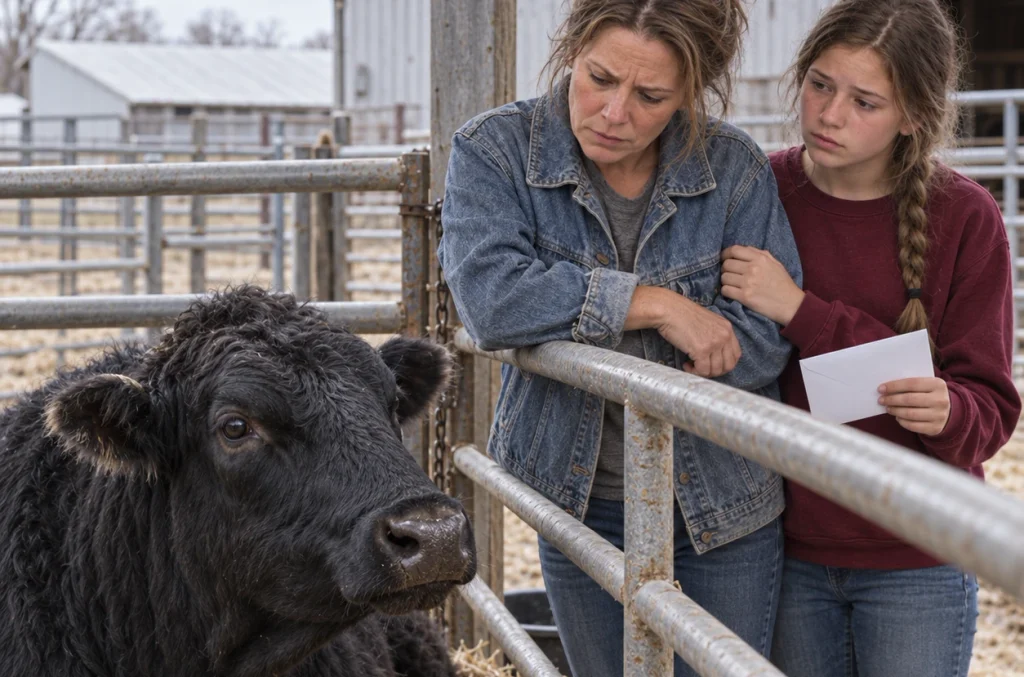
“Stay here,” Lydia said.
Her fourteen-year-old daughter caught the sleeve of her coat. “Mom. We made a list.”
Lydia still had it in her pocket. Sadie had written FEED BUNKS, GATE HINGES, NOTHING THAT EATS on an envelope, then tucked their equipment money inside. They had spent the drive to the estate sale arguing over whether a gate that dragged in mud was worth fifty dollars if the hinges came with it.
Now Lydia could see the bull’s ribs through his winter hair. She handed Sadie the envelope and walked toward the pen.
Dr. Ruth Carver was already inside, keeping to the open space beside the gate. Lydia knew the set of her shoulders. Ruth had worn that expression the March they lost a calf after working on its mother until both women were wet to the elbows.
“Can you do anything?” Lydia asked.
“I’m doing it. Give him some room.”
Ruth had the yard crew move people back. Once the alley was quiet, the bull stopped scrambling and settled on his chest. The veterinarian crouched at a careful distance, watching his breathing before she went closer.
The farm outside Belleville had belonged to a man whose equipment Lydia recognized better than his face. His tractor had always looked serviceable from the road. The cattle had been kept beyond a rise, out of sight, and the hired hand helping with the sale said they had found this bull in a separate lot with an empty feeder.
“Don’t know how long,” he added.
Lydia looked at the animal’s hollow flank. She knew what a week without enough feed looked like. This had taken longer.
Warren Haskell came up the alley carrying a rolled sale sheet. His own cattle trucks stood along the road, clean enough that the yellow company lettering showed through the dust. Lydia had watched him buy a trailer load of bred heifers without checking his account balance once.
“He isn’t going through the ring,” Ruth told him.
“Good.” Warren turned to the young man at the gate. “And nobody runs a chain under him. Find Carver the bedding she asked for.”
The young man left at a trot. Warren stayed, and Lydia wished he wouldn’t. There were people she could be uncertain in front of, but he had a way of making hesitation feel like evidence.
“You buying a bunk?” he asked.
“Maybe.”
He glanced toward Sadie, who was standing where Lydia had left her. “That one by the loader has a split underneath. Check it before you bid.”
Lydia nodded. It was useful advice, and she resented having to be grateful for it.
Ruth finished her examination and came out to wash her hands. There was a treatable problem in one front foot, she said, along with dehydration and a great deal they couldn’t know yet. She had started supportive treatment. The bull would stay where he was while they assessed whether he could rise and remain standing without being forced.
“If he can’t?” Lydia asked.
Ruth dried her fingers on a paper towel. “Then I won’t leave him here hurting.”
The auction went on around them. Someone started a compressor; a man in a seed cap bought a box of sockets. Sadie came over and slipped the envelope back into Lydia’s pocket without speaking.
They ate hamburgers from the church stand at a folding table beside the machinery shed. Lydia tore her bun into pieces and kept looking toward the cattle pens. Sadie noticed, because Sadie noticed anything Lydia hoped she wouldn’t.
“Could somebody take him?” she asked.
“If Ruth thinks he can travel.”
“Somebody with an empty pen.”
Lydia looked at her daughter. Sadie had mustard on her cuff and a chess problem drawn on the back of her sale program. She had spent half the morning explaining why Lydia’s plan to trade a rook for two pawns was terrible, even if the rook was irritating her.
“We have an empty pen,” Lydia said.
“We have an empty well account, too.”
“It isn’t empty.”
Sadie waited, but Lydia took another bite instead of telling her the balance.
By late afternoon, the bull had stood twice. The first attempt ended with him kneeling in the fresh bedding; the second left him upright, shaking, with his weight spread unevenly across his feet. Ruth kept the alley clear while he drank.
Lydia watched his throat work. When he finished, he lowered his nose into the empty tub again and nudged it, very slightly, toward the woman holding the hose.
The estate representative was willing to transfer him for a hundred dollars to someone Ruth considered capable of providing care. He would remain overnight, and nothing would be final unless Ruth cleared him to travel in the morning. There would be no promise about breeding, recovery, or any use beyond that.
“I’ll take him,” Lydia said.
Sadie looked up so quickly her hair caught in the zipper of her coat. Lydia reached to free it, but the girl did it herself.
Warren folded his sale sheet. “Carver’s first bill will cost more than the bull.”
“I know what a farm call costs.”
“Then add the next six.”
Two men behind him chuckled. Warren didn’t join them, though he didn’t look around either. Lydia could feel the heat climbing her neck.
“You bought enough today,” she said. “You can leave me this one.”
His expression changed. “This isn’t a contest, Lydia.”
She knew that. She also knew she had just made it one.
Ruth took her aside before accepting the arrangement. She asked about the isolation lot, the fencing, the trailer Lydia intended to use. Then she asked about money, and Lydia gave an answer that was technically true.
“I can pay you.”
The veterinarian watched her for a moment. “For today’s work and tomorrow’s visit, yes. What about a month from now?”
Lydia said she understood. She did not ask what the first week might cost.
They drove home with no feed bunks, no hinges, and the auction envelope lying unopened between them. Halfway down the county road, Sadie asked whether there was enough left to fix the north well if it quit.
“I’ll handle the well,” Lydia said.
That satisfied neither of them, but Sadie turned toward the window. Lydia drove the rest of the way with her daughter’s reflection beside the darkening fields.
In the morning, Ruth cleared the bull for the short trip. Lydia borrowed a low stock trailer, checked its floor, and bedded it deeply. He loaded slowly through a narrow, quiet alley, with pauses that nobody tried to hurry.
At home, Sadie had opened the gates along the planned route and put water beside the old calving shed. Their herd stood beyond a separate fence, curious about the trailer. Lydia checked the latches again before releasing the rear gate.
The bull came down carefully, favoring his front foot. At the turn into the lot he took two short steps, shifted sideways, and stopped.
“Knight,” Sadie said.
Lydia kept her eyes on the gate. “What?”
“Two forward and one over. Like the chess piece.”
“He’s got a sore foot.”
“I know. He still needs a name.”
Lydia swung the gate shut after him. Sadie worked the chain through its keeper, and for a few minutes they had a job they could do together without anything else getting in the way.
Knight stood over the water, too tired to drink at first. His right ear had an old split along its edge, with a broken yellow tag hanging behind it. When he finally lowered his head, Sadie let out a breath Lydia hadn’t realized she was holding.
They watched from outside the rail while he drank. Afterward he pulled a mouthful of hay from the rack and chewed it, dropping some of the stems. Sadie picked those up through the gap with a rake, kept her hands clear, and laid them back within reach.
Ruth returned that afternoon. She treated the infected foot, collected the samples she needed, and left written instructions for feeding and observation. Lydia read the sheet while the veterinarian put her equipment away.
“Small changes,” Ruth said. “Don’t try to undo months in a weekend. And call if he stops eating, can’t rise, or looks worse. Don’t wait because you think I’ll charge you for bad news.”
Lydia folded the instructions. “What if he never gets much better than this?”
“Then we talk about what’s fair to him.”
The first bill came to six hundred and eighty-four dollars. Lydia had expected a large number, but expectation hadn’t prepared her for the separate lines: examination, fluids, treatment, tests. Ruth had already reduced two charges.
Lydia took out the checkbook she used for the farm. The money in the equipment envelope would cover supplies and the bull himself; the rest had to come from the small reserve they had spent the summer building for the north well.
Sadie stood beside the freezer, cleaning the red coffee can she meant to use for measuring feed. Lydia set the bill facedown before writing the check.
“I saw it,” Sadie said.
“I wasn’t hiding it.”
Her daughter dried the can and put it on the shelf. Outside, Knight bumped the hay rack with his nose, and the sound carried into the suddenly quiet shed.
“How much is left for the well?”
Lydia kept her pen against the paper. She could have answered, but she was still trying to find a number that wouldn’t change her daughter’s face.
Sadie reached across the freezer and turned the bill over. “Mom. How much?”
To read the rest of the story – CLICK the NEXT button 👇👇👇