


The bobcat was standing where Paul’s wife used to empty the dirt from her shoes. It watched him come down the mown path with his tool bucket, then opened its mouth and made a small, broken sound that stopped him before he reached the shade. Paul Harlan had seen the female twice that week. Usually she disappeared before he could get his glasses settled. This morning she stayed beside the fallen chestnut, her short tail twitching, while something answered from the drainage ditch below her.
He set down the bucket.
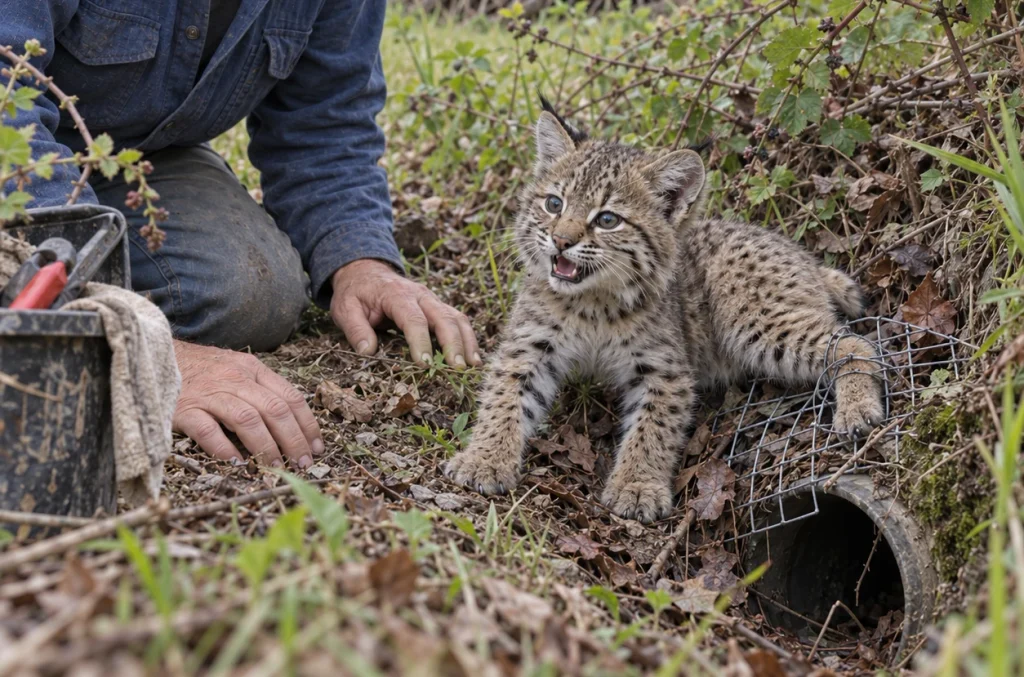
Under the blackberry canes, a spotted kitten was hanging sideways against a square of wire he had fastened over the drain the previous November. Its front paws could reach the dirt; its left hind foot could not come free.
Paul started down the slope, and the mother flattened her ears. He stopped with one boot below the other, feeling the loose ground shift beneath his heel.
“All right,” he said. “All right.”
He climbed back to the path. The kitten pulled again, and the wire gave a little metallic tick.
For thirty-four years, Paul had maintained boilers and ventilation systems at a community hospital outside Roanoke. Now sixty-six and retired, he could still identify a failing bearing by sound. There were cutters in the bucket.
But the fur around the kitten’s ankle was dark with blood. The cut wire ends were bent inward exactly as he’d left them.
His daughter called while he was searching his phone for wildlife help. He dismissed the call and sent a message saying he was outside. Tess was coming that morning to sort out the roof payments and price the lumber for the porch steps; she replied with a photograph of two coffees in her cup holders.
Paul nearly typed, Something’s happened.
Instead, he found a permitted wildlife rehabilitator through the state wildlife agency’s directory. The woman who answered asked him to describe the animal, the wire, and where the mother was standing. Her name was Audrey Lane, and she said she could be there in about forty minutes.
“Don’t try to hold it,” she said. “Even if it gets quiet. Especially don’t decide that quiet means it’s all right.”
He told her he had cutters. She asked him to bring them to the shed and wait there, away from the ditch.
From the shed doorway, he watched through binoculars. The mother approached the drain twice, then retreated when the kitten struggled. Three other kittens emerged from beneath the chestnut; one climbed over a root and fell against another, which slapped at it without getting up.
He had first seen the litter twelve days earlier.
He hadn’t mentioned it to Tess, though she called most evenings and always asked what he’d been doing. The lower meadow had belonged to his mornings with Marian, before the hospital bed came into the living room and before he learned how much a house could sound like a refrigerator.
Tess found him sitting on an upturned feed bucket. She followed his gaze before asking a question, and he was grateful for that until she said, “Is that your wire?”
“I put it there to keep leaves out.”
She crouched beside him and took the binoculars when he offered them. Her coffee remained on the workbench, the cardboard sleeve darkening where it had splashed.
“I called someone,” he said.
“Good.”
She turned the binoculars back toward the ditch. Paul sat with his hands flat on his knees.
Audrey arrived in a white van with a cracked rear taillight. She studied the ditch from the shed, asked Tess to show her the way around the mother’s position, and returned to the van for equipment. Paul noticed that she checked the carrier latch twice before lifting it out.
“She’s going to want the others away from us,” Audrey said. “We give her room to do that. Nobody follows her into the trees.”
Paul picked up a plywood panel Audrey had brought. His knee caught as he straightened, and Tess took one handle without asking. Together they carried it to the edge of the ditch while Audrey brought the carrier and a thick towel.
The mother slipped behind the chestnut. Paul could still hear her, low in her throat, and saw the grass move as the other kittens followed.
Audrey positioned the panel on the uphill side, with Tess holding it steady. Paul knelt at the drain while Audrey covered and controlled the trapped kitten. He had spent the wait imagining one clean cut followed by a small animal racing back to its mother.
Up close, the wire had folded around the ankle in two places. He opened the cutter jaws, found no room for them, and had to turn the tool over in his hands.
“That loose section,” Audrey said. “Let me see where the blade is.”
He adjusted the cutters. His hands were steady until the kitten cried under the towel; then he paused, jaw clenched, and waited for Audrey to say he could continue.
The strand broke. Audrey shifted her grip and showed him the second place, farther from the leg than he would have chosen. When the opening was wide enough, she eased the wire away rather than pulling the foot through it.
The kitten sagged against the towel.
Paul set the cutters down so carefully that they made no sound.
“Open the carrier,” Audrey told him.
He did, and she settled the animal inside. A moment later, a small paw struck the door hard enough to rattle it.
Tess let out a breath.
Paul looked through the openings and saw two angry eyes and a pale patch behind the kitten’s right ear, no bigger than the head of a roofing nail.
“That’s better,” Audrey said. “It doesn’t tell us enough, but it’s better.”
She covered the carrier and secured its door. The mother called from the trees, and the kitten answered from beneath the cloth.
Paul reached toward the cover, then stopped. “Can’t we put her beside the log? Let her mother have her?”
“She needs a veterinarian. I can’t tell you how much damage there is by looking through a towel.”
“But if you take her away—”
“I know. That’s why I want to go now.”
Tess moved the plywood back from the ditch while Paul helped Audrey carry the crate uphill. The weight inside shifted once, surprisingly slight. He shortened his steps to match Audrey’s, keeping the carrier level each time they crossed a rut.
At the path, Audrey stopped to get a better grip. “Where did you first see them?”
He pointed to the chestnut. Its roots had pulled free in a storm years before, leaving a hollow protected by the trunk and a tangle of mountain laurel. Marian used to sit on the upper side, where the wood was smooth, and knock her gardening shoes together over the grass.
Audrey looked at the pink survey flag beside it. “Is somebody working down here?”
Paul followed her gaze. The flags weren’t around the chestnut; they made a line toward it, down through the opening where the slope was gentle enough for machinery.
“Timber,” he said. “A selective cut.”
Tess stepped off the path to see past the laurel. Under the raised trunk, a kitten’s face appeared, then another. The mother stood behind them, almost invisible except for her ears.
“Dad,” Tess said. “That’s the route on the map.” The haul road Joel Tanner would start using Monday went straight through the hollow. Four thousand dollars of the timber advance was already in the roofer’s account…
To read the rest of the story – CLICK the NEXT button 👇👇👇