


Cora Lane knew somebody had been through the lower gate because it was hanging square. She always lifted the sagging end with her knee and let it drop behind her. Cora had left the padlock open when she went to work. Beth had wedged a flat stone under it, the way she had been asking Cora to do since Easter.
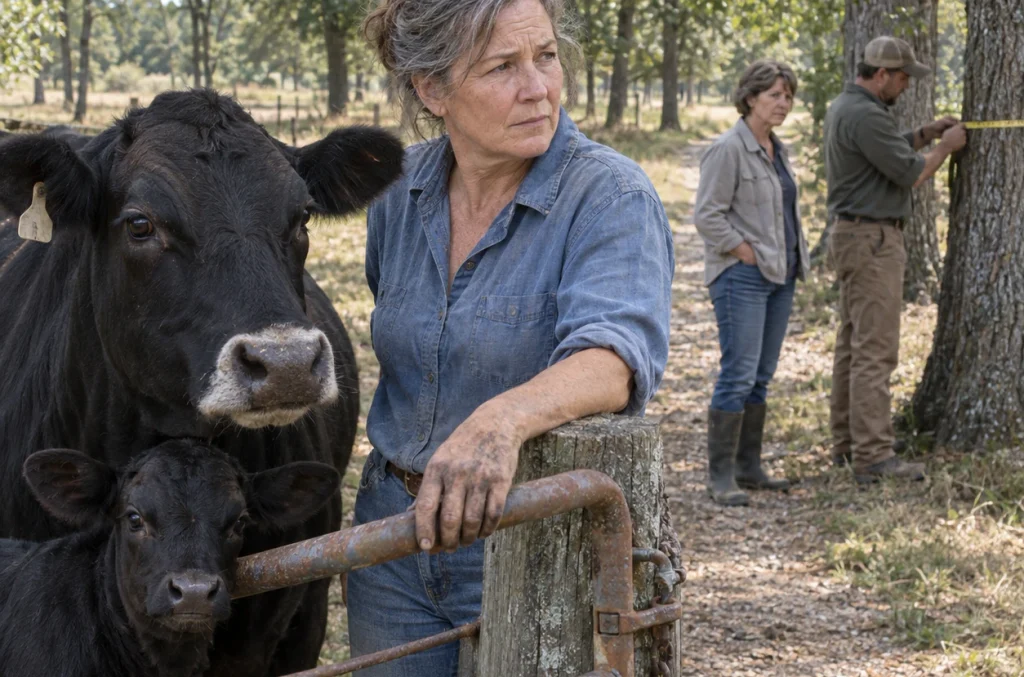
Beyond the gate, her sister stood beside a man carrying a diameter tape. He had stretched it around one of the trees Cora had spent six years making room for. Twelve cows and their calves waited across the lane, where the July sun was already climbing their black backs.
“I asked him for a number,” Beth said.
Wade Fisher released the tape and held out his hand. Cora knew his truck from town, the lettering almost worn off the door. She shook with the hand that didn’t have a split across the knuckle.
“Nothing’s agreed,” he said. “I’d need both owners signing before anything moved.”
Beth kept her eyes on Cora. At fifty-three, she still had the habit of tightening her mouth before she said something their mother would have disliked. Cora, four years older, still responded by preparing an answer before she heard it.
“This is working pasture,” Cora said.
“Then show him.” Beth stepped away from the tree. “You keep telling me that. Show him what it earns.”
Cora had come straight from the school-bus garage with grease worked into the creases of her wrists. August inspections were coming, and she had spent the morning under a bus whose brake line rubbed where it shouldn’t. There had been a place she could point to, a part she could replace, and nobody asking whether she had considered leaving it alone.
She hung her work shirt on a fence post. On the neighboring hillside, a tractor pulled a small cloud of dust behind a load of hay. Most years the second cutting in Virginia’s Floyd County was worth waiting for. This year people were checking what they had left from the first.
“Eight acres,” Beth told Wade. “There’s more woods uphill, but this is the piece we can get equipment into.”
Cora looked at her sister’s shoes. Beth had changed out of the sneakers she wore managing the grocery store and into their mother’s old rubber boots. The left one still folded at the ankle. She had driven home for boots before bringing this man to the farm.
“The other woods are too steep,” Cora said. “And this piece has water and cross-fencing.”
“I noticed the trough.” Wade glanced between them. “I can give you a written estimate. You don’t have to decide with me standing here.”
He moved toward the lane, pausing to close the cattle gate behind him. Cora watched him check the chain instead of merely draping it over the post. She would have preferred somebody careless enough to dismiss.
Beth pulled a flattened paper bag from her jacket pocket. Inside was a sandwich wrapped in waxed paper, the bread dented where she had gripped it. She offered it without meeting Cora’s eyes.
“You won’t have eaten.”
Cora took it. Pimento cheese, with the crusts still on because Beth said anybody old enough to complain could make her own sandwich. Cora wanted to thank her, but her mouth was full and Beth was already looking down the lane.
Their mother had left them the eighty-six-acre place in equal shares eight years earlier. Cora lived in the farmhouse, paid rent into the farm account, and did the daily cattle work before and after her garage shifts. Beth handled the bills and worked here on Sundays, although lately she had begun calling before she came.
They had agreed that anything beyond routine repairs needed both of them. It had sounded easy when the farm account held the proceeds of their mother’s last calf crop. They had made the rule at this very gate, with Beth holding it up while Cora searched her pockets for a hinge pin.
Across the lane, Midge rubbed her broad face against the corner post. The oldest cow had a pale ring around her muzzle and one ear tag curled from years of catching on brush. Her calf stood tucked against her shoulder, using the shade of her body.
“Let me move them,” Cora said. “Then we can talk.”
She opened the lane to the lower pasture. Midge came first, unhurried, the others following through the gap and spreading among the trees. Beth stepped back with the empty sandwich bag pressed against her thigh.
The place had been a tangle when Cora started. She had worked with a forester to take out selected trees in stages, clear dangerous limbs, and leave enough light for grass. Establishing forage had taken seasons, and the first fence had been wrong. She had paid to move it after the cattle wore a path into a wet corner.
People in Wren Hollow had called it her cow park. At the feed store, somebody once asked whether admission included a picnic table. Cora had laughed with him and then left the salt she had come for sitting on the counter.
Beth had helped stretch the replacement fence. Cora remembered her sitting in the grass, trying to pull a staple from her boot sole, laughing so hard she couldn’t hold the pliers. That was before the lower pasture became something they discussed in careful voices.
The cows passed between trunks into a patch of broken shade. There was grass here, thinner in some places than Cora wanted, but it had been rested while they grazed the upper paddock. She watched Midge lower her head, take a mouthful, and move on without crowding the calf.
Beth followed as far as the trough. She dipped her fingers into the water and wiped them on her jeans. A fly settled on the calf’s eyelid; Beth brushed it away, then held still when the calf leaned forward to smell her hand.
“He remembers your pockets,” Cora said.
“There were never treats in my pockets.”
“There was an apple once.”
Beth almost smiled. The calf lost interest and turned back to Midge. Overhead, a strip of sun shifted off Beth’s face, and for a moment Cora could see her sister noticing the relief.
“Nell asked again about buying pairs,” Beth said. “When I ran into her Tuesday.”
“Nell’s been asking since May.”
“She’s got that leased bottom field for another three years. She wants four. You told me you were thinking about it.”
Cora bent to straighten the trough’s float guard. She had been thinking about it in the way she thought about replacing her own kitchen floor: examining the problem whenever she could avoid doing anything. Nell Avery knew cattle, and her place was nine miles away. Neither fact made Cora want fewer cows.
“Look at them,” she said. “You can’t get this back by calling somebody with a truck next July.”
Beth watched the herd settle. She stayed long enough that Cora let herself hope the estimate would remain an envelope neither of them opened.
“I can see what the trees do,” Beth said. “I could see it last summer.” She rubbed a crease out of the empty bag. “Then tell me where the tractor money went.”
To read the rest of the story – CLICK the NEXT button 👇👇👇