


Ruth Hensley was peeling the Sutter Coach decal off bus nineteen when something dragged across the floor inside. She stopped with a curl of blue vinyl stuck to her thumb. The auction driver beside her lowered his clipboard, and they both listened to the small, uneven scraping behind the blackened windows.
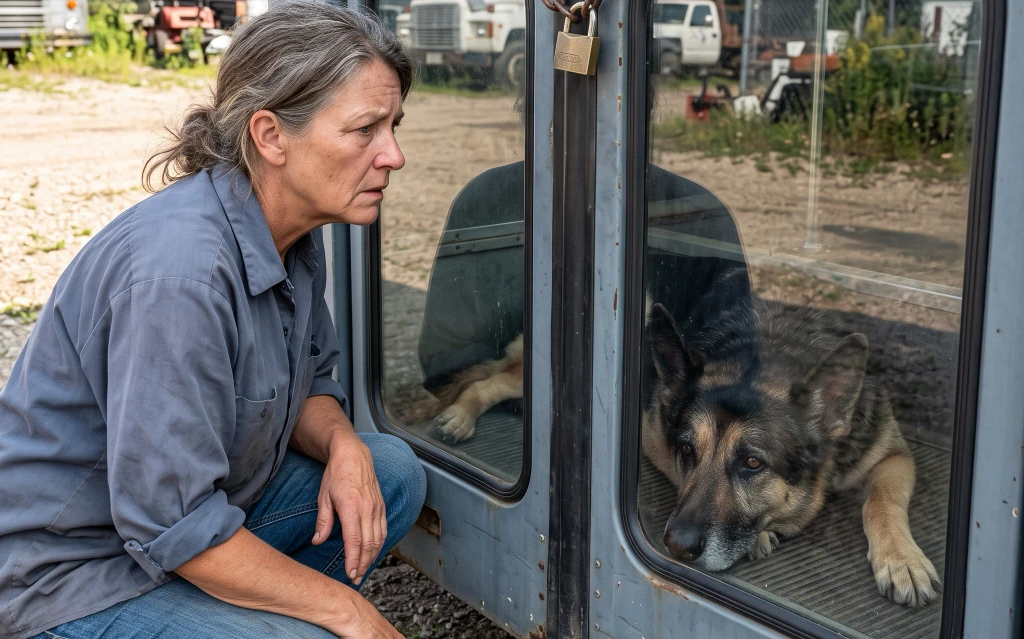
“Loose seat?” he asked.
The seats had come out Thursday. Ruth had stacked their cushions herself, turquoise faces together to keep the sun from bleaching them. She went around to the folding passenger door and pulled the handle, but the two leaves held against a length of chain looped through them.
Through the bottom pane she could see a tan paw.
“Tuck?” She bent until her knees complained. The German Shepherd lay in the stripped aisle with his nose against the rubber door seal, panting so hard his sides barely seemed to fall between breaths. A shallow plastic tub lay on its side behind him.
On Friday, Owen Keene had asked her to check his dog. Ruth had been carrying a stack of invoices into the office, her phone squeezed between her ear and shoulder. She had said of course, finish what the doctors needed to do, don’t worry about this place.
She dug for the yard keys. The key for the chain’s little brass lock was missing from the ring, and a piece of clean wire held the tag that used to carry it. Her hands began to move too fast.
“Lou,” she said to the driver. “Call the animal hospital. Tell them we’ve got a dog in a hot bus.”
Lou Salazar set down his clipboard. He had driven Sutter’s airport run until his knees made the luggage impossible; now he was helping move the last vehicles to their buyers. He took out his phone without asking why there was a dog in a bus that Ruth had marked cleared.
At fifty-eight, Ruth had spent thirty-one years repairing seats for Graham Sutter. She knew which frames would split a new cover and which passengers had used a cigarette to find out whether vinyl really resisted fire. Nineteen had spent its last winter carrying factory workers along the river, and she knew its rear emergency door had a handle you had to lift before turning.
She ran around the bus and lifted it.
The door opened into a breath of trapped heat. Tuck tried to rise at the far end of the aisle, got his front feet under him, and sank again. Ruth started toward him, then stopped when he drew back his upper lip. The movement cost him another hard breath.
“Stay there,” she said. “I’m coming slow.”
Lou brought the phone around, the veterinary technician’s voice thin on speaker. Ruth answered the questions she could answer. Yes, he was conscious. No, she couldn’t get him to stand. She did not know how long he had been shut in.
The last answer made her look away from the dog.
They opened the windows that still worked. Following the technician’s instructions, Lou brought water from the wash bay while Ruth cleared a folded cargo blanket out of the rear doorway. Tuck’s head followed the water, but he couldn’t manage the distance to it. She laid her hand on the floor within his reach, fingers curled so he wouldn’t mistake them for something being offered.
Whenever Owen delivered seats, Tuck came with him and stole the warm place beneath her sewing-machine motor. He used to leave before she could step over him, as if getting in the way had been an accident on both their parts. Now he pressed his nose against the knuckle she had broken shutting a trunk lid when she was nineteen.
“There you are,” she said, and her voice came out wrong.
With the hospital still on the phone, they worked him toward the open rear door. Lou brought the long board used for sliding luggage, and they supported Tuck onto it without making him walk. Ruth could feel the dampness of his breath against her wrist. He made one low sound when they lifted, then lay still while they carried him into the wash bay’s shade.
Lou’s station wagon was parked outside the gate. He started it and brought it close, the air conditioner running, while Ruth stayed beside the dog. She kept expecting somebody to come out of the office and explain where the water had gone, who had closed the door, what part of this she had misunderstood.
Graham appeared as Lou lowered the back seats.
He was wearing the pale blue shirt he saved for customers, with a new sweat mark below the collar. He saw the open emergency door and stopped. Then he came over quickly enough that Ruth thought, for a moment, he was going to kneel beside her.
“Let me get the front end,” he said to Lou.
“I’ve got it.”
Graham held the wagon’s hatch while they loaded Tuck. He took a rag from his pocket and put it over the projecting latch so Ruth wouldn’t strike her head. He had been doing small things like that for her for most of her working life.
“I thought he was gone,” she said.
Graham looked at the dog, then at the yard. “So did I.”
“Who was coming?”
“Get him seen first. We’ll sort it out.”
Ruth got into the back beside Tuck, with one knee against a toolbox that Lou hadn’t had time to remove. She left her van, her invoices, and the half-peeled decal where they were. Graham said he would follow them, but Lou had already started toward the road.
Bellwether, Wisconsin, was small enough that Ruth usually met somebody she knew at every stoplight. That morning she saw nothing beyond the backs of Lou’s hands on the steering wheel. Tuck’s ear lay over the corner of her shoe; she watched it move each time he took a breath.
Friday came back in unfinished pieces. Owen calling from a hospital room after the crash that had crushed his left hand. Graham putting Tuck in nineteen while the loading crew moved equipment through the yard. The bus had been standing open then, and the dog had jumped in when Graham tossed his bed inside.
Later, Graham had told her he’d found somewhere to take him. Somebody would pick him up Saturday. She had been relieved enough to ask whether the people needed his food, and Graham had said it was handled.
She had not gone back to look.
At Bellwether Animal Hospital, two staff members met the wagon with a stretcher. Ruth stood in the entry until a woman in green scrubs asked her to move so they could get through. Lou touched her elbow and guided her to a chair beneath a photograph of a yellow dog swimming with a tennis ball.
Dr. Elise Navarro came out after what might have been ten minutes. Tuck was receiving emergency treatment, she said; she was concerned about heat injury and dehydration, and they needed to monitor him. Ruth asked whether he would live. The veterinarian told her she couldn’t answer that yet.
“He’s Owen Keene’s,” Ruth said. “Owen’s in the hospital.”
“Can you reach him?”
She could. His number was still near the top of her calls, above a man asking if she could make a boat cushion cheaper if he supplied the foam. She looked at it while the receptionist placed an intake sheet in front of her.
Graham arrived carrying her purse. He had taken it out of her unlocked van, remembered that she would need it, driven it across town. He set it beside her and pulled up a second chair.
“How’s he doing?”
“They don’t know.”
Graham rubbed both hands over his knees. He smelled of the peppermint gum he chewed when he was trying not to smoke. The sheet asked when Tuck had last been seen well, and Ruth wrote Friday before she could persuade herself to be less exact.
“He was all right when I left,” Graham said quietly.
She kept the pen against the paper. “When was that?”
“Friday. But somebody could have been through.”
“Who?”
He leaned closer, lowering his voice as the receptionist answered another call. “Ruth, if you put Friday, they’re going to ask why you didn’t come back either.”
To read the rest of the story – CLICK the NEXT button 👇👇👇