


Diane Ruiz set a paper cup beside Hannah Cole and asked when she had last eaten. Hannah had two fingers beneath her son’s foot, waiting for his toes to curl. She wanted to answer after he did it.
“He’s coming to talk, isn’t he?” she asked.
The nurse glanced at the empty chair. That was enough. Hannah moved the photograph off its seat: Owen at three months, one fist caught in the ear of an enormous German shepherd, the dog enduring the indignity with his eyes half shut.
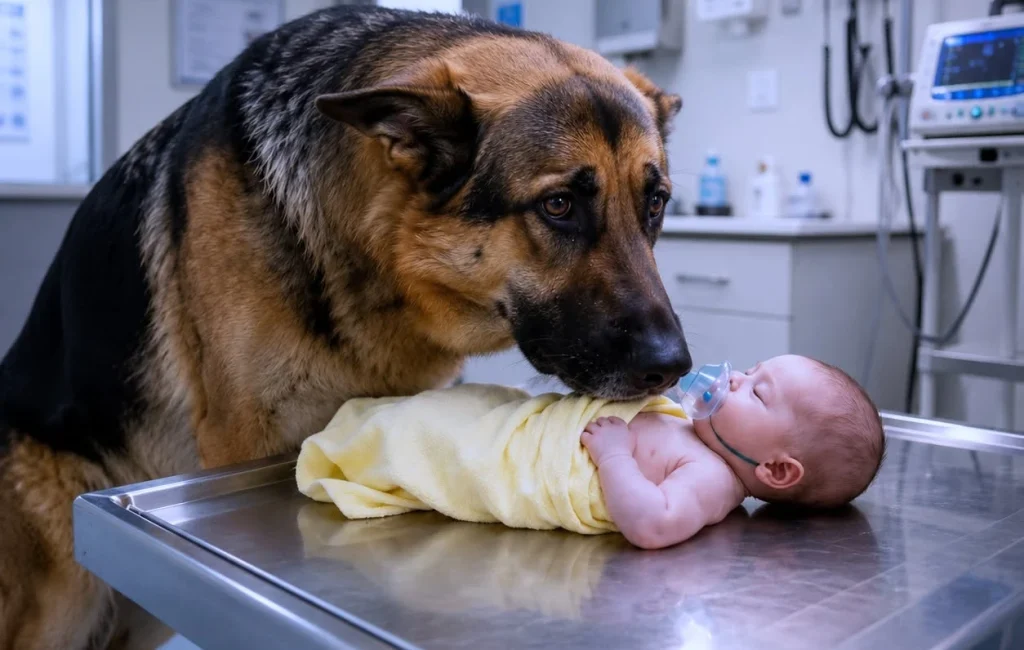
Now Owen was six months old. On this ninety-third morning in the pediatric intensive care unit at Alder Creek Regional Medical Center in Millhaven, Ohio, a ventilator breathed through the tube at his mouth. His whale-print blanket lay over legs that had grown thinner while the sleeves of his pajamas grew shorter. Hannah kept buying the next size.
“Have a few sips,” Diane said. “I’ll stay until Dr. Shah gets here.”
She checked the pumps with the practiced movements Hannah knew almost as well as her own kitchen drawers. Nearly thirty years on this floor had taught Diane to notice the parent as well as the numbers. Hannah drank because it gave the nurse something she could fix.
Dr. Daniel Shah arrived alone. He sat beside her, close enough that she couldn’t pretend he was stopping in on rounds, and explained what the latest results meant. The infection persisted despite treatment and outside consultations. Owen’s kidneys and liver were struggling; every adjustment seemed to ask more of a body with less to give.
“What about another hospital?” Hannah asked. “Somewhere that does trials?”
He described the calls already made. She heard him out, searching each answer for an overlooked possibility, until he said they needed to discuss making comfort the focus of Owen’s care.
Hannah put the cup down before she spilled it. “He was in my arms when we got here. He had a fever. That’s what we came for.”
She could still feel the moment an emergency nurse had taken him from her and run. For a while his father had come every evening; after the first month, the second chair had stayed empty. Hannah had learned to sleep with her shoes on because taking them off suggested she meant to settle in.
Dr. Shah waited. He hadn’t mentioned removing support that morning, but she could see the conversation beyond this one, and she couldn’t follow him there yet.
“Then bring Boone,” she said.
He looked at the photograph in her lap.
“He used to settle when that dog came. His eyes would open. You saw his heart rate come down.” She pushed the picture toward him. “If you’re asking me what would comfort him, that’s my answer.”
The animal-assisted care program had been suspended a month earlier. Funding had disappeared, and unresolved infection-control questions had been folded into the closure. Dr. Shah couldn’t authorize a visit on his own, but he agreed to take her request to the administrator.
Hannah spent the afternoon answering every footstep with a look at the door. She hummed the sunshine song when Owen stirred and dealt with a billing-office call while holding his foot. The caller offered to try another day; Hannah said yes without asking which one.
Dr. Meredith Voss came with Shah after lunch. Her cream jacket brushed the crib rail as she explained that the hospital could not admit an animal whose program no longer operated. Hannah noticed that she read Owen’s name from the card at his bed.
“Ten minutes,” Hannah said. “You can put whatever precautions you need around it.”
“We don’t establish clinical policy through individual requests.”
Shah spoke before Hannah could answer. “A compassionate exception deserves consideration here.”
Voss kept her attention on Hannah. The Whitcomb Family Foundation would tour the unit that Thursday; its support helped pay for the pediatric expansion. Allowing an unsanctioned visit during that review, she said, would undermine standards the hospital depended on donors to sustain.
Hannah stared at the small hand lying open on the blanket. “Will they be coming into his room?”
“That hasn’t been determined.”
“But you’ve determined the dog can’t.”
Voss drew herself up. “I appreciate how emotional this is. My responsibility extends to every child here.”
“He’s one of them.”
For a moment Hannah thought the administrator might actually look down. Instead, Voss warned that any attempt to bring Boone onto the unit would involve security. She left Shah standing beside a request he had failed to get granted.
That evening Diane found Hannah rubbing the corner of the photograph flat. She recalled Boone’s first visit, the startled resident, Owen’s determined grip on his ear. Hannah smiled at the memory and then couldn’t bear the photograph anymore.
“His handler’s Walt Hensley,” Diane said. “Retired fire captain. Search and rescue before they started visiting us.”
“Do you have his number?”
Diane took out her phone. After a few taps she laid it beside the sink with a contact card open, then announced that she needed to check another room. Hannah copied the number onto a parking receipt. When Diane returned, neither mentioned the phone.
Hannah called from the family bathroom with the faucet running. On the fourth ring, a man’s sleepy voice answered; when she gave her name, he asked whether her boy was the one with the blue whales.
She sat on the closed toilet lid. “Yes. That’s Owen.”
She told him about the proposed change in care and the refusal. Walt listened without offering encouragement he couldn’t support. He remembered Owen, he said, and believed Boone did too. They arranged to meet in the employee courtyard the following afternoon.
October wind chased leaves around the courtyard’s dry fountain. Walt arrived in a faded canvas jacket and explained that Boone was in his truck, with the engine running and the temperature controlled. They needed to talk before bringing him any closer.
Walt had written letters about the program’s closure and attended two board meetings. At the second, someone had escorted him out. He studied Hannah’s photograph, rubbing a work-roughened thumb along the edge of her phone case, then handed it back.
“That was his last smile,” she said.
A woman spoke from beyond the brick arch. “The front entrance won’t work.”
Tessa Moreno, one of Owen’s night nurses, stepped into view. She had come outside for a short break and overheard enough to understand. When Walt told her she didn’t need to risk her job, she looked toward the fourth-floor windows.
“I’ve been taking care of him for weeks. I can’t unhear this.”
On the back of a discharge instruction sheet, she sketched the loading-bay employee entrance, the old service corridor and the freight elevator. She marked a supply alcove on four. Tomorrow evening would work better: the foundation’s media crew would have finished its preliminary walkthrough, and the usual security round would be past.
“Eight-thirty,” she said. “Ten minutes in the room. We keep him away from equipment, and then he leaves.”
Walt folded the map. “They can use this to restrict your visits, Hannah. You need to hear that before we do anything.”
She pictured Owen waking without finding her beside him. It frightened her enough to make her pause, but she couldn’t turn the photograph facedown and wait for another conversation about letting him go.
“I hear you,” she said. “I’m still asking.”
Tessa told her to keep the plan private. That night Hannah described Boone’s ears to Owen while his eyelids remained closed, and through the next day she watched workers polish glass and carry flowers past his door. Late in the evening Tessa reported that he had been alert for a few brief stretches.
Hannah was waiting at the service entrance a minute before the agreed time. Walt came through first. Boone followed at his knee, sable fur dark down his back, moving with the unhurried care of a large dog accustomed to narrow spaces.
He touched his nose to Hannah’s hand. She let her fingers sink between his ears, and for a moment she could feel how much pressure she had been holding in her jaw.
Tessa led them toward the freight elevator. On four, they waited beside linen carts while footsteps passed; then she guided them along the back hall, away from the public desk. Boone’s nails made small, distinct clicks that Hannah heard above everything else.
Inside the room, she opened her phone’s camera. She wanted something for Owen beyond the old picture, even if all she caught was his eyelids moving. She propped the phone against her cup, stepped to the crib and whispered the dog’s name.
Boone stopped well short of the rail.
His muzzle lifted. He drew air through his nose, then moved toward the feeding cart beside the sink, where pale feed had dried along a cabinet hinge. Walt shortened the leash as the dog sniffed the seam and the tubing below the pump. Boone struck the metal frame once with his paw.
Hannah’s lifted hand remained above the blanket. Before she could call him toward Owen, Boone turned from the cart to the gray access panel behind the monitor stand, planted his feet and growled.
To read the rest of the story – CLICK the NEXT button 👇👇👇