


Nora Ellis got to Room 3B at Cypress Reach Elementary before the bell so she could say the first sentence to an empty room. She stood beside her desk with the folder open, facing the place where Ms. Rusk would sit.
“The hero I chose is my dad.”
It came out too softly. She tried again, keeping her finger on the drawing of the dog beside him. Outside the window, somebody bounced a rubber ball against the handball wall, and she waited for each thump before starting over.
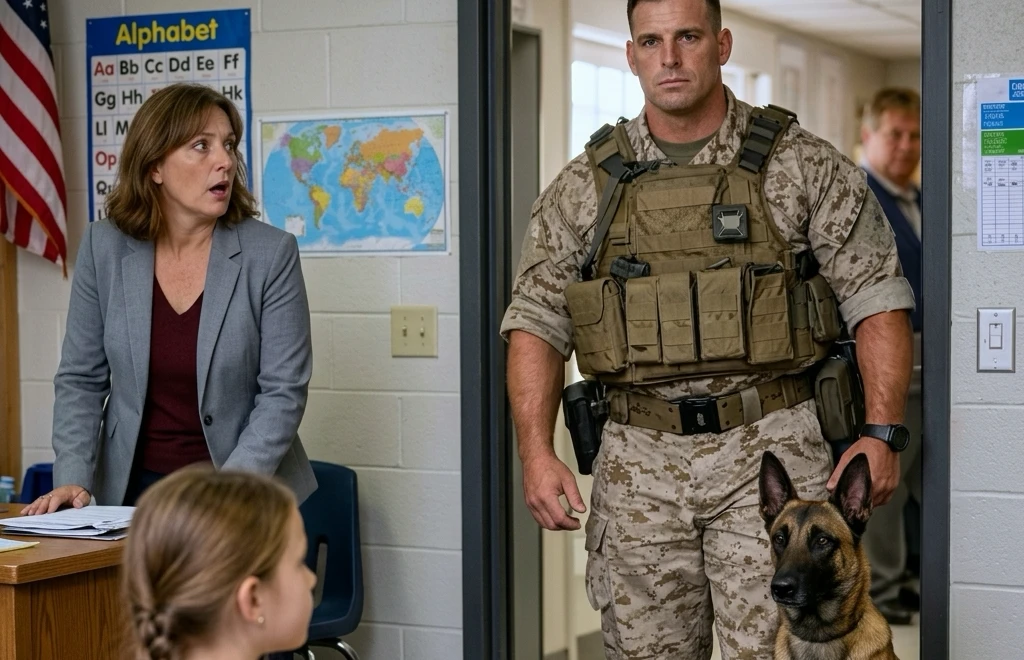
Her father had helped her practice over a video call on Sunday. When she forgot the word detection, he had waited while she found it on her notes. He could have supplied it in a second; she liked that he hadn’t.
In her picture he was wearing his camouflage uniform. Flint stood at his left knee, with pointed ears and a small white mark above the right one. Nora had drawn that mark three times before getting it thin enough. It was an old training scar, her father had told her, and didn’t hurt anymore.
She was eight, and she had only met Flint twice. Most of what she knew came from photographs and her father’s calls: the dog was four, a Belgian Malinois, and they had worked together for three years. Flint found things people needed to stay away from. Her dad trusted his nose.
When Ms. Rusk arrived, Nora sat down quickly. She tucked her notes under the drawing so the teacher wouldn’t see how many words she had circled to practice.
Ms. Rusk was good at making a difficult page look manageable. She could cover three quarters of a math worksheet with another sheet, leaving one problem, and suddenly Nora could do it. That morning she straightened the row of finished projects on the counter and reminded everyone that the third-grade assignment was about a real person.
“Someone whose work you can describe accurately,” she said. “You don’t need to make anybody more impressive than they are.”
Nora moved her folder to the edge of her desk. She had left out the parts she didn’t understand. In her picture, a small American flag stood beside her father and Flint on a plain strip of brown ground.
Two children went before her. Ms. Rusk asked one boy where his grandmother worked, then let him finish talking about the people she helped at the hospital. When she called Nora, Nora stood before she could decide to ask for another turn later.
The walk to the whiteboard felt longer carrying something. She set the folder on the little ledge and opened it toward the class.
“My dad is Staff Sergeant Adam Ellis. He’s a Marine, and he works with Flint.” She touched the ears in the drawing. “They train together, and Flint searches for things that could hurt people. My dad watches him and knows when he’s found something.”
Ms. Rusk looked up from her clipboard. “Who helped you write that?”
“My dad told me about his job. I wrote it.”
“And all of this is something he actually does?”
Nora glanced at the page to find what she had said wrong. She had checked the long word with him. Even the number of years was right.
“Yes.”
Ms. Rusk came forward and took the folder. She turned a page, then another, with her lips pressed together. Nora reached to keep the drawing from slipping out and withdrew her hand when the teacher held it more tightly.
“Sometimes we hear something at home and mix it up with something we’ve watched,” Ms. Rusk said. “A movie, for instance.”
“I didn’t.”
The teacher uncapped a red pen. Across the top of the first page she wrote NOT VERIFIED, large enough that Nora could read it upside down.
“You can sit down for now.”
Nora left her hands open for another moment, expecting the folder back. Ms. Rusk set it on her own desk, away from the completed projects. Nora went to her chair without it.
At recess she stayed on the low wall by the classroom, where she could see the desk through the window. Her folder was still there. She thought about the boy’s grandmother and wondered whether he had brought something Nora had forgotten to bring.
When school ended, Ms. Rusk placed the folder on Nora’s desk. Nora slid it into her backpack under her lunch box, although she had spent the whole morning wanting it back.
At their rented duplex, her mother was taking off the shoes she wore at the grocery store. Beth looked up when Nora passed the kitchen without opening her backpack.
“How did the presentation go?”
Nora brought her the folder but kept one hand on the closed cover. Her mother stopped reaching for it, and after a moment Nora let go.
Beth read the red words. Nora watched her mother’s thumb stop moving along the paper’s edge.
“She thinks I got it from a movie,” Nora said.
Her mother pulled out the other kitchen chair. “Tell me what you said.”
Nora gave the presentation again, this time with her elbows on the table. Beth listened through the difficult word and the sentence about Flint. When Nora finished, her mother said that those were the things Dad had told them. Nothing on that page needed to be made up.
Nora took the folder to her room. She put it on top of her backpack for Tuesday, where it wouldn’t get bent.
After Nora was asleep, Beth sat with Adam’s number on her phone. She was thirty-five and could run a checkout line with three people asking her questions at once; she still found it hard to begin a call that would hurt him and leave him too far away to do anything useful.
He was finishing a training assignment away from their home base in northern San Diego County. He was due back Friday. Years earlier, after an accident during training overseas, he had come home quieter, listening from the edges of rooms. Beth knew the effort behind the patience Nora heard on the phone. She didn’t want to turn this week’s short calls into another thing he had to carry.
She looked at the time beside his number. They would have started early at the training site; he might already be asleep. She set the phone facedown without calling.
On Tuesday, Nora brought the folder when Ms. Rusk called her up again. She thought she might get another turn. She had practiced explaining what detection meant, in case that was the part the teacher didn’t understand.
Ms. Rusk opened the folder before Nora could begin. She picked up the red pen and drew a line beneath yesterday’s words.
“We need to clear this up,” she said to the class.
Nora stood with her shoes touching. The teacher closed the folder and lowered it into the plastic wastebasket beneath her desk. One corner caught on the rim; Ms. Rusk pushed it down beside the crumpled worksheets.
Nora bent her knees a little, almost following it. She could still see the blue cover. There was a pencil shaving stuck to the tape along its spine.
“Before we go on, Nora, you need to apologize to everyone for presenting that story as a fact.”
To read the rest of the story – CLICK the NEXT button 👇👇👇