


Beth Lawson had brought sunflowers for a boy who would never turn eight. They had been Danny’s favorite. She was trying to keep their paper sleeve dry when something lifted beside the memorial pine—a gray head, briefly visible through the snow, then gone. She stopped with one boot outside the pickup. The dashboard clock read 4:14, the minute she had meant to be here. For three years she had arranged this drive around those numbers, even when the weather made the mountain highway a place any sensible person would avoid.
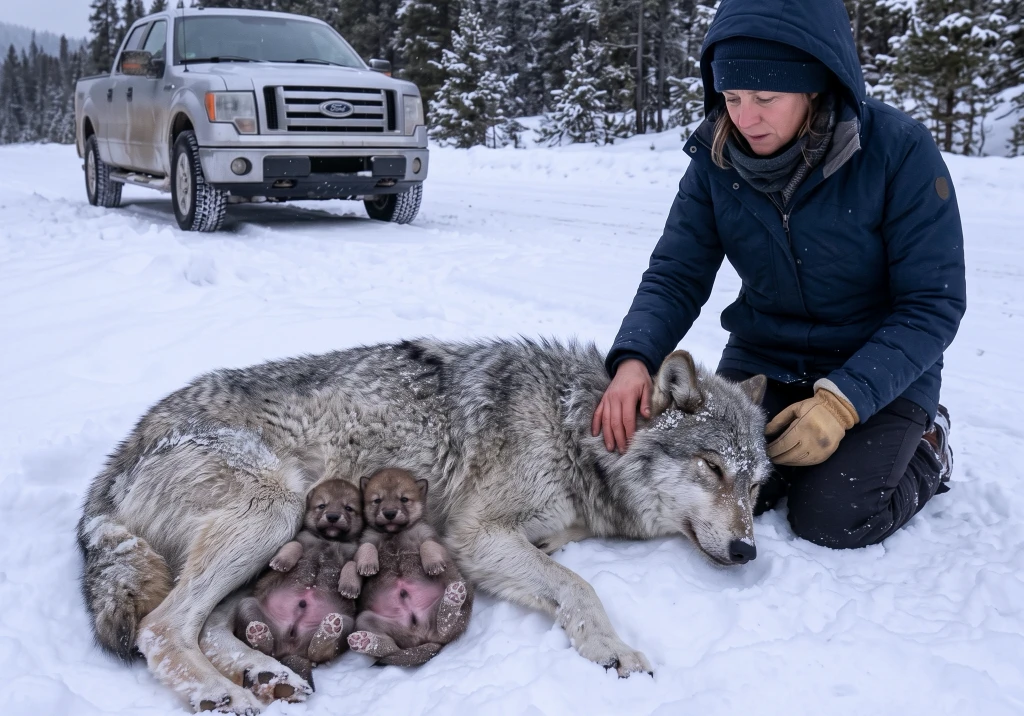
The head rose again. This time she saw the ears.
May fifth, and another late storm was coming over the pass. Down in Helena, people had been setting flowers on porches that morning. Up here, wet snow clung to the white cross she had fastened to the pine, and the road beyond her headlights had almost disappeared.
Beth shut the truck door and moved toward the tree. She had expected twenty minutes beside the cross, long enough to say Danny’s name until she could say it without catching her breath. Then she would go home.
A wolf lay a few yards past the memorial. Two small bodies pressed against her stomach, one dark, the other almost the color of the dirty snow. The pale pup made a sound Beth felt before she quite heard it.
She backed up a step. The mother watched her without getting up.
Beyond them, a second adult lay partly buried beside the ditch. He did not move. A smear of dark fur on the pavement, tire marks, and a broad furrow through the snow suggested what had happened; smaller paw prints followed the furrow, doubled back, and ended where the female lay. It looked as though she had pulled him off the road.
Beth couldn’t tell how long ago. Snow was already softening every edge.
Another short trail led toward the highway, ending beneath the pups. The mother had moved them closer to the road before collapsing around them. Beth stared at that last yard of disturbed snow, at the effort it must have taken, and found herself remembering the ambulance parked in this same turnout.
Danny had still been alive when they lifted him inside. He died three hours later at the hospital, with a strip of adhesive pulling at the skin on the back of his hand. Beth remembered wanting to loosen it because it looked uncomfortable.
She had been driving. Paul had told her about the invisible ice so often that the words eventually sounded rehearsed, though she knew he meant them. He had left after almost three years of trying to reach her across their kitchen table. His own grief had needed somewhere to sit, too.
The mother lowered her muzzle against the pale pup. Her tongue moved once, too slowly to clear the snow collecting on its face. Beth put the sunflowers down and went back to the truck.
Her phone showed no service. She tried an emergency call anyway, holding it high beside the windshield until the attempt failed. The valley had a veterinary hospital that stayed open all night; she had passed its sign often enough to remember the turn.
Under the rear seat were the things she had carried since the crash: blankets, a first-aid bag, a folded utility tarp. At the hardware store, she could tell a customer where to find any of them without looking up. Keeping them in her own truck had never made the drive easier.
She started the heater and carried the blankets back. The wolf’s eyes followed her hands. There was no growl, but Beth didn’t mistake the stillness for permission; the animal was so weak that her head settled into the snow again before Beth reached the pups.
“I’m taking them out of this,” she said. Her voice sounded small in the wind.
The dark one stirred when she lifted him. His brother barely did. She carried them against her coat and settled them together in a nest of dry blankets on the rear floor, then turned back before she could start counting all the things she didn’t know.
The mother was much heavier than she looked. Beth tried to raise her shoulders and felt something pull sharply in her own back. She stopped, breathing through her teeth, with the wolf’s weight still against her knees.
She had moved bags of concrete and broken lawn mowers at work. Weight needed somewhere to go. She spread the tarp beside the animal and worked it beneath her in short, clumsy pulls, keeping away from the muzzle whenever the head shifted.
Once the wolf pushed with her front paws. Beth held still until the effort passed, then took up the folded edge again. The tarp slid six inches and caught on a buried stone.
“Again,” Beth said, though she was the one who had to move.
By the time she reached the truck, roughly fifteen minutes had vanished. Her coat was wet inside, her fingers too stiff to separate. She brought the tarp up over the low running board, braced it with her knee, and used the edge of the door opening to take some of the weight while she dragged the mother into the cleared rear footwell.
For a moment Beth couldn’t stand. She leaned against the truck with her forehead on the cold door frame, listening for a vehicle that might come around the curve. None did.
Behind her, the mother shifted her head toward the blankets. Beth moved the pups within reach and watched the gray muzzle touch each of them. The pale one’s chest was moving, but she had to watch closely to see it.
She shut the door, leaving the sunflowers where they had fallen.
The first skid came before she was clear of the bend. Beth’s hands tightened until her wrists hurt, and the old hospital room seemed to open behind the windshield. She eased her foot off the gas and let the truck settle before she touched the wheel again.
She wanted to hurry so badly that slowing down felt like refusing help. Yet the three animals were behind her, and the road still required the same small decisions. She followed the edge posts, one to the next, saying, “Stay with me,” whenever the rear of the cab grew too quiet.
The drive took more than an hour. When the hospital sign finally appeared through the snow, one letter was dark. Beth parked crookedly near the entrance and went inside without taking the keys from the ignition.
“There are wolves in my truck,” she told the man at the desk. “Three. Please come.”
Dr. Sam Keller looked at her wet clothing, then through the glass at the idling pickup. He called for a technician and a stretcher before asking her another question. Outside, he opened the rear door only far enough to look, then directed Beth to stand back while they brought the mother out.
The pups went through another door in a padded carrier. Beth followed as far as she was allowed and stopped beside a rack of folded towels, with nothing left in her hands.
Keller returned long enough to tell her the female was dangerously cold, dehydrated, and badly underfed. Both pups needed support; the smaller one was having trouble breathing. He would notify the wildlife authorities while his team worked.
“You’ll have to give me room,” he added.
Beth nodded, then caught his sleeve when he turned away. She released it immediately. “I brought all of them.”
“I saw.” He waited until she looked at him. “We’re working on all three.”
From the treatment-room doorway, she could see the mother beneath a warming blanket and the technician crouched beside the pups. A monitor traced its narrow green line above the table. Beth stood with her palms flat against her own thighs, trying to keep them there.
The mother’s head moved. Beth took one step forward, believing she was waking.
Then the wolf’s whole body went rigid, and the blanket slid to the floor.
To read the rest of the story – CLICK the NEXT button 👇👇👇