


The bottle was cooling by the time Dr. Daniel Mercer admitted the calf would not take it. Luis Bennett was still kneeling on the rubber floor, holding it well away from the small elephant’s face. He had loosened the cap to release the warm, sweet smell, and for a moment Eli’s trunk had uncurled toward it.
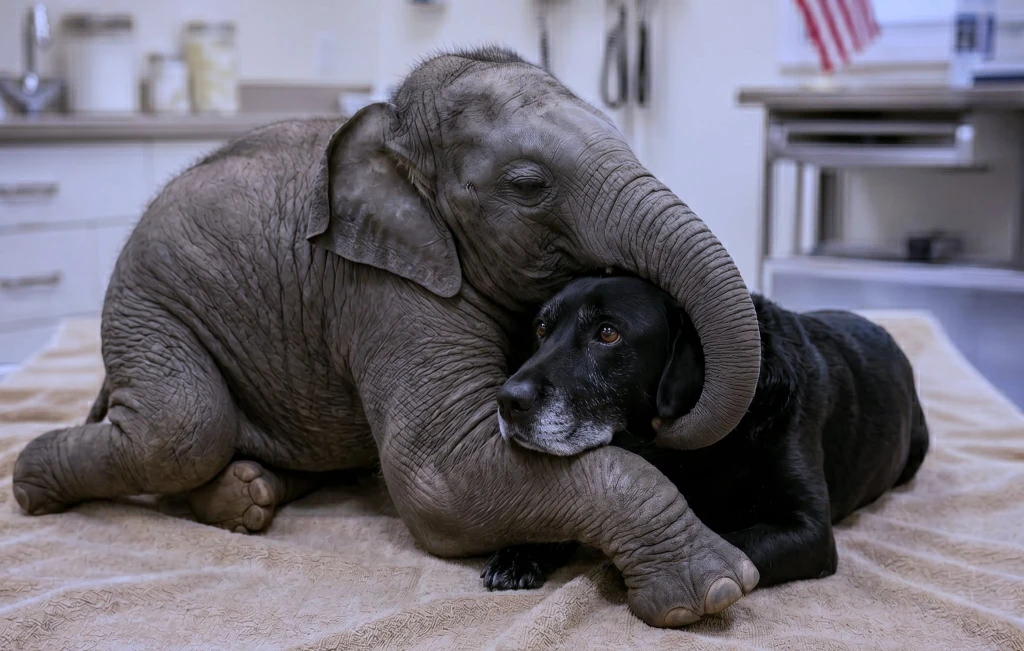
Then the calf had backed into the corner.
Daniel rested his wrist against the rail. Beyond the treatment wing, the resident elephants were calling across Juniper Hollow’s pastures, but Eli gave no sign of wanting them. Nora Bell had brought Mabel, the fifty-year-old matriarch, close enough to rumble through the fence; even two-year-old Poppy, usually irresistible to newcomers, had failed to draw him out.
“Twenty minutes,” Nora said beside him. Dried formula stiffened the cuff of her shirt. “Luis has been down there twenty minutes.”
At three weeks old, Eli should have been following his mother. Instead, five days earlier, U.S. Fish and Wildlife Service officers had delivered him to this sanctuary outside Boerne, accompanied by records from a seized roadside zoo on the Gulf Coast. His mother had collapsed during the seizure, starved and crippled by neglected joint disease. She had died that night.
An untreated infection had damaged both of Eli’s eyes. The team had brought the infection under control; the sight was gone. Now even familiar footsteps made him brace for something he could not see.
Luis tightened the cap and stood, one hand on his knee. He looked up at Daniel and shook his head.
“We can’t restrain him for another tube today,” Nora said.
Daniel nodded. The two previous attempts had left the calf exhausted and struggling, and the most recent had frightened him badly enough that Daniel had stopped the procedure. Fluids and temporary nutritional support were buying hours. They were not getting Eli strong enough to live without them.
In the office, Helen Ward had arranged his records beside a cup of coffee she had not touched. She ran the sanctuary’s operations, including the night coverage that had kept somebody beside Eli since his arrival. She waited until Daniel sat before she turned the weight sheet toward him.
“Another loss,” she said. “And the kidney values?”
“Worse.”
“Then we need to discuss ending this.” Her finger remained beside the figure. “Before what we’re doing becomes something we’re doing for ourselves.”
Daniel was fifty-two. He had made that decision for animals he had spent weeks trying to save, and he knew Helen was asking him to do his job. Still, he could see Eli’s left ear turning that morning when the compressor started outside.
“He’s listening,” he said. “I saw him follow a sound. When we approach, he expects another procedure. I need a way to change that.”
Nora sat with her hands between her knees. “We’ve run through the bottles. The formulas. Both elephants.”
“Give me fourteen days.”
Helen looked at him until he added, “As an outside limit. We keep supporting him and assess him every day. If we can’t control his suffering, or he’s failing despite support, we stop sooner. I won’t ask you to wait for a date.”
Nora finally nodded. Helen drew a line beneath the day’s entry, leaving tomorrow’s space open.
That evening Daniel took his usual route through the county shelter beside the sanctuary gates. The two facilities shared veterinary help, and he often checked on a recovering dog before going home. Ruth Walker shut off her hose when she saw him.
“No supper again?” she asked.
He shook his head. She hung the nozzle on its hook and led him past the barking runs to a quiet kennel at the back.
A black Labrador mix lay on a raised cot, his forepaws hanging over the edge. He was a big young dog, perhaps eighty pounds, with a pink seam through the hair on his left shoulder. He lifted his head when Ruth stopped, and his tail struck the canvas once.
“Boone,” she said. “About two. A sister brought him down from Wyoming.”
She told Daniel what the woman had told her. Boone had belonged to Owen Kessler, an outfitter who took pack strings into the mountains. While searching for a missing mule, Owen and the dog had come on a grizzly beside a kill. Boone had tried to draw it away from his owner.
Owen had died there.
Rangers had found the dog stretched across Owen’s chest the next morning, wounded and too weak to stand, still resisting anyone who approached. The responders had needed to sedate him before they could treat him. Owen’s sister had brought Boone home to Austin, then discovered what her work hours and apartment could not provide.
“She brought all his records,” Ruth said. “Cried putting his bowl down. He wouldn’t eat for her unless she held the food, either.”
Daniel lowered himself beside the kennel. Boone looked at him without coming closer. The shoulder had healed cleanly; the food dish was untouched.
“Will he eat from your hand?”
“Enough. Then he goes back there.” Ruth nodded toward the wall behind the cot.
Daniel stayed another minute. He thought of Eli withdrawing from every offered bottle, and of this dog accepting a mouthful only when somebody waited beside him. The comparison gave him an idea. It gave him no assurance that the idea was safe.
“Could you have his lead ready tomorrow?” he asked.
By morning, Helen had heard his proposal and said no. Nora’s objection was more specific: a startled bark could send a blind calf straight into a wall, and a frightened calf could crush a dog without meaning to. Daniel listened through both objections before he answered.
“One room. No forced approach. We watch what they actually do.”
“You can’t promise what he’ll do,” Nora said.
“I know. That’s why either of you can end it.”
They reviewed Boone’s intake checks and the requirements for bringing him across from the shelter. Helen finally permitted one session in the padded observation room, with separate exits, staff ready at the door and veterinary emergency support immediately available. If either animal’s distress increased, they would separate them.
Luis removed the trough and anything with an exposed hard edge. He and the other handlers moved Eli on a padded cart, then lowered him onto hay in the corner. The calf was too weak to walk the distance himself, but he found enough strength to press backward against the rubber wall.
Daniel brought Boone down the hall on Ruth’s lead. Through the viewing glass he could see Helen beside Nora; Luis stood at the door. Only after the room was ready did Daniel unclip the lead and let the dog pass his leg.
Boone sniffed the floor. Eli took two quick breaths, then returned to his earlier rhythm. Daniel kept his hand near the door control. Boone turned his head away, yawned, then lowered himself sideways onto the mat, several feet from the calf.
He put his chin down and sighed.
Daniel stayed by the wall. A yawn could mean strain; quiet could change. He watched until his back ached, and still Boone made no attempt to crowd the corner.
Nearly an hour into the session, a thin whine came from the dog’s chest. Eli’s ears shifted toward it. His breathing grew slower, and he let his trunk rest loosely on the hay.
Boone moved on his elbows, his belly close to the floor. He paused, moved again, and stopped within reach of the calf’s short trunk. Then he stretched out his left foreleg and laid the black paw on the rubber.
Eli lifted his trunk. The tip searched above the mat, drifting past the paw before finding it on the next sweep. Daniel had watched this calf shrink from every living thing they had offered him; now Eli was closing the last few inches himself.
His trunk brushed Boone’s fur, then jerked back against his chest.
To read the rest of the story – CLICK the NEXT button 👇👇👇