


Jesse held the bottle sideways so Nathan could see the milk line. It had not moved. On the other side of the mesh, the bear cub had pushed his face beneath his forelegs again, leaving one rounded ear exposed.
“He heard me come in,” Jesse said. “That’s something.”
Dr. Nathan Bell took the bottle, though his keeper had already tried everything he could. Five days into treatment at Alder Creek Wildlife Rescue, an ear turning toward a boot had become worth writing down.
The forest crew had found Ash in a ravine in the Selkirk foothills, trying to nurse from his dead mother. Her hide and gallbladder were missing. By the time the orphan reached their center in Washington’s Skagit County, infection had damaged both eyes beyond recovery.
He was roughly three months old, still a nursing cub, with ribs Nathan could find through the fleece without pressing. Antibiotics had controlled the infection. Fluids and assisted feeds were buying time, but handling distressed him, and he would not take the bottle willingly. On this cold April morning, his temperature was falling again.
Ruth Keene checked the warming pad, then reached past Nathan for the bottle. She tested a drop against her wrist before kneeling beside Ash. The cub stiffened at her touch and turned away from the nipple; Ruth stayed with him until the formula cooled, her free hand resting open on the mat.
They had tried a recording of a nursing bear and moved Fern, a calm older female, into the neighboring pen. Ash could hear and smell her through the barrier. He had wedged himself farther into his corner.
At the clinical review, Laura Pike put the treatment chart between them. The operations manager had a second clipboard under her elbow, filled with the needs of animals that were getting better. She left it there.
“We need to talk about stopping,” she said.
Nathan was fifty-two, with more than twenty years in wildlife medicine. He had made that decision for animals he had carried into surgery himself. He looked through the notes again, though he knew where the blank feeding entries were.
“Two weeks,” he said. “Let me try to get him eating on his own.”
Ruth’s eyes stayed on him. “With support. And we reassess every day. He doesn’t owe us two weeks if he’s suffering.”
Nathan agreed and signed beneath the conditions. That evening, when he should have driven home, he took the road from their rural center toward the county shelter.
A volunteer had mentioned a dog there that morning. Nathan did occasional surgery for the shelter, and Beth Norris let him through the side entrance. She led him past the barking runs into the recovery wing.
The black Labrador mix lay on a folded moving blanket, looking at the wall. At the sound of the latch, the end of his tail tapped once. The rest of him stayed where it was.
“Boone. Eight,” Beth said. “His stitches are out. He could leave tomorrow, if there was somewhere to take him.”
The dog had belonged to an elderly timber cruiser who lived up a logging road near Mount Baker. Three weeks earlier, a cougar had come close to the cabin, drawn by the trash. The man had gone outside with a flashlight. Boone had fought the cat and driven it back, taking wounds across his neck and shoulders, but he had not saved his owner.
The next morning, deputies making a welfare check had found Boone lying across the man’s chest. Animal control had to move him before the emergency crew could reach the body. Beth showed Nathan the healed tracks through the clipped fur, then put the medical folder back.
“He’ll take food from my hand,” she said. “A little. Then he turns toward the hall again.”
Nathan crouched at the gate. Boone lifted his eyes, taking in the jacket, hands, and unfamiliar boots. Nathan waited. The dog lowered his chin without getting up.
Beth worked a piece of kibble between her fingers. “I keep bringing different toys. He lets me put them beside him.”
Nathan stayed until Boone had eaten several pieces. Driving home, he thought about the dog listening for someone in a hallway, and the cub whose ear still moved when Jesse entered the shed. Before calling Beth back, he pulled over.
He spent most of that night reading veterinary papers and reports of unusual animal companionships. None described a dependable way to put these particular animals together. By morning, after the night staff had treated another drop in Ash’s temperature, Nathan brought the idea to his team.
Ruth set her pen down before he finished.
“A dog that just fought a cougar,” she said. “With a cub that can’t see him coming.”
“Yes.”
“And when one of them gets frightened?”
Nathan spread the clinic floor plan on the table. Exam Room Two had two exits and an observation window. They could remove the furniture, lay traction mats, and use a sliding divider until they had watched both animals. Jesse could recall Boone into the side bay. Nobody would reach between teeth.
“Any sign we need to stop, we stop,” Nathan said. “You can call it. Any of you.”
Ruth checked Ash twice during the discussion. Only after his temperature had stabilized, the health checks were cleared, and everyone had agreed on the separation procedure did they prepare the room.
Nathan fetched Boone in his truck. The dog climbed into the rear seat and turned around carefully, as though there ought to be something familiar behind him. When there wasn’t, he folded himself against the door and slept through the drive.
Jesse had removed the stools and steel table. The cleaned room had been aired, and thick rubber mats covered the floor. Ruth brought Ash wrapped in fleece, his head sagging against her wrist, too quiet for her liking.
Boone entered first. He inspected the edges of the room, then lay down facing the door. When Ruth came in with the cub, his nostrils widened, but he lowered his chin and looked aside. His tail made the same single tap Nathan had seen at the shelter.
They began with the divider between them. Ash pulled into himself on the warm bedding. Boone stayed down. After a long interval without threat from either animal, Nathan let Jesse withdraw the divider. The staff went behind the glass, leaving the safety bay available.
Boone breathed out through his nose with a small, rough whistle. Ash’s exposed ear turned toward it. Nathan took his hand off the door handle so the tiny movement would not make the latch click.
The dog rose only enough to move in a shallow curve, then lay down again about six feet from the cub. He offered his side to the corner, with his head pointed toward the empty room. His breathing was the loudest living sound Nathan could hear.
For nearly forty minutes, they watched Ash move a little at a time. His paws loosened. His nose emerged, withdrew, then emerged again. Between long pauses, he worked his way toward the dog, following the breaths across the mat until the six feet had become less than one.
Jesse shifted, and Nathan caught his sleeve before his boot scraped. Boone rolled onto his left side. He slid his right forepaw into the remaining space and stopped.
Ash touched the fur with his nose. The paw stayed still while he smelled along it, his head trembling with the effort of holding it up.
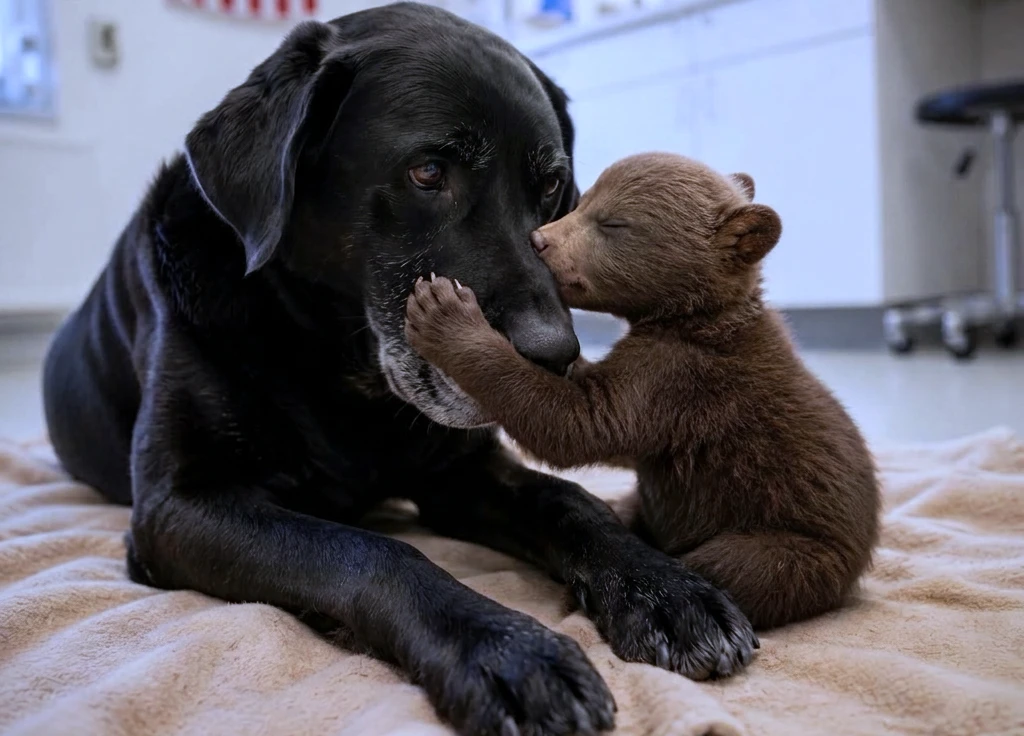
Then the cub crawled the last few inches and lowered his head onto Boone’s outstretched paw.
Boone exhaled and closed his eyes. A little later he shifted his hip, and Ash lifted his head at the scrape of claws. The dog huffed as he settled; Ash found the offered leg again.
Beside Nathan, Ruth wiped her face with her cuff. Jesse bent over, his hands on his knees, and Nathan rubbed his palms over his eyes before looking through the glass again.
They stayed another hour. Each time Boone moved, Ash listened and found him. Then Ruth touched Nathan’s elbow. The cub’s treatment was due, and Boone needed to go outside.
“Do I go in and pick him up?”
To read the rest of the story – CLICK the NEXT button 👇👇👇