


The German Shepherd grew heavier in Caleb Ward’s arms on the last few steps to the truck. Until then, the dog had been shivering hard enough to shake the zipper on Caleb’s coat. Now the coat lay still around him, and Caleb hurried. He settled the animal across the passenger seat and pulled the door shut against the wind. One amber eye followed him around the hood. Caleb climbed in, started the engine, and waited for the old heater to give him something warmer than mountain air.
“Stay with me a little longer.”
An hour earlier, he had been looking for tire tracks. Sheriff Owen Bell had called the night before about chainsaws running after midnight above Slate Creek, outside Pine Hollow, Idaho, where the logging roads crossed into protected state land. He wanted someone who knew the ridges to see whether the reports amounted to anything.
Caleb had said he was busy. Owen had waited without asking what occupied a man who lived alone, bought groceries before the stores got crowded, and stopped answering his phone after supper. At forty-one, Caleb had arranged his life to require very few explanations.
Seven winters earlier, Owen had found his overturned truck in a drainage ditch. Caleb remembered the sheriff’s hand coming through the broken window and staying there while the rescue crew worked. He had agreed to look at the road.
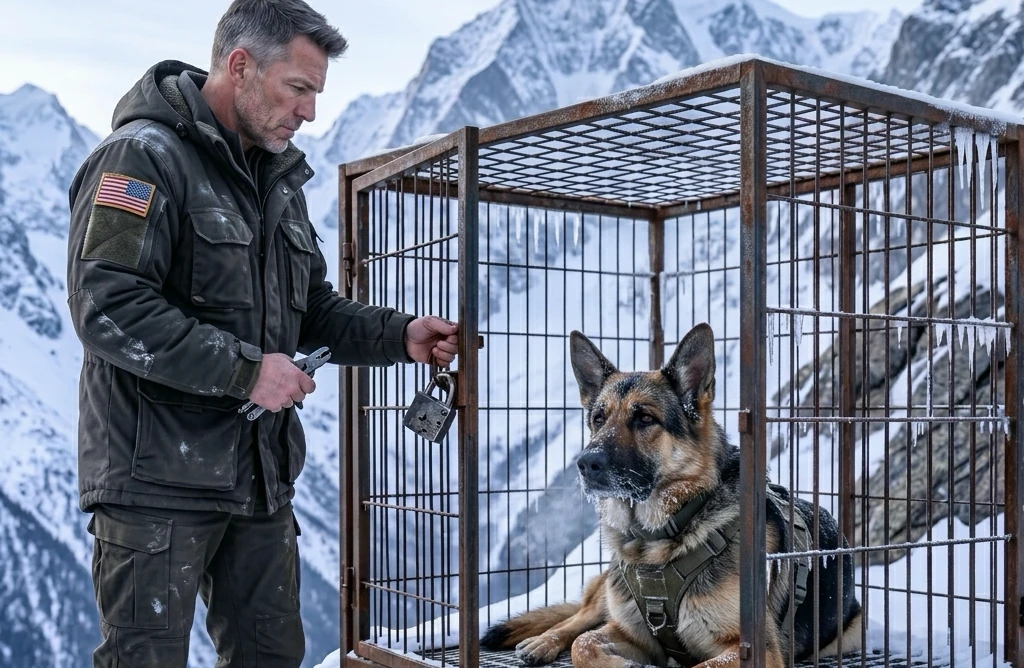
The cage stood on an exposed shelf above the timber, its wooden supports wedged into frozen ground. Snow had sifted through the steel floor. A little burner smoked beneath a crooked flue, producing a smell of scorched fuel and almost no warmth.
The Shepherd lay against the far side, left foreleg folded at an angle Caleb didn’t like. Ice hung from the longer fur along his belly. When Caleb approached, the dog raised his head and watched his hands.
During his years as a Navy SEAL, Caleb had worked around dogs that could settle while everyone else moved. This one had that stillness, though exhaustion might explain some of it. He couldn’t tell how long the animal had been there, or who had taught him to wait without barking.
Caleb kept his voice low while he worked on the lock. The metal finally gave under his pry tool, and the door swung out with a shriek that made the dog’s shoulders jerk. Caleb crouched to wait, his hands open where the dog could see them.
“Come on, if you can.”
The dog placed his good foot outside. His injured leg failed when he tried to follow, and Caleb caught him under the chest. Teeth flashed near his sleeve, then disappeared; the dog held rigid while Caleb gathered the rest of his weight.
He wrapped his coat around him before carrying him down. Halfway to the truck, the Shepherd twisted to look toward a dark cleft in the trees below the ridge. Caleb stopped long enough to follow his gaze, but he could see no movement.
Now the road unwound beneath the truck in narrow, icy bends. Three miles downhill, the dog lifted his head toward the rear window and made a low sound in his chest. Caleb checked the mirror, then the next opening through the trees. Nothing followed them that he could see.
He kept the dog’s shoulder steady on the rough stretches. When the tires finally reached the gravel below his cabin, he discovered that he had been gripping the wheel hard enough to hurt his fingers.
Inside, he spread wool blankets near the stove and called Dr. Mara Collins. She asked about the dog’s breathing, told him to move the blankets farther from the direct heat, and said she was coming. Caleb stayed on the floor until he heard her Subaru laboring up the drive.
Mara took in the dog, the melting ice, and Caleb’s wet shirt. She set down her bag without her usual complaint about his driveway.
“Where was he?”
“Locked up above Slate Creek.”
She crouched where the Shepherd could see her, letting him smell her hand before she moved closer. When she reached for his neck, he recoiled. Mara stopped and waited, her hand resting on her own knee.
The examination took most of the afternoon. She monitored his temperature as he warmed, gave fluids, and listened carefully to the rough sounds in his chest. Caleb fetched towels and held things when she asked; the rest of the time, he tried to stay out of her way.
Once, the dog lifted his muzzle and rested it against Caleb’s wrist. Caleb had been about to reach for a fresh towel. He stayed where he was instead, feeling the damp fur cool against his skin while Mara finished what she was doing.
“He’s badly chilled and dehydrated,” she said. “I’m concerned about his lungs. That leg looks like an old injury, but I’ll need pictures at the clinic before I tell you more.”
She eased apart a mat of fur near his ribs. A blackened piece of nylon came free, its torn edge bearing the remains of a stitched seam. Caleb recognized harness webbing and turned it between his fingers.
“Service dog?” he asked.
“Could have done several kinds of work. Don’t give him a history we can’t check.” She looked at the raw band around his neck. “We have enough to deal with already.”
Mara stayed until his temperature was improving and his breathing had settled enough to reassure her. She left an antibiotic, a written care and feeding schedule, and her direct number, with instructions to call immediately if he worsened. She would check him again the next morning.
“And tell Owen,” she said, pulling on her gloves. “He needs to see where you found him.”
Caleb nodded. The dog had finally closed his eyes, though an ear still moved whenever Mara touched her bag.
“What am I putting on his chart?”
Caleb looked at the broad paws extending beyond the blanket. He had spent the afternoon calling him boy, as if that were enough to keep bringing him back.
“Ranger.”
Mara wrote it down. When she said the name aloud, the dog opened his eyes and found Caleb again.
That night Caleb slept in the chair beside the stove. At three, he woke to claws making a careful adjustment on the floor. Ranger stood between the chair and the front door, scarcely bearing weight on his bad leg.
Caleb checked the window. After a while the dog returned to his blankets, but Caleb stayed awake, listening to the wind press against the stovepipe.
By the next afternoon, Ranger could manage a few steps without help. On the second day he followed Caleb to the kitchen and positioned himself where both doors were visible. Caleb moved the water bowl closer so he wouldn’t have to keep getting up.
A coil of rope beside the shed stopped him cold. Later, the clink of a chain sent him backward into Caleb’s legs. Caleb put both objects away; he knew how an ordinary sound could turn a familiar place unfamiliar.
Owen came that evening, after Caleb finally called. He removed his hat when he saw Ranger, then listened to the account without interrupting. Caleb kept the burned webbing on the table between them.
“We’ve had complaints up there for months,” Owen said. “Poaching. Missing timber. People hear things and then decide they didn’t.”
“You’ve got a cage to look at now.”
“I’ll get it photographed. You got pictures?”
“Getting him out came first.”
Owen nodded and wrote down the location. Ranger watched the pen move, then shifted his attention to the north window. When Owen crouched near him, the dog allowed one brief touch beneath his jaw.
“What were they doing up there with you?” the sheriff murmured.
Before daylight the next morning, Ranger went to the front door and stood with his nose against the lower seam. Caleb got his boots on, expecting an urgent trip outside. The dog moved down the steps and stopped at the edge of the yard.
Caleb followed the line of his lowered muzzle. A short length of chain showed beneath a spruce, with fresh boot marks beside it.
Thirty yards from his front steps, a steel trap waited with its jaws open.
To read the rest of the story – CLICK the NEXT button 👇👇👇