


Nora Bell had almost reached the used fencing when the bison closed ranks around the cow with the torn yellow tag. One animal shifted sideways, then another, until the trembling cow disappeared behind a wall of shoulders. Through a gap beneath their bellies, Nora could still see her front leg shaking.
“Mom. The wire.”
Eli held the auction list against his coat. At twelve, he had acquired his father’s habit of putting a thumbnail beside the thing they had come for, as though the paper might otherwise change its mind. They needed two rolls. Nora had eight hundred dollars to spend and a well repair estimate folded in the glove compartment.
She looked back at the bison.
Forty of them stood in the last livestock pen at Cedar Flats Wildlife Park, sixty miles from the Montana ranch she was trying to keep. The park had closed in October. Now its picnic tables, tractors, and feed bins belonged to people who would be gone before dark.
The animals were harder to sell. Some were too thin to ship far, and the receiver wanted the group removed together by a buyer with suitable facilities. The sale was subject to veterinary approval and whatever movement paperwork the animals required. Nobody could simply back up a cattle trailer and take the cheap ones.
A former keeper carried a forkful of hay toward the pen. Before he reached it, a man beside the machinery laughed and said the animals would cost more to bury than to buy. The keeper kept walking, hay stems caught in the broken cuff of his glove.
Nora moved closer, staying behind the outer barrier. The bison watched her with a steadiness she had not expected from animals whose ribs were showing. She could not tell which were ill, but they were tracking movement, making room, maintaining the group. The cow inside it had not been left alone.
“Your west fence won’t hold them.”
Grant Harlan stood beside her in a coat darkened at the shoulders by melting sleet. His land touched Willow Bend on two sides. He knew where her wire sagged because, during Ben’s last winter, he had repaired part of it without sending a bill.
He also knew the balance of her mortgage. She had told him when he offered to buy the place after the funeral, and regretted it every time they spoke.
“The north enclosure is game fence,” she said.
“With a rotten brace at the far corner. And no stock inside it for two years.”
She had spent those years selling equipment, finishing Ben’s unfinished jobs, and explaining to people that she understood what things cost. Before his illness, she had surveyed grazing land for a conservation district. She knew the difference between an empty pasture and a useless one.
At the microphone, the auctioneer asked for three thousand dollars. He lowered the figure twice without finding a hand. Eli stopped holding his place on the list.
“Eight hundred for the group,” the auctioneer said. “Forty head. Subject to the conditions you all received.”
Nora lifted paddle 63.
Grant turned sharply. Somewhere behind them, a folding chair scraped and a man said, “There goes the wire money.” A few people laughed, then waited for someone else to bid.
Nobody did. The auctioneer pointed at her paddle, repeated the conditions, and brought his hand down on the table.
“We can do this,” Nora told Eli.
He looked at the cardboard number in her hand. “You already did it.”
At the payment desk, she wrote the check with the pen chained to the counter. The receiver confirmed that the park could accommodate a short delay if the veterinarian required it, but feed and care after the following afternoon would be charged to her. He slid the paperwork around, showing her where to sign.
Behind him, the keeper was removing his gloves finger by finger. Nora asked how the weakest cow had been eating, and he described where she stood at the feeder, which animals displaced her, how much slower she had become that week. Nora wrote it on the back of the auction list.
Then she began making calls.
Mae Collier, who hauled livestock and had helped empty the ranch during Ben’s illness, answered from a truck stop. She listened until Nora finished, then asked whether this was a request for advice or a trailer.
“Both.”
“Bit late for the first one.”
Mae could arrange a second driver and suitable trailers. Dr. Ruth Haines could examine the herd that afternoon. Before Nora left the desk, transporting the animals cost more than buying them, and the totals were still climbing.
Grant waited by her truck. He had bought the two rolls of fencing.
“You can have these at what I paid,” he said. “If Ruth clears the animals, call me before you unload. I’ll bring panels.”
“I haven’t asked you to take this on.”
“Neither did the people driving past your west gate.”
He put the wire in her truck bed and left. Eli climbed into the passenger seat without touching the sandwich Nora handed him. She wanted him to say he had seen the cow’s leg too, that he understood why she could not walk past. Instead, he unfolded the weather notebook Ben had kept behind the truck visor.
Ben’s last entry was dated in March. Several blank days followed it; then, on the morning after the funeral, Eli had begun his own narrow columns: wind, temperature, precipitation. Nora had bought him a new notebook for school, but this was the one he carried.
“Will we still have money for the pump?” he asked.
“We’ll work it out.”
“Is that yes?”
She watched a loose strand of baling twine twitch against the windshield. “It’s not something you need to worry about.”
Eli wrapped his sandwich again. By the time Ruth called, he had put it in his backpack for later.
The veterinarian approved transport for the herd, with special care for several animals and a plan for examining them again after arrival. She wanted them kept separate from other livestock while she completed their health work. Nora had no cattle left, and Ruth knew the old enclosure.
“Grass hay to start, and the feeding plan we discussed,” Ruth said. “Don’t try to fix months of neglect in a weekend. That yellow-tagged cow worries me.”
“Sixteen,” Nora said. The keeper had managed to read the remaining digits.
“Then keep an especially close watch on Sixteen.”
The last trailer reached Willow Bend the following evening. Nora had spent the intervening hours replacing braces, opening frozen fittings, and watching the operating account shrink on her phone. The money marked for the well and winter bills paid for hay, hauling, and the first veterinary visit.
Willow Bend had six hundred and forty deeded acres and private grazing leases on several thousand more. Ben’s cattle had been gone long enough for standing grass to accumulate. The old game fence extended around part of the leased range, though every weak stretch would have to be repaired before she could use it.
With that work, careful rotation, and purchased feed during recovery, there was room for the bison. There was considerably less room in Nora’s bank account.
The deed included a long eastern strip Ben called the handle. He had reseeded its worn ground over several seasons and taken Eli there to check the new grass, letting him measure with a ruler from his school bag. Grant had wanted that strip for years because it connected two sections of his own ranch.
Grant brought heavy panels, two employees, and the habit of giving instructions before anyone asked. Mae ignored him whenever his directions conflicted with hers. Between them they secured the unloading area, and the animals entered a broad sheltered paddock inside the north enclosure.
Eli worked outside the perimeter, carrying tools to whichever adult called for them. When Nora told him to go eat, he asked who would hold the flashlight. She nearly answered that she could manage, but Mae took it from him and pointed toward the house.
“Your mother can find a gate without you for twenty minutes.”
Sixteen went down before supper was over. She lay near a panel, her legs folded awkwardly beneath her and her breathing visible in the light from Nora’s truck. The other animals stood nearby, then moved off when Mae placed hay farther along the fence.
Ruth returned. Working through the protected handling space with Mae, she assessed and treated the cow, then stayed long enough to see her begin drinking from the shallow tub they positioned within reach. She could not promise the animal would rise.
“No pulling. No trying to get her up yourselves,” she told Nora. “Give her quiet. Call if her breathing changes, or if she stops responding.”
They secured a windbreak outside the enclosure. Mae finally went home, and Ruth left to check another patient, her number at the top of Nora’s screen. Nora sat in the truck beyond the fence, rubbing the heel of her hand against the place between her eyebrows.
At three, Eli appeared beside the passenger door in Ben’s canvas coat. The sleeves covered his fingers, and his feet were inside boots he had not laced.
“You should be asleep.”
“You said you’d come in when she stood up.”
“I didn’t say that.”
“At supper. You said probably by bedtime.”
Nora remembered saying it while searching for Ruth’s number. She had meant to get him upstairs, where a cow could not die in front of him. Now he was standing in the cold because he had believed her.
“Go inside, Eli. Please.”
He looked past her at the motionless animal. “Just tell me if she dies. Don’t wait until after school.”
She nodded, and he went back along the cleared path. In the kitchen window, the light came on and stayed on.
Nora kept her window open a crack so she could hear the cow. Occasionally she spoke without expecting a response. She told Sixteen about the frozen valve Ben used to warm with a towel and the way he left the wet towel for someone else to find.
The cow turned one ear. Nora talked a little more, then stopped when her voice began to shake. For the next hour, there was only the movement of the herd and the soft irregular scrape of Sixteen shifting on the bedding.
Near dawn, the cow brought her forelegs under her chest. Nora reached for the phone, then held still as Sixteen pushed up, lost the effort, and settled again. On the next attempt, her hindquarters lifted and her front legs straightened beneath her.
She stood with her head low. Another cow approached, sniffed her flank, and moved alongside her toward the hay. Nora let the phone drop into her lap.
Eli was watching from the kitchen doorway. She raised her hand, and he raised his notebook in answer.
Grant arrived as the light strengthened. He had come for his employees’ tools, which they had left beside the barn. Instead, he stopped at Nora’s truck and looked toward the recovered cow.
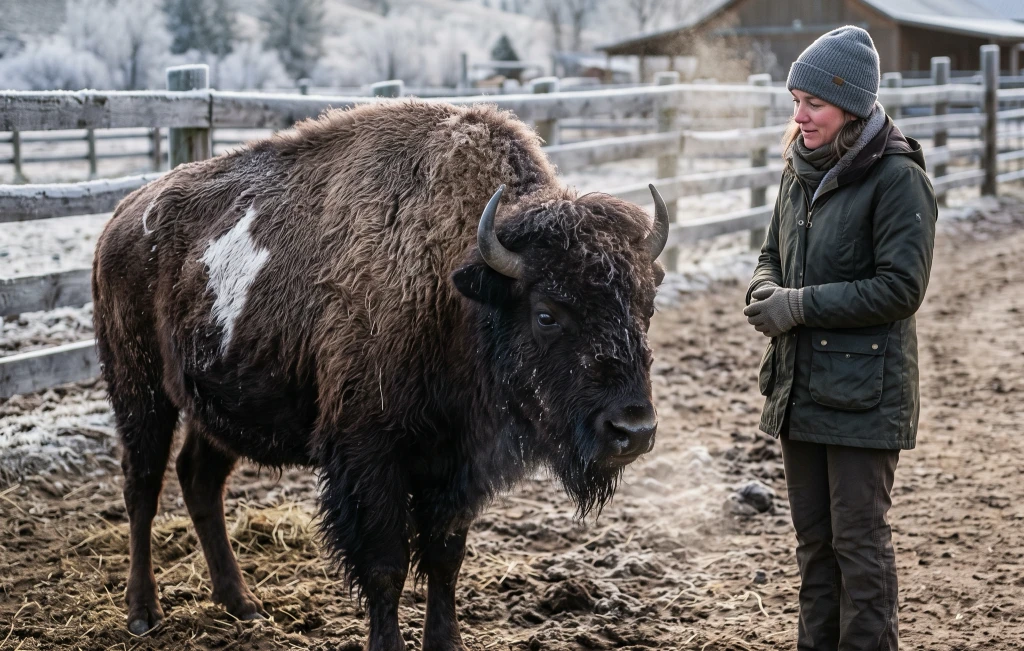
Sixteen turned broadside beside the water tub. Her rubbed coat parted over the left hip, exposing white hair in the shape of a diamond with a break through its center. Nora had taken it for an old injury the evening before.
Grant set the tool bag down. He asked for her binoculars and adjusted them twice, although the cow was close enough to see plainly.
“What is it?” Nora asked.
He lowered the binoculars. “Don’t sell any of them until we’ve talked.”
At the auction, he had wanted her to leave forty bison behind a bankrupt park’s fence. Now his eyes kept returning to the gap in that white diamond. “Grant,” she said, “whose brand is on my cow?”
To read the rest of the story – CLICK the NEXT button 👇👇👇