


On Sunday night, Ben’s image froze on Lauren Reed’s laptop while Clara rehearsed her real-life hero report. He was at a temporary field site several hours north of Oceanside, visible as half a uniformed shoulder against a beige wall. When the connection returned, he was correcting her claim that Scout could smell any danger in the world.
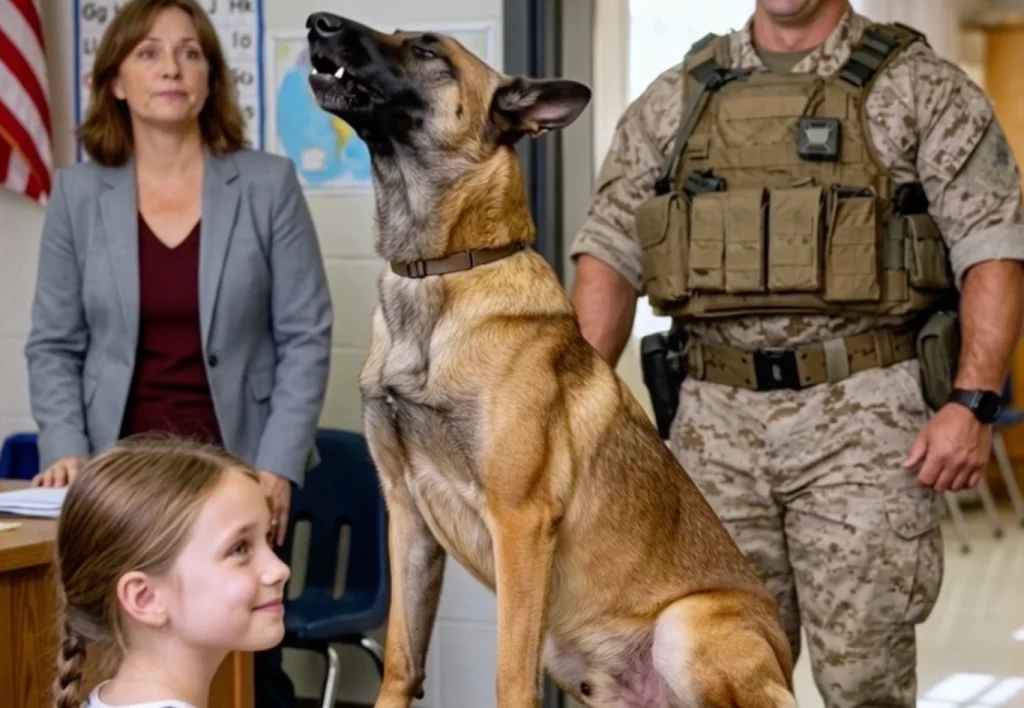
“Use the part you can explain without guessing,” he said.
Clara crossed out the exciting sentence. She wrote that four-year-old Scout had been paired with Ben for three years, searching for specific things while Ben watched the Belgian Malinois’s pace, breathing, and head. Detection remained circled in purple because she understood the rule about restricted details better than she understood that word.
Her drawing showed Scout at Ben’s left, with a pale training scar above the dog’s right ear. Ben confirmed she had chosen the correct side. Then he asked her to begin again and waited through the silence after she forgot “Staff Sergeant” until Clara found it on her own card.
On Monday, Clara arrived at Harbor Ridge Elementary in Oceanside early enough to give her opening to an empty Room 3B. Ms. Harrow found her returning the cards to a blue folder, moved a cart out of the presentation path, and angled the blind away from Clara’s pages.
Clara trusted that attentiveness. The teacher had once covered most of an overwhelming math sheet so Clara could face one row at a time. She told Clara to use the presentation shelf, “where nothing gets bent.”
On the board, three boxes read A REAL PERSON, YOUR OWN WORDS, and INFORMATION WE CAN CHECK. Ms. Harrow said the reports would hang in the hall for Family Learning Night. “Checking is how we take good work seriously.” Clara copied the sentence onto her rubric.
An aunt who repaired elevators and a grandfather who had played in a Navy band went first. Ms. Harrow asked for their sources, then clipped both projects to the display line.
When her name came, she placed the drawing on the whiteboard tray and faced twenty-two desks. Tessa smiled from the second row. Clara fixed her eyes on the green bead at the end of Tessa’s braid and began.
“My dad, Staff Sergeant Ben Reed, is my real-life hero. He serves in the Marine Corps and is partnered with a military working dog named Scout.”
She described the partnership and why a handler had to study a dog closely. She explained that Scout did not choose where the team went, and Ben did not simply wait for a bark. They communicated through practice and changes small enough that another person might miss them.
Ms. Harrow interrupted at the word communicates. “Tell us what that means in this case.”
Clara glanced at card three. “Scout can’t talk, so Dad has to know how Scout says things with his body.”
Several children nodded. The answer belonged wholly to Clara, and for a second the purple circle around detection stopped troubling her.
Then Ms. Harrow asked who had written the sentences. Her pencil rested across the scoring boxes instead of inside one.
“I wrote them,” Clara said. “Dad corrected the things I got wrong.”
“What source did you attach?”
Clara looked inside the folder. The rubric said to name where information came from; she had written Interview with Staff Sergeant Reed on the last page. It had not said a child needed a letter or a photograph. “I talked to him.”
“Your father told you he is assigned to that kind of work?”
“He is assigned to Scout. Scout lives at the kennels when Dad isn’t with him.”
Ms. Harrow lifted the folder and examined the drawing, the citations page, then Clara’s carefully printed account. “This uses specialized language, and there is nothing here an outside reader can verify. I cannot hang a claim about military duties in the hallway because it sounds convincing.”
“You can call him,” Clara said. She offered it as a solution, but the teacher’s eyebrows drew together.
“A presentation is not the time to negotiate the rubric.” Ms. Harrow uncapped her red pen. “The same standard applies to everyone.”
At the top of Clara’s title page she wrote two large words: NOT VERIFIED. The strokes pressed hard enough to leave shallow tracks in the sheet below. She placed the folder on her desk rather than the display line and asked the next speaker to come forward.
Clara returned to her chair with her note cards but no folder. The green bead in Tessa’s braid was hidden now because Tessa had lowered her head.
Later, Ms. Harrow calmly corrected two reversed numbers on Clara’s math page. Her ordinary helpfulness made the red judgment harder to place.
At dismissal Ms. Harrow gave the folder back with a yellow note clipped to it: Revise unverifiable material before resubmitting. Clara tucked it between her lunch box and sweatshirt so no one outside would see.
Lauren had not yet changed out of the cardigan from her grocery shift when Clara reached their duplex. Clara laid the blue folder across the schedule her mother was reading.
“I need you to read the red part first,” she said.
Lauren did. She put both hands on the counter until her first anger passed, then checked the rubric, Clara’s citation, and the disputed sentences. The facts came from Ben, the writing from Clara, and the assignment required no official attachment.
“I’m going to ask her what she needs,” Lauren said. “Until she answers, we are not changing true information into something else.”
Before dinner, Lauren used the school portal to offer a call, conference, or appropriate unit confirmation. A timestamp appeared beside SENT.
Clara refused a clean copy and left the marked folder beside Tuesday’s backpack.
By the time Room 3B settled after the next morning’s announcements, Ms. Harrow had not opened Lauren’s message. She had seen the notification. The family-project display had to be finished by Wednesday, she told herself, and the class had heard a claim she now considered unsupported. In her idea of fairness, a public statement required a public correction.
She called Clara to the front before the reading lesson. The blue folder was already in her hands.
“Yesterday I paused this project because it did not meet our verification standard,” she told the room. “Returning the same version does not resolve the problem.”
“My mom wrote to you,” Clara said.
“Adult messages are handled outside instructional time.” Ms. Harrow turned the folder so the red notation faced outward. “Right now I am responsible for what this class has been taught to accept as fact.”
The wastebasket stood at the end of the whiteboard, not beneath Ms. Harrow’s desk. She crossed to it with the briskness she used when removing a broken marker. Clara understood her intention only when the folder struck the plastic liner.
Its upper corner buckled against the side. Ms. Harrow pushed once, and the blue cover settled among spelling drafts, eraser dust, and the curled cedar scraps from the pencil sharpener.
Then she returned to the front of the room. “Clara, you owe your classmates an apology for presenting a story as if it were verified fact.”
To read the rest of the story – CLICK the NEXT button 👇👇👇