


The call reached Detective Nathan Calder at 6:42 on a Wednesday evening, while he was rereading his notes from that morning’s meeting with Chief Owen Mercer. At forty-six, after twenty-three years in the department, Nate knew Owen did not use the word alone casually. A coffee ring darkened the corner of the page. Beneath it, in Nate’s own cramped handwriting, were four words: Bring this tomorrow. Alone.
“Nate?” Officer Maya Torres sounded as if she were trying to keep her voice official and failing. “It’s the chief. Ruth came home with groceries and discovered him collapsed on the living-room sofa. The paramedics pronounced him twenty minutes ago.”
Nate stared at the closed office door. That morning Owen had run five miles, complained about the department coffee, and ordered Nate to keep their next meeting from everyone—especially Deputy Chief Grant Vale. Now somebody was calling his death a heart attack. “Where’s Atlas?” Nate asked.
“At the Mercer house. Mrs. Mercer’s neighbor has him.”
Shortly before ten, Owen lay in a polished casket at Graydon & Sons Funeral Home, still in the dark-blue uniform he had worn for thirty years. The speed of it bothered Nate before anything else did. A healthy police chief had died at fifty-eight, yet the county medical examiner had never been called, and Vale had arranged a morning service before the release papers had cooled.
Ruth Mercer sat beside the casket with both hands wrapped around a paper cup she had forgotten to drink from. At fifty-six, silver threaded the auburn hair at her temples. For twenty-eight years she had quieted rooms full of third-graders without raising her voice; that evening, the people surrounding her lowered theirs whenever she looked up.
“His physical was clean last month,” she told Nate. “He’d been coming home late and shutting me out. Elaine started bringing coffee most mornings so I could leave for school on time. Monday night I heard him say on the phone, ‘This reaches farther than I thought.’ Then he saw me and changed the subject.”
Nate looked at Owen’s folded hands. Thirty years earlier, when sixteen-year-old Nate was caught prying open a corner market, Owen had taken him to supper with Ruth instead of ending the night at juvenile detention. Meat loaf, volunteer hours, and Sundays at their table had changed his life more effectively than any lecture.
“Did Vale tell you why the medical examiner wasn’t involved?” Nate asked.
Ruth’s grip tightened around the cup. “He said an examination would only make a terrible day worse.”
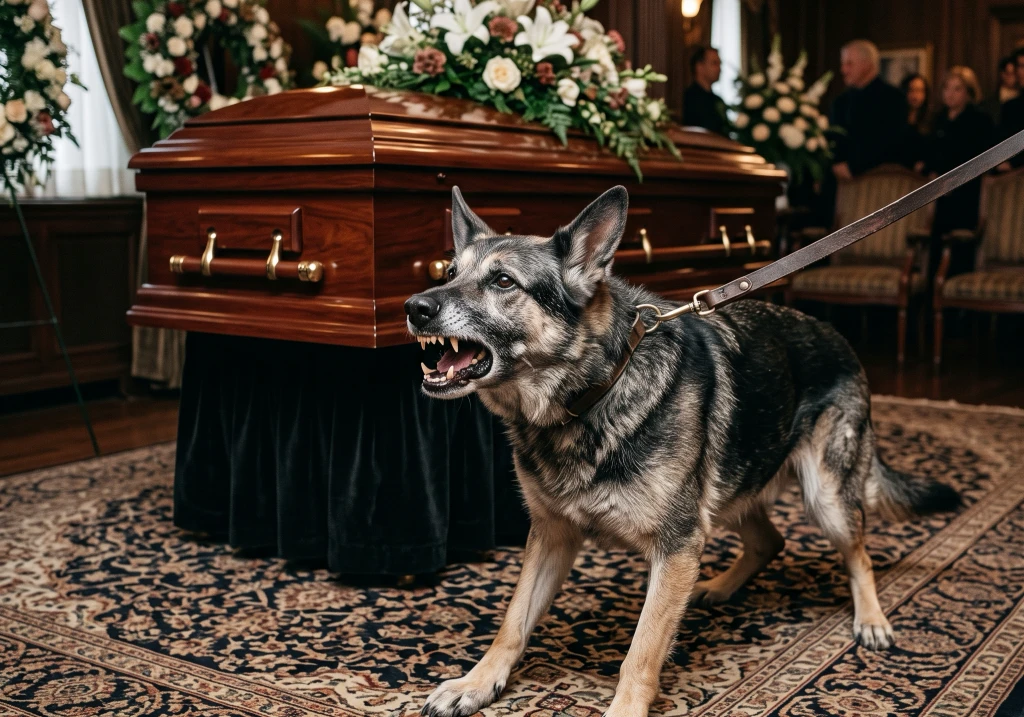
The viewing-room door opened, and Ruth’s neighbor came through it two-handed on Atlas’s leash. The German Shepherd was eleven now, deep-chested and gray around the muzzle. One ear stood higher than the other and carried little sound, damage left by the warehouse blast seven years before that had killed his first handler and ended his police career.
Owen had slept on a folding chair through the dog’s first nights after surgery. When the department retired Atlas, Owen brought him home. The animal who entered Graydon House had spent years moving through crowds at Owen’s knee; he crossed three steps with that old discipline, caught a scent, and stopped so abruptly the neighbor nearly fell.
Atlas faced the casket. His nostrils worked.
Then a thin sound gathered in his throat, and he pulled.
Nate took the leash before the dog could drag the woman across the carpet. “Easy.”
Atlas did not look at him. He leaned toward Owen with every pound of his body, claws catching in the rug, the whine rising into short, hard barks. Flowers trembled in their stands.
“Get him outside,” Vale said. He had appeared at Nate’s shoulder in an immaculate dress uniform, blond hair combed into place, his expression composed with the care of a campaign photograph. At forty-nine, after eight years as Owen’s second in command, Vale knew how to make impatience sound like procedure. “Ruth has endured enough.”
“Atlas is family,” Ruth said.
“He’s distressed. Keeping him here isn’t kindness.”
Nate watched the pattern of the barking. Atlas would pull, freeze, sample the air, then pull again. It resembled the alert he had once used when he found a concealed person, though age and retirement had softened the trained posture. “Who signed the final release?” Nate asked.
Vale’s eyes moved from the dog to him. “The attending paramedic and the family physician. Don’t turn grief into an investigation.”
Dr. Lena Ortiz arrived ten minutes later without an invitation. The Alder County medical examiner was thirty-eight, small enough that crowds often failed to make room for her until she spoke. She read the paperwork near the foyer, glanced once toward Vale, and asked Nate to take Atlas into the hall.
“I learned about Owen from a deputy,” she said quietly. “My office should have been notified. Sudden death, active police chief, no documented cardiac history—I would have requested at least an external examination.”
“Can you do one now?”
“Ruth can ask. Vale has already told the funeral director the service leaves for the cemetery at six-thirty.” Lena looked through the open doorway. Atlas stood with his head low, staring at the casket from thirty feet away. “That dog isn’t proof of anything. He is a reason to slow down.”
Nate asked the funeral director for a chair and stayed after the staff moved to the residence wing. Atlas settled at his feet, rose again, and paced back to the closed casket. Rain ticked against the tall windows through the small hours. The room smelled of lilies, furniture polish, and the cold mineral breath of the air-conditioning.
At 5:17, long after midnight but before first light, Atlas stood and growled toward a dark corner beside the side entrance.
A man stepped into the aisle wearing a black raincoat and a felt hat drawn low. He was trim, perhaps in his mid-fifties, and carried himself with the balanced stillness of someone accustomed to being watched. “My apologies. I expected the room to be empty.” Each word arrived clipped and precisely weighted. Nate could not place the cadence; it sounded practiced rather than inherited.
“The building is closed.”
“The night attendant let me in. Adrian Shaw. Our work crossed paths overseas, before you knew him.” The man offered a business card, but he did not come close enough for Nate to take it. Atlas lowered his head another inch. “Apparently the dog hasn’t forgotten me.”
“From where?”
Shaw’s gaze kept returning to the casket. “Overseas work. A long time ago.”
Something knocked once inside the wood.
Atlas wheeled and drove toward the platform. Nate caught the leash against his hip as the dog clawed at the casket skirt, barking with a force that filled the room. When Nate turned back, Shaw’s face had gone slack beneath the brim of his hat. The man backed through the side door and vanished into the rain before Nate could reach him.
Nate laid both palms on the lid. No second sound came. He called Lena twice, but both calls went to voicemail. Waking Ruth with a noise he could not prove would only multiply her grief. He wrote Adrian Shaw’s name, the time, and the vanished visitor’s description in his notebook, then settled beside Atlas and kept one hand on the leash. The dog remained against the casket through the last wet hour before dawn.
Ruth returned shortly after six with her sister, Elaine. Vale arrived moments behind them, found Nate and the dog where he had left them, and ordered Atlas taken home before the service. Ruth ended the argument with one look and took the leash herself. Nate kept the visitor and the uncertain sound in his notebook; he needed more than exhaustion before he gave either to her.
The chapel already held teachers, patrol officers, city officials, and families who had come early for the six-thirty service. County Commissioner Everett Sloan sat in the front row. At sixty-two, he was the silver-haired patron who had appointed Owen chief fifteen years earlier. He squeezed Ruth’s shoulder before taking a seat two chairs from Vale. Lena slipped into the back row with her medical bag as the funeral director called the pallbearers forward.
Atlas had been quiet through the gathering crowd, but when the funeral director reached for the casket handles, the dog surged hard enough to pull the leash from Ruth’s hand.
He struck the platform, caught the hanging silk between his teeth, and tore it free. Several people cried out. Vale reached for Atlas, and Nate moved between them.
“Listen to him,” Nate said. “I heard one sound inside that casket before dawn. I couldn’t prove what it was. I can prove the dog will not let Owen leave this room.”
“You sat here until you started hearing things,” Vale snapped. “Move.”
Nate looked past him to Ruth. Asking would either disgrace the man who had given him a life or keep that man from losing his. “I need the lid opened.”
Vale turned on Ruth before she could answer. “You’re in shock. Don’t let him do this to Owen.”
Ruth rose. Her face had emptied of everything except decision. “I am Owen’s wife. Release the latches.”
The funeral director released the brass latches. As the lid lifted, Atlas stopped barking. Owen lay motionless under the chapel lights, his color wrong but no worse than it had been the night before. Lena came down the aisle with her medical bag, pushed past the frozen pallbearers, and placed two fingers against his neck.
Ten seconds passed.
Then her eyes lifted to Nate’s.
“He has a pulse.”
To read the rest of the story – CLICK the NEXT button 👇👇👇