


The auctioneer wanted five dollars for the safe. Ben Calder crouched beside it instead of bidding, close enough to see where the burned steel curled inward and the cut stopped.
“You lose something down there?” Grant Talbot called.
Ben heard the laughter behind him. He put a finger near the damaged corner, careful of the edge. Someone had worked hard to get through that door. Then, several inches short of the chamber, they had quit.
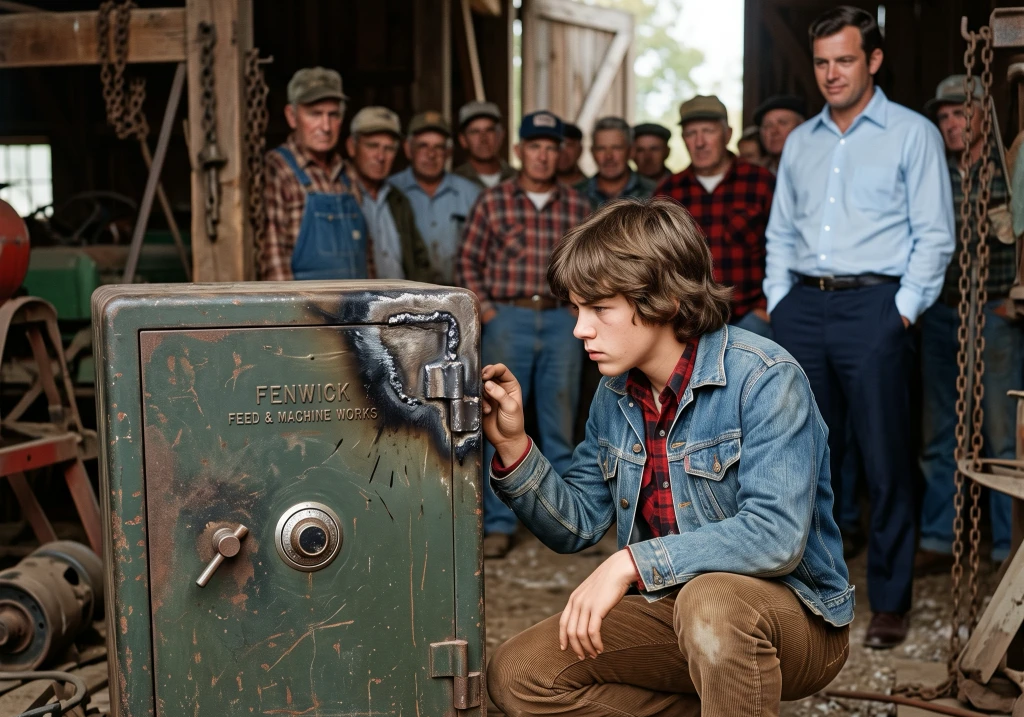
It was a Saturday in Pennsylvania, in the fall of 1971. Ben was fifteen, and the forty dollars folded in his pocket had come a little at a time: hauling feed, cleaning machinery, stretching fence for neighbors. He and his grandfather had come to the closed Fenwick Feed & Machine Works looking for a hydraulic pump they could afford. The safe was no help with that.
Walter Calder stood beyond the circle of men, his cap pushed back. Their sixty acres had taken rain when they needed to plant and heat when the corn needed moisture. Then the tractor engine had failed. Walter had pieced it together with used parts, and there was almost nothing left for the pump.
Ben looked at him, then back at the steel.
The mill had been shut nearly a year, but grain dust still caught in the seams of the machinery shed. Diesel and cutting oil lingered inside. Since before sunrise, farmers from three townships had been picking over the equipment; now the workers had rolled out what remained, including this eight-hundred-pound floor safe with its broken brass dial.
“Nobody’s opened it,” the auctioneer said. “Buy yourself some scrap.”
“Could feed chickens out of it,” Talbot said. “If you could get the feed in.”
Talbot owned the supply business and leased thousands of acres. For eighteen months he had been buying more land from people who were having a year like the Calders’. Twice he had offered Walter money for their farm. Ben remembered both visits, especially the way Talbot discussed access and drainage without once asking where the house stood.
At the safe, the factory seams were even. Near the damaged place, another ridge of metal ran at a different angle. Ben had watched his grandfather mend enough equipment to know that the difference meant something, even if he could not yet say what.
He raised his hand.
The bidding stumbled upward. Ten dollars. Fifteen. At twenty-five, Talbot wanted to know whether Ben was opening a museum. Ben kept his eyes on the auctioneer, because looking around would mean seeing Walter, and he was afraid he might mistake his grandfather’s silence for an order to stop.
“Forty,” Ben said.
The auctioneer waited. Ben could feel the folded bills against his leg, though he had already spent them. Then the safe was his, and someone behind Talbot laughed again.
Walter helped him arrange the chain hoist. With the auction workers guiding the load, they lowered the safe onto the truck and secured it for the drive. Ben carried the receipt in his shirt pocket; he kept touching it as though it might explain what he had done.
For the first few miles, Walter watched the road.
“What’s in it?” he finally asked.
“I don’t know.” Ben turned toward him. “The cut doesn’t go far enough.”
Walter waited while Ben described the edge and the different weld. Having to explain it without the safe in front of him made his observation sound smaller.
“Might be empty,” Walter said.
“I know.”
“Then we’ll get it open and know for certain.” He changed gears. “Bring the light when we get home.”
That evening, with the safe unloaded in the barn, they scraped loose rust from the damaged corner. Ben held the flashlight while Walter worked. Under the flakes, the second weld continued around a reinforced inner section, narrow and uneven beside the broad factory work.
Ben reached for the grinder. Walter caught its cord before he could plug it in.
“Ruler first. And that magnet.”
They followed the seams, checking exposed layers and chalking what they could establish. Walter showed him the rough repair and the old heat discoloration, traces of straw and blue fading into gray. This work belonged to a different occasion.
“The torch stopped here,” Ben said.
“And this was welded afterward.” Walter moved the light. “Somebody wanted this section closed.”
Ben looked again at the place he had almost put the grinder. Behind the steel there might be paper. Walter reminded him how much heat could reach the contents before a cutting tool ever touched them.
They left it alone that night.
On Sunday, they moved it to the clear concrete beside the workbench. Their old overhead hoist took the strain while they worked with a chain, steel rollers, and a pry bar, stopping whenever anything shifted wrong. Walter kept Ben out of the load’s path. By the time they had the safe settled and blocked, Ben’s palms were sore and the afternoon was gone.
The cutting began Monday evening. Walter had marked the later welded section, away from the factory seams. He stayed beside Ben with the extinguisher within reach, watching the metal as carefully as he watched the wheel.
Ben had expected the satisfaction of something giving way. Instead he got noise, vibration up his arms, and a groove that scarcely seemed deeper when they stopped. They let the metal cool between short passes. Walter used damp rags on the heated steel while the tool was safely set aside; even so, he called a halt sooner than Ben wanted.
On Tuesday, the hardened layer consumed three wheels. Ben’s forearms shook when he finally put the grinder down. Walter took the flashlight to the narrow opening and found more steel behind it, confirming that the work they had uncovered was a modification, not part of the original door.
“We’re getting there,” Ben said.
Walter looked at his hands. “Tomorrow.”
Ben wanted to object, but could not have held the tool steady if his grandfather had agreed. He swept the cooled debris instead.
On Wednesday, they finally opened the inner wall. Ben leaned toward the gap with the flashlight, expecting at least a shape he could recognize. The beam crossed bare metal.
He moved it slowly from side to side. No bundle lay on the floor of the chamber. No shelves held anything. He could hear the auctioneer calling it scrap again, with Talbot adding his joke.
Walter reached for the light, but Ben kept it a moment longer. The repair still bothered him. Why close an empty compartment that carefully?
He picked up the small machinist’s hammer and tested the back wall. The first taps rang sharply. In the lower corner, the sound shortened.
Ben tapped twice more. Walter brought the chalk without being asked.
They opened that place carefully, taking off small sections until a narrow cavity showed behind the wall. Something black sat inside it. Ben eased out a document box wrapped in oilcloth and put it on the workbench with both hands.
The little lid lifted easily. There were photographs, receipts from the 1920s, handwritten records, and folded surveys. Under the papers lay a heavy iron piece Ben first took for a machine fitting.
Walter opened the largest map. Ben recognized the creek at the lower edge of their farm, then traced a thin channel upstream through the valley toward the mill. His grandfather turned the iron piece over and identified it as a survey marker.
Beneath it was an envelope. Ben unfolded the sheet inside and brought it under the light.
“Should the mill claim this water as its own,” he read, “deliver the enclosed papers to the county.”
To read the rest of the story – CLICK the NEXT button 👇👇👇