


Nora Whitaker had already photographed the flock when she centered one trailing swan in the viewfinder. Before she could press the shutter again, the bird vanished into the reeds. Nora advanced the film and made a second frame of the suddenly empty water, expecting the swan to drift back into view.
Instead, something struck the water twice, and a ragged sound rose from the reeds. Nora lowered the camera. It was not a startled birdcall or the splash of a fish. It had breath behind it—short, failing bursts that made her set her old Minolta on the grass and walk toward the muddy edge.
A large white swan lay wedged between broken stalks less than six feet from shore. Mud darkened its breast. One wing was pressed close to its body, while the other hung at an angle that made Nora’s own shoulder ache. Feathers along the leading edge were clotted red, and each attempt to pull free tightened a loop of flattened reeds around its legs.
The damage looked recent. Water around the bird held only thin pink threads, yet the exposed feathers had been crushed and torn. Nora could not tell whether the animal that attacked it was gone or watching from the brush behind her. She checked the bank once, saw nothing moving, and kept her body between the swan and shore.
The swan lifted its head. Its beak opened, but only a dry hiss came out.
“I see you.” Nora crouched, keeping her hands close to her knees. “I’m not coming at you yet.”
Nora knew frightened swans could injure a person, but her phone had one bar of service and the county wildlife number offered only a recording. When the bird struggled and slid deeper, waiting became its own decision.
She ran to her hatchback, leaving the tripod and camera in wet grass. She returned with rubber boots, a faded red wool blanket, and a broad canvas equipment bag with a broken divider. The lake poured over her boots on the second step and soaked her jeans.
“I’m going to cover your head,” she said. “You’re allowed to hate me for it.”
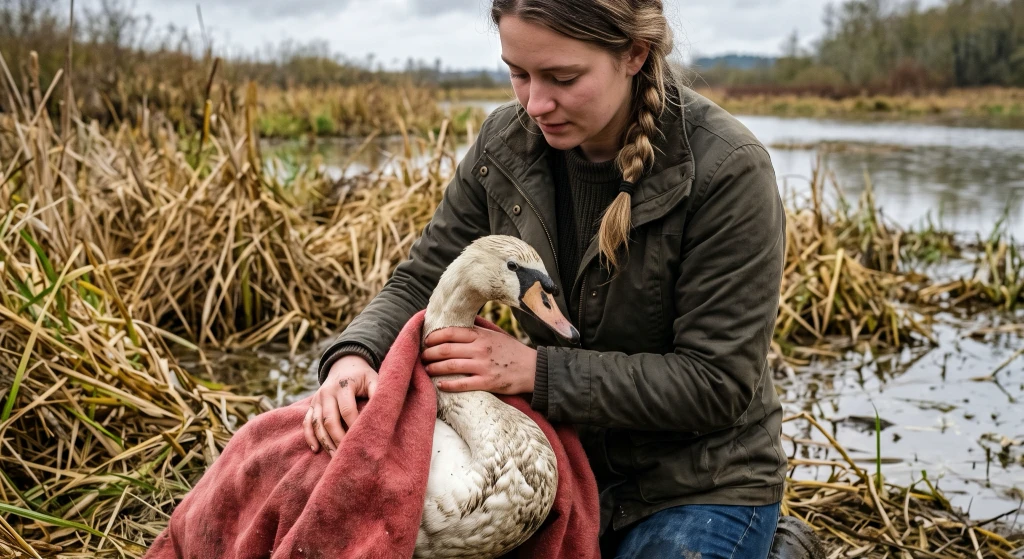
She approached from the side, speaking in the low voice Ray had used when teaching her to load film in darkness. The swan struck once and missed her wrist. Nora spread the blanket over its head and back, gathered the injured wing against the body, and felt through the wool for the reeds trapping its legs. One stalk broke, then another. When the bird’s full weight shifted into her arms, she planted a boot in the mud and held on.
Its good wing hammered once beneath the blanket and nearly knocked her sideways. Nora sank to one knee, felt mud close over the boot, and waited until the movement stopped. She did not try to stand until she could feel both webbed feet clear of the reeds and the injured wing resting exactly where she had found it.
The swan was heavier than it had looked through the lens. Its heartbeat knocked against her palms as she carried it to the bank and eased it into the blanket-lined equipment bag, leaving the top open and clear of its neck.
“That’s it,” she whispered. “You’re out.”
At twenty-three, Nora made her living photographing people and spent free mornings waiting for landscapes to forget she was there. Her father, Ray, had taught her that patience in the makeshift darkroom of their small house outside Asheville. He had blacked out their only bathroom and let his eight-year-old daughter watch a neighbor’s face rise from blank paper beneath a red safelight. With a juried show opening in six weeks, she still preferred film because it forced her to look before she took.
The bird no longer fought. Nora dragged the bag across the grass, recovered her damp camera, and secured the swan on the back seat between rolled blankets.
Two veterinary clinics refused wildlife, and a third sent her back to the unanswered state hotline. Then a man at Cedar Hollow Veterinary Center outside Waynesville asked how much blood she could see.
“Less than before. The wing is hanging, and she’s barely alert.”
“I hold the wildlife-rehabilitation permit required for this intake, and Cedar Hollow is my approved facility,” he said. “Keep the wing where it rests, and don’t offer food or water in the car. How far out are you?”
“Thirty-five minutes.”
“Make it a safe thirty-five. I’ll meet you at the side entrance.”
Nora kept the car cool and spoke whenever the breathing behind her became too faint to hear. Ray called after receiving her hurried text. “You got her out,” he said. “Now let the next person do his part.”
The veterinarian waited where he had promised. He was close to thirty, dark-haired, and plainly exhausted beneath a faded work shirt. “Nora? I’m Caleb Monroe.” He looked into the open bag without reaching for the bird. “You kept the bad wing from opening. That mattered.”
Inside the clinic, Caleb dimmed the exam room and asked Nora to hold the blanket while he checked the joints, clipped matted feathers, and listened to the heart. The swan fought his first touch, then weakened again.
“Adult mute swan, and badly dehydrated,” he said. “Punctures and torn muscle, but I don’t feel a displaced fracture. A fox or loose dog could cause this. I’ll confirm the sex from the blood sample, and I need a radiograph before I promise anything.”
After weighing her and checking her breathing, Caleb sedated the swan. A technician named Marisol helped with the radiograph and treatment. There was no broken bone. Caleb flushed the wounds, removed debris, closed what was safe to close, and dressed the deepest tear so it could drain.
Nora waited outside the treatment line with the blanket bundled against her stomach. She watched Caleb pause twice to reassess the bird’s breathing rather than rushing to finish. Marisol recorded every medication and finding on the wildlife intake sheet, then brought Nora a dry clinic sweatshirt without commenting on the water running from her jeans.
More than an hour later, the swan lay in a padded recovery pen, her head against a rolled towel.
“The intact bone gives her a chance,” Caleb said. “The tissue damage is serious. Even if the wounds heal, we won’t know for weeks whether she can fly well enough for release.”
Nora looked through the pen door. “You’ll keep her?”
“I can take her under my permits here at the clinic. Fluids, antibiotics, bandage changes, then controlled movement.” He rubbed the bridge of his nose. “She may not thank either of us.”
“She doesn’t have to.”
The swan stirred at Nora’s voice. One dark eye opened, then closed again. Caleb watched. “Can you come back at seven tomorrow morning?”
Nora glanced at him. “Why?”
“Because the first bandage change requires two steady people,” he said. “If you’re willing to register as a supervised volunteer, I can train you to assist without extending the handling.”
To read the rest of the story – CLICK the NEXT button 👇👇👇