


The first warning was a thin whine beneath the diesel, too faint for anyone who had not spent thirty years listening to engines work. Cal Brennan lifted his foot from the throttle and watched the temperature needle ease past the mark where it belonged. Twenty miles ahead, beyond McClure Pass, a service yard kept a bay open for stranded freight trucks. Twenty miles was nothing on a good day. That afternoon it might as well have been another state.
He downshifted his aging Kenworth and felt the loaded trailer push against him on the grade. The engine answered with a cough. On the dashboard, a palm-sized walnut box trembled against the strap that held it beside his GPS.
“Easy,” Cal said, though he was no longer sure whether he meant the truck, himself, or Nora.
At fifty-three, after thirty years on the road, he knew which western Colorado curves held black ice after noon. He also knew when a machine had stopped negotiating. The second cough came harder, followed by a shudder through the steering column and a dark burst from the exhaust in his mirror.
Cal switched on his hazard lights, let the rig lose speed, and guided it onto a narrow turnout. The steering went heavy just before he set the brakes. When he killed the engine, the cab filled with a silence so complete that the ticking metal beneath the hood sounded like rain.
The CB had been nearly empty all afternoon. A dispatcher at a truck stop in Montrose had repeated the weather bulletin over coffee: weeks without useful moisture, exposed fuels despite patchy snow, a hard cold front arriving behind powerful wind. A wildfire in December sounded wrong until she listed the red-flag conditions. Cal had listened, looked at the pale sky, and decided the road still looked like a road.
Nora would have called that his oldest bad habit—mistaking familiarity for control.
She had been gone three years. The walnut box held only part of her ashes, but he carried it as faithfully as his logbook. The rest waited at home. Leaving all of her there had felt worse than taking some part over roads they once traveled together. Each morning he secured the box beside the GPS. Each night he moved it into the sleeper, as if wood and brass could be offended by neglect.
“Looks like we’re staying awhile,” he told her.
He thumbed the satellite phone’s power switch, but the screen remained dark. He had left it unplugged at his last stop. The twelve-volt adapter lit, but the phone did not; its charging port shifted under the plug, damaged in a fall from the bunk. Cal reseated the battery. Nothing. His emergency power pack had been drained by his flashlight. He sat still, embarrassed in the privacy of an empty cab.
His company knew his route. Missing the evening check-in would start calls; missing the next one would bring someone looking. He had food, water, flares, an extreme-cold sleeping bag, and an independent bunk heater that could sip from the fuel tank for close to two days. Under ordinary circumstances, waiting was the sensible choice.
He pulled on his insulated coat and gloves and stepped down into a wind that took hold of his breath. The mirror thermometer read fifteen degrees below zero. Snow lay in shallow ribbons under the spruce, leaving brown grass and deadfall exposed on the sunward slopes.
When Cal raised the hood, white vapor rolled past his face with the sweet, sharp smell of coolant. A radiator hose had split along the clamp, spraying the front of the engine. He could carry spare belts, patch an air line, and change a fuel filter on a shoulder, but he could not make a sound cooling system out of an empty one. He lowered the hood before the wind tore it from his hands.
That was when something tawny moved between two trees.
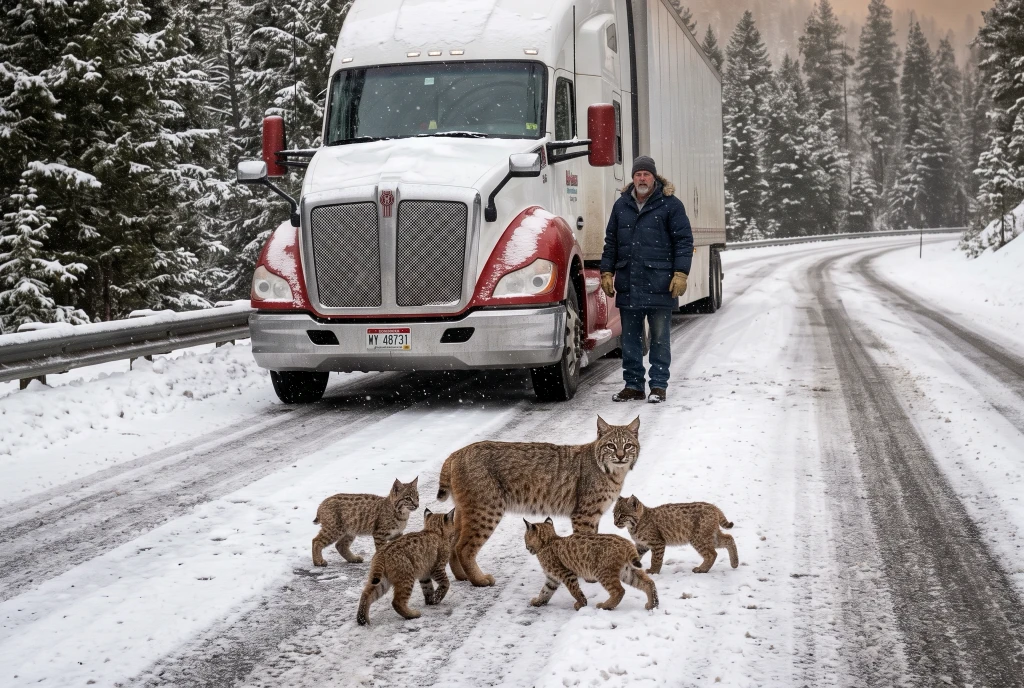
Cal stopped beside the front tire. Most black bears should have been denned, but the country held mountain lions, coyotes, and the occasional wolf. The animal that stepped into view was smaller, long-legged for its compact body, with dark bars on its forelegs and a short tail. A bobcat.
She stood at the edge of the timber, perhaps twenty yards away. Cal could not truly know she was female from where he stood. Then four spotted youngsters emerged behind her, and the question answered itself.
“Well, I’ll be,” he whispered.
The kittens were not newborns. They were half-grown, all ears and overlarge paws, old enough to travel but young enough to crowd together when the wind struck them. Cal had seen single bobcats cross the highway at dawn, brief as thrown shadows. He had never seen a family, and certainly not one that remained after seeing him.
The mother came forward several paces. Her ears flattened, lifted, then turned toward the west. Instead of a hiss, she made a rough, carrying chirp. One kitten answered from the brush.
Cal kept his hands low. “I’m not coming any closer.”
The cat paced across the opening, looked toward him, then back into the trees. She repeated the call. Her young kept glancing in the same direction, their bodies compressed close to the ground.
At first Cal smelled only coolant. The next gust brought something drier and dirtier, a bitterness that caught behind his tongue. He turned west.
A brown-black column had risen beyond the ridge while he was under the hood. It spread across the colorless sky, flattening under the wind. Far below it, between the trunks, an orange pulse appeared and vanished.
Fire.
He climbed onto the running board for height and looked along the highway. The service yard was twenty miles east. The last ranch access lay miles behind him. Dense timber climbed above the north shoulder, while the ground to the south fell into broken gullies. The forecast gusts were supposed to reach sixty or seventy miles an hour. Even if the main front moved more slowly through patchy snow, windblown embers could cross a ridge and start ahead of it.
Waiting in the truck had stopped being sensible.
Cal dropped into the cab and worked by habit. Water inside his coat. Food, flares, wool cap, first-aid kit, emergency blanket, flashlight, sleeping bag lashed beneath the pack. He hesitated over the walnut box only long enough to feel ashamed of hesitating, then freed it from the dashboard strap and slid it into the padded inner pocket.
Outside, the mother bobcat had gathered her four young at the mouth of a narrow game trail. The trail angled southeast, away from the visible smoke and off the highway into country Cal had only ever seen through glass. She moved twenty feet into the trees and stopped. One kitten wandered toward the ditch; she turned it back with her muzzle, then faced Cal again.
He told himself she was watching a possible threat. He told himself the trail was simply her own escape route and that a frightened man could turn any pause into an invitation. Both explanations were reasonable.
Then the cat walked farther down the trail, stopped once more, and waited while smoke lowered over the road.
“Nora,” Cal said, tightening the pack straps, “if this is the worst decision I’ve ever made, you’re allowed to say so.”
The box pressed against his ribs as he crossed the shoulder. The mother held his gaze until his boot left the pavement—then she turned, gathered her four young, and led him into the smoke-dark trees.
To read the rest of the story – CLICK the NEXT button 👇👇👇