


The black vulture dropped beside the farm road, and Owen Pike lifted his foot off the gas. Under the bird’s spread wings, something small was trying to raise a paw. The paw swung once. The vulture hopped backward, then folded its wings and stepped in again. Owen braked hard enough to send a box of pipe fittings sliding against the partition behind his seat.
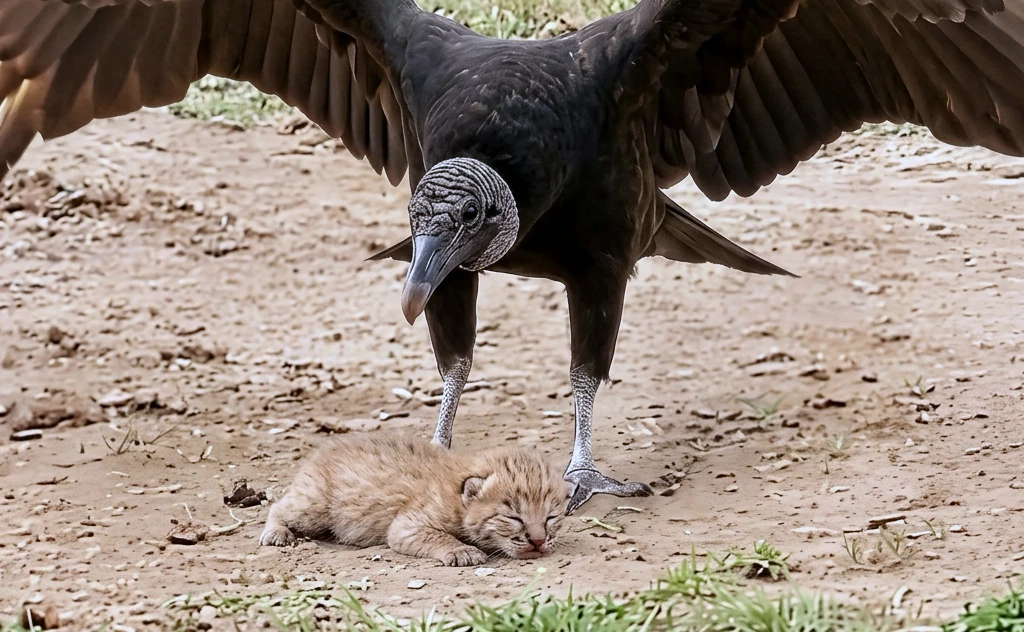
He pulled onto the broad shoulder fifty yards ahead. With the lane clear, he backed slowly, watching the bird in his mirror until the spotted shape came into view through his passenger window. It was a kitten, smaller than the ones people offered outside the feed store, with eyes that hadn’t opened yet.
Owen pressed the horn. The vulture flapped onto a fence post and turned toward the sound; below it, the kitten’s paw dropped into the dust. He already had his other hand on the door handle when he stopped himself.
There was an old bath towel behind his seat. He could get the kitten into the van, but then what? He took out his phone and called county animal care instead.
“It’s beside the irrigation ditch. North of the leaning cattle gate, on the road out of Weslaco.” He gave the dispatcher the nearest intersection. “I think it’s a baby bobcat. There’s a vulture trying to get at it.”
He had driven this delivery route six mornings a week for nearly twelve years. Usually that meant slowing for turkeys and keeping his coffee upright. Now the familiar gate and culvert told an officer where to stop.
The bird lowered itself from the post. Owen hit the horn again, then eased the van to an angle that put its shadow across the kitten. He stayed behind the wheel until the county truck arrived.
Officer Mateo Reyes carried gloves, a thick towel, and a ventilated carrier around the front of the van. When he crouched, Owen could see the kitten’s ears folded against her head and dark, matted fur across one shoulder. She made a small rasp as the towel closed around her.
“She couldn’t have walked here,” Owen said through the open window.
Mateo glanced at the ditch, then at the thorn brush beyond it. “Doesn’t look like she could walk much of anywhere.” He settled her into the carrier and called a veterinarian before lifting it into his truck.
Owen watched until the truck turned away. The vulture had moved higher, to a utility pole. He put the van in gear, leaving the towel where it was.
Dr. Anika Rao called Grace Moreno after the kitten began responding to care. By the time Grace arrived, the fur was clean enough for the shoulder marks to show. Anika had given warmed fluids and was watching her breathing. Her examination had found no broken bones; the shallow injuries worried her less than the dehydration, missed feeds, and time on the hot shoulder.
“She’s about a week old,” Anika told Grace. “Possibly younger. She’s responding, but we need to see her hold steady.”
Grace put her bag under a chair and washed her hands. At thirty-eight, she had raised native mammals under a state rehabilitation permit for years, including bobcats considerably bigger and angrier than this one. This kitten’s entire objection to being examined had been that thin rasp.
Mateo stood near the door with his empty gloves folded together. Grace asked him where the kitten had lain, how far the brush was from the shoulder, whether he’d seen another animal or fresh road debris. When he finished, she made him go back over the location.
“The bird came from which direction?”
“Southeast, according to the driver. I saw it on the pole.” He pointed across the room as though the road ran through it. “Brush on that side. The ditch between.”
There was no dead adult to explain the kitten, no clear sign of a collision. Grace watched her press her nose into the towel and open her mouth, searching for something that wasn’t there. Whatever had separated her from her mother had left them very little information.
“I can take her,” Grace said. “But I’d like to look where she was found.”
Mateo glanced at the small bundle. “You think her mother’s still there?”
“I think this one’s too young to have traveled far. That’s enough to look.”
Anika drew the cover back into place. “You can look tonight. She stays in care until she’s warm, hydrated, and alert enough for us to consider anything else.”
Grace could arrange the feedings, warmth, and long rehabilitation. If a mother was in that strip of brush, she wanted to find her before she began raising the kitten herself.
Near dusk she returned to the ditch with Mateo and a state wildlife officer. They left the kitten in care and kept their own feet on the already disturbed ground. Grace bent to look beneath the grass.
Mateo found the first print where the ditch mud held moisture. He pointed with a straight finger, careful not to touch it. The track was round, with no visible claw marks; two more led beneath a mesquite toward dense thorn.
“Bobcat,” Grace said. “An adult. Recent, too.”
He smiled, then waited for her to smile back. She looked along the bank before answering the question he hadn’t quite asked.
“It gives us somewhere to put a camera. We don’t know whose tracks they are.”
The strip of cover was narrow. Farm equipment crossed the fields, traffic ran beyond them, and drainage lines like this carried coyotes after dark. Grace could see possible entrances in the thorns, but she kept out of them; searching every hollow might drive away the animal they needed to find.
They fixed a trail camera toward the sheltered opening beside the ditch. Mateo checked the angle while the wildlife officer kept clear of the track line. Before darkness settled, they were back in their vehicles.
That night, at her center, Grace watched the kitten on an incubator camera between prescribed feedings. She entered quietly for care, wearing gloves, and left as soon as she could. The kitten found a rolled towel with her nose, pressed both little paws into it twice, and fell asleep in the crease.
On the next check, Grace’s hand rested briefly on the incubator latch. The kitten was breathing evenly, her nose tucked down. Grace took her hand away and went to write the feeding entry instead.
Before sunrise she met Mateo at the ditch. They exchanged the camera’s memory card and returned to the truck to look at it, leaving the opening clear. The first frames contained grass, then a raccoon crossing the bank.
Grace advanced the images. At 4:17 a.m., an adult female bobcat had entered the frame.
Grace toggled between the three photographs, tracing the female’s progress with her finger: a stop at the ditch opening toward the road, a position nearer the shoulder, a turn back into cover. None showed where she went next.
“That’s her?” Mateo asked.
“It’s a female using the right stretch of ground.” Grace enlarged the image. “We can’t say more from this.”
Neither spoke. The kitten was at the center, due for another feeding; this animal had been here in the dark, within yards of the place where Owen had stopped. Mateo looked from the screen toward the field.
“You’re going to put that baby outside again?” Mateo asked.
To read the rest of the story – CLICK the NEXT button 👇👇👇