


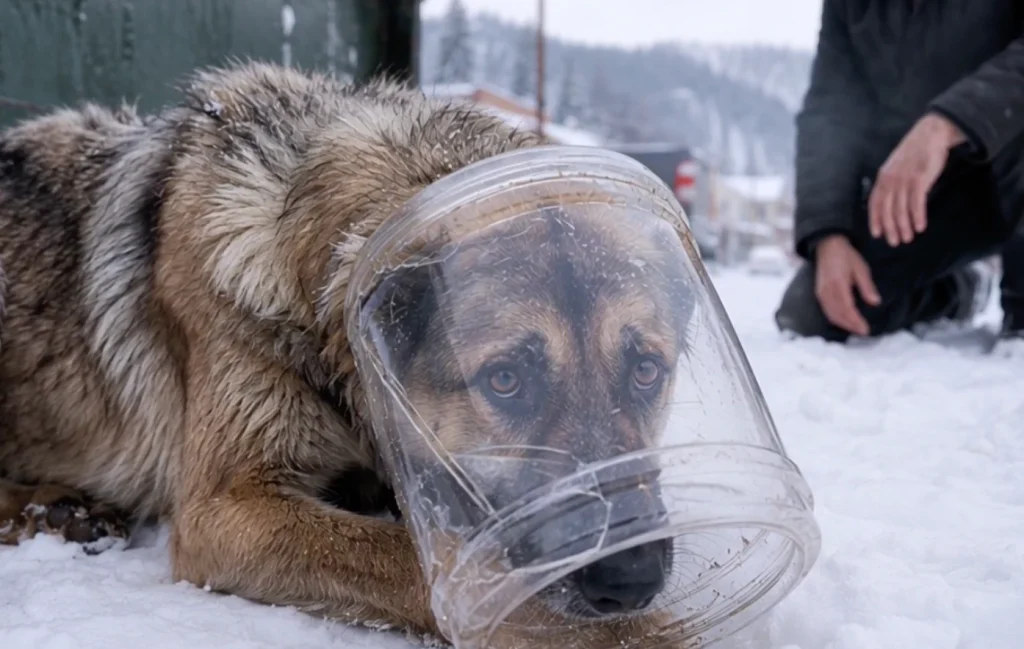
Daniel Rowan had already passed the grocery store when the dog went down. In his rearview mirror, he saw her forelegs fold beside the dumpster, the clear container around her head tilting toward the traffic. He braked hard enough to spill a box of deck screws across the floor of his truck.
A driver behind him leaned on the horn. Daniel pulled off the road and sat with both hands on the wheel, looking back. Half a block wasn’t far, but he had managed to put it between himself and her.
The dog struggled up while he was crossing the parking lot. She was a young German shepherd, all narrow hips and oversized paws, her cream and smoke-gray coat filthy along the belly. What had looked like a bucket was a large plastic pretzel jar; its opening had caught behind her ears, and a crack in the bottom let her breath escape in small white bursts.
A torn grocery sack lay under the dumpster. She lowered her head toward it, bumped the jar against the pavement, and tried again from a different angle. Whatever food was in that sack, she could smell it.
“Here, girl. Come on.”
A customer had stopped outside the store. When he reached toward her, she threw herself backward so violently that Daniel heard plastic scrape stone. The man raised his hands, and she fled into the narrow passage between two retaining walls, where a drift stopped her.
“Leave her a minute,” Daniel told him.
He went into the passage slowly. At the far end, the dog was trying to turn without bringing her neck within reach of either wall. Daniel sat in the snow before she could make another attempt.
For twenty-four years in the Navy, most of that time with the SEAL teams, he had made a living noticing what happened just before trouble. The man hadn’t needed to touch this dog. His raised hands had been enough.
Daniel angled his shoulder toward her instead of facing her squarely. At six feet two, he had to make himself smaller deliberately; even at fifty-five, with gray in his hair and weight he hadn’t meant to lose, people tended to look at him when something needed handling. Lately he had been avoiding places where that might happen.
The dog scraped a paw down the jar. Her nails left pale lines in the plastic, but the opening didn’t move. She let the paw hang, then set it carefully in the snow.
“I’m going to stay right here.”
He could feel the cold working through his pants. Getting up again would hurt, and carrying anything might hurt more. He had stopped mentioning that sort of calculation to people because it led to questions about appointments.
Claire had been gone nearly two years. Eighteen months after her death, a doctor had told Daniel he had multiple myeloma, and for a while he had kept the medication schedule and every appointment in a folder with labeled tabs. Then he missed a blood draw, canceled a follow-up, and began silencing the phone whenever the clinic called.
The disease wasn’t in remission. He hadn’t been back to find out how far it had progressed. At home, the folder was still arranged perfectly.
The dog made a muffled sound. Daniel brought out his multitool, opened the small blade, and stopped with it resting across his knee. Her eyes followed the movement through the fogged plastic.
“Nothing quick,” he said. “You can count on that.”
Several minutes passed before he touched the jar. She recoiled, and he withdrew his hand. The next time she stayed still long enough for him to work at the existing crack, widening it a little and keeping the blade well away from her skin.
He could not hurry without frightening her. That left him watching her sides rise, waiting for her shoulders to loosen, feeling his own fingers grow clumsy. By the time he could set the tool down and ease the split farther apart, snow had collected in the folds of his coat.
The jar fell away between them.
She jerked her head, tested the movement again, then plunged her muzzle into the drift. Daniel put an arm across her path without thinking. Her whole body locked beneath it, and he took the arm away.
“All right. My mistake.”
He returned to the truck for his water bottle and the shallow parts tray he’d just bought at the hardware store. When he came back, she hadn’t left the passage. He poured a little water into the clean tray, slid it within reach, and moved away.
She drank lying down. The thin metal made a faint clicking sound each time her tongue touched it, a sound Daniel remembered from the bowls Claire used to leave along their property. Raccoons muddied them, birds balanced on the rims, and once a skunk had claimed the porch so thoroughly they used the back door for a week.
He had complained about those bowls. He had also chipped ice from them when Claire asked. After she died, he’d carried every one into the trash.
When the dog finished, she reached toward him. Her nose brushed two of his fingers, barely a touch, and then her legs buckled. He caught her against his coat before her head hit the ground.
For an instant she struggled. Then he felt how little weight there was under the fur, and how completely she had spent herself. He kept his hands still until her breathing settled.
The county shelter’s number was in his phone. He thought of calling, of explaining where she was and letting someone arrive with a crate and a practiced way of lifting her. For most of the past two years, he had found somebody qualified to take over whatever he couldn’t bear to finish.
Dusk was coming to Cedar Inlet. Along this stretch of Minnesota’s North Shore, the forecast called for temperatures below zero before morning. Daniel tucked his coat more securely around the dog and carried her to the truck.
At home he folded the thick quilt beside the kitchen radiator. The dog took one look at that exposed patch of floor and crawled under the dining table instead. From the far corner, with the wall behind her, she could watch both Daniel and the door into the mudroom.
He set down water and a small helping of plain chicken softened in broth, then backed away. She didn’t move while he watched. Daniel took a snowblower manual off the counter and opened it to a page about replacing a belt.
He had read the same paragraph three times when she came out. One piece disappeared into her mouth; the next went back under the table. He heard a little scrape against the baseboard.
Daniel turned a page. She crossed the kitchen again, carrying chicken behind the mudroom curtain, and on her next trip pushed a piece into his left work boot. He lowered the manual before he could stop himself.
She froze beside the boot with another piece held between her teeth. Her shoulders dropped. Daniel lifted the manual again, leaving the page upside down.
“It’s yours,” he said.
He went upstairs for an old blanket to use himself. The warmer quilt could stay where he’d put it; perhaps she would want it later. When he returned, she was standing beside the chair where he had left his canvas daypack open.
He used that pack for walks along the lake and, before he’d started canceling them, hospital visits. An unopened oncology envelope protruded from an inside pocket. The dog sniffed the canvas, fetched a piece of chicken, and dropped it through the zipper.
Daniel stopped in the doorway. She made another trip, then another, leaving food beside the letter and backing away whenever his weight shifted. Her supper was still in the bowl; she stood hungry in his warm kitchen, waiting beside a bag she had begun to pack.
To read the rest of the story – CLICK the NEXT button 👇👇👇