


They called me unmarriageable. By the time I reached my twenty-second year, after enduring four years of humiliating parlor inspections and twelve distinct, devastating rejections, the word had etched itself into my very bones. I had genuinely started to believe them. My name is Eleanor Whitmore, and my legs have been entirely useless to me since I was eight years old. A childhood riding accident shattered my spine, severing me from the world of walking women and leaving me utterly dependent on a remarkably crafted contrivance of mahogany and tufted leather—a wheelchair my father had specially commissioned from a master craftsman down in Richmond.
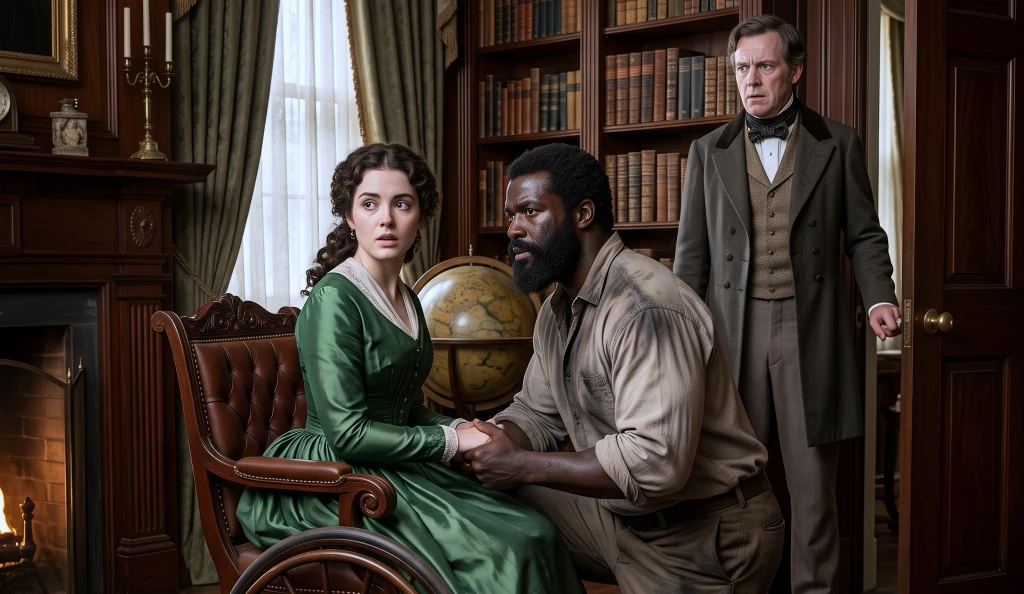
But it was never the mere wood and leather that rendered me unmarriageable in the rigid, unforgiving high society of Virginia in 1856. It was the silent, damning implications the chair carried. To the planter class, I was damaged goods. I was a liability, a heavy burden in silk skirts, a woman fundamentally incapable of fulfilling the most basic, unspoken expectations of Southern womanhood. I could never stand gracefully beside a husband at endless social functions. I was presumed unable to bear children without catastrophic complications, and I certainly could not manage a sprawling plantation household on my own two feet. My father, desperate to secure my future, arranged twelve separate proposals. Twelve men walked into our home, and twelve men walked out. Each rejection grew progressively more brutal, stripping away my dignity layer by layer as my reputation as the crippled Whitmore girl bled through the counties.
Yet, this is not a chronicle of my physical brokenness. It is the story of my father’s final, desperate gamble—a terrifyingly radical solution that involved giving me to an enslaved man known to the county only as the brute. It is the story of how that deeply unorthodox arrangement blossomed into the most profound, earth-shattering love I would ever know. It is the record of how a society that looked at me and saw worthless refuse, and looked at him and saw mere property, was proven catastrophically, beautifully wrong about us both.
The turning point of my life, the moment that would irrevocably alter the fates of three human beings, arrived in the blustery early days of March 1856. The Whitmore Estate sprawled proudly across the Piedmont region of Virginia, a breathtaking stretch of land situated twenty miles west of Charlottesville. Here, the gentle, rolling hills collided with dense, ancient forests, and endless acres of bright green tobacco fields stretched eagerly toward the hazy blue spine of the Blue Ridge Mountains. We possessed five thousand acres of prime, fertile farmland, worked by two hundred enslaved souls. At the center of it all sat the grand house my grandfather had erected in 1790. It was a massive, imposing two-story fortress of red brick flanked by pristine white columns. Inside, heavy crystal chandeliers imported directly from France caught the afternoon light, casting prisms across sweeping hallways and so many vacant rooms that my father and I could easily go days without crossing paths, should we choose to avoid one another.
I took my first breath within those brick walls in 1834, the sole child of Colonel Richard Whitmore and his beautiful wife, Catherine. I never knew my mother. She succumbed to a violent bout of childbed fever a mere three days after my birth, leaving my father a grieving widower with a squalling infant daughter. He had absolutely no interest in ever remarrying. Instead, he raised me himself, offering a peculiar but steady combination of emotionally distant affection and fiercely practical determination.
Determined that I would not be a mere parlor ornament, he saw to it that I was educated far beyond the meager finishing-school standards afforded to most Southern girls of my station. Under his strict tutelage, I learned to read the flowing scripts of Greek and Latin. I was taught to calculate complex financial figures, and we spent our evenings debating the finer points of dense philosophy and volatile national politics. His grand intention had always been to marry me well, to leverage my exceptional education as a gleaming asset that would attract a man of immense wealth and sharp intellect.
Then came the horse, the snake, and the fall.
I was eight years old, a child buzzing with unearned confidence, insisting on riding a mare entirely too spirited for my limited skill. I had begged and pleaded until my father, who spoiled me more than he cared to admit, finally relented and indulged my whim. We were riding near the edge of the woods when a snake slithered across the path. The horse spooked violently, rearing up on her hind legs with a panicked whinny. I was thrown backward into the air. I landed squarely across a massive, fallen oak log, and I distinctly heard a sickening, hollow crack. It was not the ancient wood giving way. It was my spine.
Specialists were summoned, rushing by carriage from Richmond and on trains from Philadelphia. They poked, they proded, they conferred in hushed, somber tones in the hallway outside my bedroom. Finally, they delivered their grim verdict to my father. The damage was absolute and permanent.
My legs would never function properly again. I might, in time, regain a phantom tickle of sensation, perhaps some limited, spastic movement in my toes, but the doctors were unequivocal: I would never walk naturally. I would never run through the tobacco fields. I would never dance at a cotillion. I was bound to a wheelchair for whatever remained of my life.
To his credit, my father immediately set to work altering our world to fit my new reality. He commissioned the exquisite mahogany wheelchair, ensuring its large wheels glided soundlessly across the polished heart-pine floors of the estate. Recognizing that I could no longer easily attend the lively social functions that served as society’s classrooms, he hired a small army of private tutors to keep my mind sharp. He ordered the house thoroughly adapted, tearing out the elegant interior steps and replacing them with smooth wooden ramps. He had the doorframes widened to accommodate my wheels and moved my bedroom to the ground floor. He could adapt our home with money and carpentry, but he was entirely powerless to adapt Virginia society.
By the time I turned fourteen, the age when the other daughters of the planter class were being coyly courted at sun-drenched picnics and lavish garden parties, I was sequestered at home, burying my face in dusty volumes of poetry. By sixteen, as my childhood peers were joyously announcing their engagements and flashing diamond rings, I was relegated to watching the world spin madly on without me through the wavy glass of the parlor windows. And by the time I reached eighteen, my father launched his relentless, humiliating campaign to secure me a husband.
Colonel Whitmore was fifty-one at the time, still robust and in excellent health, but he was plagued by a gnawing, suffocating anxiety regarding my fate once he was gone.
“You need ironclad protection,” he told me one evening, staring into the fireplace. “You need a man to care for you, someone to ruthlessly manage this estate, to ensure you are utterly secure.”
“I can manage the estate,” I countered, lifting my chin. “You have spent years teaching me every nuance of the business, the ledgers, the farming rotations.”
“Eleanor.” His voice was terribly gentle, yet entirely immovable. “You know perfectly well that is not how our society operates. A woman standing alone is a target. A woman sitting alone…” He gestured vaguely toward my wheelchair, unable to finish the thought. “You need a husband.”
The very first proposal was extended to Thomas Aldrich, a thirty-five-year-old tobacco planter hailing from Lynchburg. My father invited him for an opulent dinner, proudly presenting me in the formal parlor. I sat in silence, my hands folded tightly in my lap, watching Mr. Aldrich’s pale eyes travel slowly from my carefully styled hair, down my silk bodice, resting for a long, uncomfortable moment on the leather seat of the wheelchair, before darting away to study the Persian rug.
“Miss Whitmore is exceptionally educated,” my father boomed, trying to fill the oppressive silence. “She reads Greek fluently, speaks conversational French, and manages the household accounts with a skill that rivals my best overseers.”
“Colonel Whitmore,” Thomas interrupted, his voice tight. “Might I have a word with you privately?”
They retreated to the study, leaving me alone in the cavernous parlor. I knew exactly what was transpiring. I could hear the muffled, low baritones bleeding through the heavy oak doors, already imagining Thomas uttering the very excuses that every subsequent suitor would soon learn to parrot.
My father returned twenty minutes later, his face pale and drawn. He was alone. “Mr. Aldrich has declined the arrangement. He feels the situation is… not suitable. Because of the walking.”
“Eleanor—”
“You can say it aloud, Father,” I snapped, the humiliation burning hot in my chest. “He declined because I am a cripple. Because I am damaged. Because to a man like that, I am entirely useless.”
“You are not useless,” he said fiercely. But the devastated look in his eyes betrayed the truth: he knew the rest of the world vehemently disagreed.
The second attempt occurred three agonizing months later. James Morrison was forty years old, a stern-faced widower struggling to raise three young children. The muffled conversation behind the study doors lasted considerably longer this time. I heard voices suddenly raise in anger, heard my father’s desperate, bargaining tone, but the final result remained unchanged. Morrison finally emerged, pausing in the parlor door to look down at me with an expression that tasted sickeningly like pity.
“Miss Whitmore, you seem a profoundly lovely young woman,” he stammered, twisting his hat in his hands. “But my children… they require a mother who can—who can physically manage them. Keep up with them. I am truly sorry.”
The third, fourth, and fifth proposals dragged out over the agonizing span of 1853 and 1854. With each rejection, the cruelty seemed to take on a sharper, more personalized flavor. The excuses drifted back to me through the whispers of house servants and the pitying letters of distant aunts.
“I need a wife who can stand proudly beside me at the Governor’s ball, not one who sits staring at people’s waists.”
“The wedding ceremony itself would be a grotesque embarrassment. How exactly would she process down the church aisle? Roll?”
“I’ve heard on good authority she cannot even bear children. What, then, is the point of the marriage bed?”
That final rumor was a particularly insidious brand of poison. Some arrogant country doctor had wildly speculated at a dinner party—without ever having laid eyes or hands upon me—that the severe trauma to my spine must surely have paralyzed my ability to carry a child. The rumor caught the wind, spreading like a ravenous wildfire through the incestuous ranks of Virginia society. Suddenly, in the eyes of the world, I was no longer merely disabled. I was barren.
I tried desperately to correct the vicious lie. We produced letters from the esteemed physicians in Philadelphia explicitly stating that my reproductive system was entirely intact, that the lower spinal injury did not preclude childbirth. But society reputations have never cared a lick for medical facts. Once I was casually labeled as unable to bear an heir, I might as well have been wearing a bell around my neck, warning the town of plague.
By the dawn of 1855, my father’s matchmaking attempts had devolved from strategic to outright desperate. He began soliciting men from across state lines—reaching into North Carolina, Maryland, even as far as Kentucky. He drastically lowered his stringent standards regarding wealth, pedigree, and social standing. He began dangling increasingly astronomical dowries to sweeten the bitter pill of a paralyzed bride.
The answer was uniformly, unequivocally, no.
The ninth rejection, which arrived in January of 1856, nearly broke us both. The suitor was a man named William Foster, a fifty-year-old acquaintance my father had met through shipping connections. Foster was a thoroughly unpleasant man—portly, perpetually sweating, twice widowed under vague circumstances, and sporting a well-documented reputation for heavy, mean drinking.
To secure this prize, my father was offering a staggering dowry of five thousand dollars, easily a full third of our estate’s annual profits. Foster happily toured our sprawling property, spent hours closeted with my father’s lawyer, and meticulously examined the lucrative financial arrangements. He seemed highly agreeable.
Then, he was brought in to meet me.
He did not bother with pleasantries. He stood over my chair, smelling sharply of stale tobacco and corn liquor. “Can you sew?” he barked.
“No, sir,” I answered, keeping my voice level. “The nerve damage has left my hands with somewhat limited dexterity for fine needlework.”
“Can you cook a proper meal?”
“I have never learned to cook, sir. We employ a full kitchen staff for that.”
“Can you manage a house full of lazy servants?”
“I am perfectly capable of directing all household operations from this chair, yes.”
Foster grunted, wiping his damp forehead with a soiled handkerchief. He turned away from me, addressing my father as if I were a piece of defective farm machinery. “Colonel, your daughter has a charming enough face, but I require a wife who can perform actual wifely duties. The money is handsome, but this physical situation is entirely untenable.”
After Foster’s carriage finally rolled away, I wheeled myself down the hall and found my father sitting in the darkened study. He was staring blankly at the wall, a heavy crystal glass of amber bourbon trembling slightly in his grip.
“Father, you have to stop,” I said quietly from the doorway. “I do not need—”
“Twelve proposals, Eleanor,” his voice was flat, hollowed out by defeat. “I have arranged twelve distinct proposals over the last four years. Every single man has declined. Some used polite Southern manners, some were astonishingly brutal, but they all left me with the exact same underlying message.”
He finally turned to look at me, his eyes bloodshot. “They believe you are not worth marrying.”
The words landed against my chest like physical blows, knocking the air from my lungs. I gripped the leather arms of my chair until my knuckles turned white. “Then I will simply not marry. I will stay right here in this house. I will help you manage the ledgers and the overseers until the end of our days.”
“I am fifty-five years old, Eleanor. I could drop dead of an apoplexy tomorrow morning, or I could stubbornly live twenty more years. But either way, the grave takes me eventually. And when they put me in the ground, what exactly happens to you?” He slammed his glass down on the mahogany desk. “Our male relatives will inherit every inch of this estate.”
“Cousin Robert…”
“Do you honestly believe your cousin Robert will allow you to stay here, occupying the master wing?” he scoffed bitterly. “He will sell this plantation to the highest bidder the moment the dirt settles on my coffin. He will toss you some pathetic, meager pittance to live on, and he will stick you in a dreary boarding house somewhere in Richmond, leaving you entirely dependent on his fickle charity.”
“Then change it! Leave the estate directly to me in your will.”
“I cannot!” he roared, startling me. He immediately scrubbed a hand over his tired face, lowering his voice. “Virginia law explicitly forbids it. Women cannot inherit vast property independently, especially not unmarried women, and most especially not…”
He gestured helplessly at my wheelchair, absolutely unwilling to utter the cruel words the courts would use to describe me.
I felt the familiar, hot prickle of tears burning behind my eyes, but I swallowed hard, refusing to let them fall. “Then what, exactly, do you suggest I do?”
He picked up his glass and took a long, slow drink of the bourbon, staring into the empty fireplace. “I do not know yet. But I swear to God, I have to figure something out. Because I will not go to my grave leaving you unprotected in this world.”
Part 2
That agonizing conversation took place in late February of 1856. Four weeks later, as the early spring winds whipped against the parlor windows, my father summoned me to his study. The room smelled of old paper, leather bindings, and the lingering scent of his pipe tobacco. He stood by the window, his posture rigid, and delivered a solution so radical, so entirely untethered from the rigid social norms of our world, that my first instinct was to assume his mind had finally snapped under the pressure.
“I am giving you to Josiah,” he stated, his voice devoid of any inflection. “He will be your husband.”
I stared at him, the silence stretching so taut I thought it might snap. “Josiah? The blacksmith?”
“Yes,” my father replied, not meeting my eyes. “The enslaved blacksmith.”
“Father, you cannot possibly be serious.”
“I am completely serious.” He finally turned away from the window and began to pace the length of the Persian rug, a habit he fell into only when navigating a crisis. “Eleanor, we must deal in reality. No white man in this county, or any other, will marry you. That is the stark truth we face. But you require protection. You need a man who is physically strong enough to carry you when necessary, capable enough to manage the heavy tasks you cannot perform, and loyal enough to care for you long after I am in the ground.”
“And you honestly believe an enslaved man…” I trailed off, the absurdity of the concept choking my words.
“Josiah is the strongest man on this entire estate,” my father interrupted, stopping his pacing to look at me intently. “He is intelligent, he is in prime health, and by every single account from the overseers, he is remarkably gentle despite his terrifying size. He will protect you. He will provide for your physical needs. And, practically speaking, he will not abandon you, because he is bound to you by law.”
The cold, calculated logic of it was deeply horrifying to me. “Father, this is… this is simply not how the world works!”
“I am well aware it is unconventional,” he snapped, his temper flaring. “I know polite society will aggressively condemn it. But society has already condemned you, Eleanor. Twelve different men looked you up and down and decided you were not worth the trouble of a wedding ring. So I am thoroughly done caring about what society thinks. I am arranging protection for my daughter using the exact resources I have available to me.”
“You are treating me like property,” I said, my voice trembling with a mixture of rage and profound hurt. “You are handing me over to a slave as if I am a piece of defective furniture you no longer wish to store.”
“I am ensuring that you survive!” he shouted, the echo ringing off the high ceiling. He closed his eyes, taking a deep, shuddering breath, and when he spoke again, his tone was pleading. “Eleanor, I have spent four exhausting years trying to secure a husband for you through all the proper, respectable channels. It has failed miserably. So now, I am trying something else. If it offers you any comfort, know this: I have observed Josiah quietly for years. He has never once been violent. He has never been cruel.” My father leaned closer, dropping his voice to a conspiratorial whisper. “He reads, Eleanor. Yes, I am fully aware it is against the law, but I have seen him doing it. He is smart, he is highly capable, and he is everything you need in a protector.”
I sat frozen in my leather chair, my mind reeling. My father actually expected me to marry—or whatever pathetic facsimile of marriage existed when one party was legally considered property—a man I had barely exchanged two words with. A man the other enslaved workers and the white overseers alike called “the brute” because of his frankly monstrous proportions.
“Have you even asked Josiah if he wants this?” I managed to ask.
“Not yet,” my father replied. “I wanted to speak with you first.”
“And if I flatly refuse?”
My father’s face suddenly looked ancient, the lines around his eyes deepening into trenches of exhaustion. “Then I will keep stubbornly trying to find a white husband, and we will both know in our hearts that I am going to fail. And when I die, you will spend the rest of your days rotting in a cheap boarding house, entirely dependent on relatives who actively wish you were dead.”
It was the bleakest, most devastating presentation of my future he could have possibly painted. As much as my pride wanted to rage against his madness, to scream that there simply had to be another way, I found myself paralyzed by his brutal logic. No white man wanted me. My options had violently narrowed: accept my father’s scandalous, radical solution, or face a looming future of utter vulnerability and destitution.
“Can I at least meet him first?” I asked, my voice barely above a whisper. “Actually talk to him in private?”
“Of course,” my father nodded, looking visibly relieved. “I will arrange it for tomorrow morning.”
That night, I lay awake in the dark, tangling my fingers in the linen sheets, trying desperately to visualize my future. I knew of Josiah, of course. Every soul on the Whitmore Estate knew about the brute. He was an absolute giant, standing well over seven feet tall, with shoulders built like a draft ox and massive hands rumored to bend raw iron without the heat of the forge. He spent his days in the sweltering blacksmith shop, hammering out horseshoes, fixing plowing equipment, and shaping heavy tools. The other enslaved people gave him a wide, fearful berth. Visiting white planters frequently commented on his imposing size with a deeply unsettling mixture of morbid fascination and poorly concealed dread.
I tried to picture this mountain of a man moving into the main house. I tried to imagine living side-by-side with a stranger society deemed chattel, a man who looked perfectly capable of snapping my fragile spine a second time with two fingers. I tried to picture him as my husband, my intimate protector, my designated guardian for the decades stretching out after my father’s passing.
I simply couldn’t see it. I could not see past my own visceral fear and the absolute, staggering impossibility of the plan. Yet, as the purple hues of dawn began to bleed through my window curtains, one chilling thought crystallized in my racing mind. If my only choice was between a slow, humiliating death by the charity of Cousin Robert, or a life beside a giant my father implicitly trusted… perhaps the radical choice was the only choice left.
They brought Josiah up to the main house shortly after breakfast. I was waiting in the parlor, my wheelchair positioned carefully by the large window to catch the morning light. I heard his heavy, deliberate footsteps echoing down the hardwood hallway long before I saw him.
My father entered the room first, stepping aside to make way for a figure that literally had to duck his head and angle his shoulders to fit through the double doorframe.
My first panicked thought was a prayer: Dear God, he is impossibly large.
Josiah was easily seven feet tall, weighing at least three hundred pounds, and not an ounce of it appeared to be soft. It was the dense, unyielding muscle born from years of relentless labor at the anvil. His skin was the color of dark, polished mahogany, his face heavily weathered and partially obscured by a thick, dark beard. He wore his rough cotton work clothes, the fabric pulling taut across his chest and thighs, strained to its absolute limit by his frame. He stood awkwardly in the center of my grandmother’s delicate parlor, his massive, scar-crossed hands clasped tightly in front of him, his head bowed in the submissive, defensive posture required of any enslaved person standing in the master’s house.
He looked as though he could tear the brick walls down with his bare hands. The nickname fit perfectly.
My father loudly cleared his throat, breaking the heavy silence. “Josiah, this is my daughter, Miss Eleanor.”
Josiah’s dark eyes flicked upward, landing on me for a fraction of a second before darting safely back to the floral pattern of the rug. “Yes, sir,” he rumbled. His voice was entirely jarring—it was incredibly deep, vibrating in my chest, yet surprisingly soft and remarkably gentle.
“Eleanor,” my father continued, adopting a brisk, businesslike tone. “I have explained the general situation to Josiah. He understands that, going forward, he will be completely responsible for your personal care and your physical protection.”
I forced myself to speak, though my hands gripped the wheels of my chair so tightly they ached. “Josiah… do you truly understand what my father is proposing here?”
Another fleeting, nervous glance in my direction. “Yes, miss. I am to… to be your husband. To protect you, and to help you manage.”
“And you have freely agreed to this arrangement?”
He frowned, genuine confusion wrinkling his brow, as if the very concept of his personal consent was a foreign language. “The Colonel said I should, miss.”
“But do you want to?”
The directness of the question seemed to startle him. For the first time, he lifted his head and truly looked at me. His eyes were a deep, warm brown, completely lacking the dull hostility I had expected to find. “I… I do not know what I want, miss. I am a slave. What I want does not usually matter to anyone.”
The brutal honesty of his words hung in the air.
“And that is entirely fair,” my father interceded smoothly. “Eleanor, perhaps you and Josiah should speak privately for a while. I will be directly across the hall in my study if you require me.”
Before I could protest, my father stepped out, pulling the heavy parlor doors shut behind him with a decisive click. I was entirely alone in a room with a seven-foot-tall enslaved man who, by the decree of my desperate father, was supposed to become my husband.
The silence returned, thicker and more suffocating than before. Josiah stood rigidly in the center of the rug, looking like a caged bear terrified of breaking the fine china. I was equally paralyzed, wildly unsure of the etiquette required when addressing a human being who had just been gifted to you like a carriage horse.
“Would you like to sit down?” I finally asked, gesturing nervously toward a delicate, curved-leg chair with embroidered silk cushions.
He looked at the fragile antique, then down at his own massive thighs. “I truly do not think that chair would hold me, miss.”
“The sofa, then,” I offered.
He moved toward the heavy settee and lowered himself onto the edge with extreme caution. The wooden frame groaned ominously in protest under his weight, but mercifully held. Even while seated, he towered over me. He rested his enormous hands on his knees, and I found myself staring at them. Each finger was the size of a small club, heavily calloused and marked with pale burn scars from flying sparks, a pair of hands perfectly designed to crush stone.
“Are you afraid of me, miss?” he asked, his deep voice barely a whisper.
“Should I be?”
“No, miss,” he answered immediately. “I would never hurt you. I swear that to you.”
“They call you the brute,” I pointed out, my voice shaking slightly.
He visibly flinched at the word. “Yes, miss. Because of my size. Because I look… frightening to people. But I am not brutal in my heart. I have never hurt anyone. Not on purpose.”
“But you could,” I pressed, unable to let it go. “If you wanted to.”
He met my gaze squarely, and for a moment, the submission vanished from his posture. “I could,” he agreed softly. “But I would not. Not you. Not anyone who did not deserve it.”
I studied his face. Beneath the thick beard and the defensive posture, there was a profound, weary sadness in his eyes. A resignation. There was a quiet dignity that entirely contradicted the monstrous reputation society had strapped to his back. In that moment, looking at this discarded man, I made a sudden decision.
“Josiah, I want to be completely honest with you,” I said, leaning forward slightly. “I do not want this arrangement any more than you probably do. I do not know you, and you certainly do not know me. My father is orchestrating this madness because he is terrified and desperate. I am deemed unmarriageable by the world, and he thinks your strength is the only solution left to keep me safe. But if we are going to do this… if we are going to live under the same roof, navigate this strange life together… I need absolute honesty from you. Are you a dangerous man?”
“No, miss.”
“Are you cruel?”
“No, miss.”
“Are you ever going to hurt me?”
“Never, miss. I promise you on everything I hold sacred in this world, I will never lay a hand on you in anger.”
The raw, desperate earnestness in his voice was impossible to deny. He believed every syllable he spoke.
“Then I have one other question for you,” I said, watching him closely. “Can you read?”
He stiffened. His dark eyes widened in sudden alarm, a flash of genuine terror crossing his features. “Why… why do you ask me that?”
“Because my father mentioned it to me. He said he had quietly observed you reading. I need to know if it is true.”
Josiah sat in agonizing silence for a long time. We both knew the stakes. Reading was strictly, violently illegal for enslaved people in Virginia. Admitting to literacy was an invitation to the whipping post. Teaching an enslaved person could ruin a white family.
Finally, he dropped his gaze to his boots. “Yes, miss,” he whispered. “I can read. I taught myself the letters when I was much younger. I know it is strictly forbidden, but I… I simply could not stop myself. Books are…” He struggled to find the right words, his large hands opening and closing on his knees. “They are doorways to places I will never be allowed to go. They give me thoughts I would never be permitted to have otherwise.”
“What do you read?”
“Whatever scraps I can find, miss. Discarded newspapers, mostly. Sometimes proper books I borrow from other slaves who found them hidden away. I read very slowly. I was never taught properly, but… I do read.”
“Have you ever read any Shakespeare?” I asked, testing the waters.
His head snapped up, startled by the casual nature of my question. “Yes, miss. There is an old, battered copy of his works in the estate library that no one ever seems to touch. I have slipped in and read it at night when the house is entirely asleep.”
“Which plays have you read?”
“Hamlet, Romeo and Juliet, and The Tempest.” His voice suddenly gained a rich texture, a spark of pure enthusiasm overriding his fear. “The Tempest is my favorite.”
“Why that one?”
“The idea of Prospero controlling that entire island with his magic,” Josiah explained, his hands animating slightly as he spoke. “Of Ariel desperately wanting freedom. And of Caliban… being treated like a deformed monster by everyone around him, but perhaps being more deeply human than any of them.” He stopped abruptly, his jaw clicking shut, as if remembering his place and the color of his skin. “I am sorry, miss. I am talking far too much.”
“No,” I said, and to my utter shock, I realized I was smiling. It was the first genuine smile to touch my face in days. “Keep talking, please. Tell me your thoughts on Caliban.”
And then, something genuinely extraordinary happened in my grandmother’s formal parlor. Josiah, the massive, feared blacksmith, began to dissect Shakespeare with a level of sharp intelligence and profound insight that would have left my expensive tutors speechless.
“Caliban is labeled a monster,” Josiah said softly, leaning forward. “But Shakespeare clearly shows us that the man has been enslaved. His home, his island, was stolen from him. His mother’s sacred knowledge was dismissed as wicked witchcraft. Prospero calls him a savage beast, but Prospero is the intruder. Prospero is the one who washed ashore and claimed absolute ownership of everything in sight, including Caliban’s very body. So, if you look at the truth of it… who is really the monster in that story?”
I was entirely captivated. “You view Caliban as a sympathetic figure.”
“I view Caliban as a human being,” Josiah corrected gently. “A man treated as less than human, treated like an animal, but human nonetheless. Just like…” He trailed off, swallowing hard.
“Like enslaved people,” I finished for him.
“Yes, miss.”
For the next two hours, the world outside the parlor doors simply vanished. We talked about Shakespeare, about the nature of philosophy, about the grand ideas contained in books. Josiah’s education was entirely informal, built on stolen moments in the dark, but his mind was devastatingly sharp, and his desperate hunger for knowledge was a living, breathing thing in the room. As the morning slipped away, my lingering dread dissolved completely. This man sitting on my sofa was not a brute. He was brilliant, he was gentle, and he was deeply thoughtful. He was simply a beautiful mind trapped inside a body that society looked at and immediately deemed monstrous.
As our conversation finally began to naturally wind down, I wheeled myself a fraction closer to him. “Josiah… if we actually do this. If we become whatever it is my father expects us to become, there is something you need to know. I do not think you are a brute. I do not think you are a monster. I think you are an intelligent man who has been forced into an impossible, cruel situation. Just like me.”
His dark eyes immediately filled with moisture, shining in the daylight. “Thank you, miss.”
“Call me Eleanor,” I insisted. “When we are alone behind closed doors, you will call me Eleanor.”
“I should not, miss. That would be highly improper.”
“Nothing about this arrangement is proper,” I reminded him with a bitter laugh. “If we are meant to be husband and wife, or whatever this partnership is to be called, you must use my given name.”
He nodded slowly, respectfully. “Eleanor.”
Hearing my name spoken in his deep, resonant voice sent an unexpected, musical shiver down my spine.
“Then you should know something as well,” Josiah said, his voice firming up. “I do not believe for one second that you are unmarriageable. I think every single man who walked out of this parlor was a blind fool. Any man who cannot see past a wooden chair to the brilliant woman sitting inside it does not deserve to breathe the same air as you.”
It was the single kindest, most validating sentence anyone had spoken to me in four long years. I felt a tear break free and slide down my cheek.
“Will you do this, Josiah?” I asked quietly. “Will you agree to my father’s plan?”
“Yes.” There was absolutely no hesitation in his voice now. “I will protect you. I will care for you. And I will try every day to be worthy of you. I will do everything in my power to make this life bearable for us both.”
I extended my hand. He reached out, his enormous, calloused fingers completely swallowing mine. His grip was incredibly warm, and shockingly, achingly gentle. As we shook hands, sealing our fates together, my father’s terrifying, radical solution suddenly did not seem so impossible anymore.
Part 3
Our highly unorthodox arrangement formally commenced on April 1st, 1856. My father insisted on a small, deeply surreal ceremony to mark the occasion. It was certainly not a wedding in any legal or religious sense—enslaved people were explicitly barred from legally marrying in Virginia, and white society would sooner burn our estate to the ground than recognize a union between a white plantation daughter and a Black man. Yet, my father gathered the entire household staff in the grand foyer.
The white overseers stood on one side, their faces tight with poorly concealed outrage and utter confusion. On the other side stood the enslaved house servants, their expressions carefully blank, though their eyes darted nervously toward Josiah. My father stood on the landing of the sweeping staircase, a heavy family Bible in his hands. He read a few select verses about duty and protection, his voice echoing off the crystal chandelier. Then, he closed the book with a resounding thud.
“Josiah is now entirely responsible for Eleanor’s personal care and physical protection,” my father announced to the silent room. “He speaks with my direct authority regarding her welfare. You will treat him with the exact respect that position demands.”
A room was hastily prepared for Josiah adjacent to my own on the ground floor. It was connected by a sturdy inner door, allowing him immediate access to me while maintaining a thin, necessary veneer of propriety for anyone passing in the hallway. That afternoon, I watched from my chair as he moved his meager worldly possessions from the cramped slave quarters into the main house. It took only one trip. He brought a few rough cotton shirts, a handful of battered books he had secretly collected over the years, and a small, heavy canvas bag containing his personal tools from the forge.
The first few weeks were excruciatingly awkward. We were two strangers thrust together, desperately trying to navigate an impossible, deeply intimate landscape. Since I was eight years old, I had been bathed, dressed, and lifted exclusively by female servants. Josiah, meanwhile, had spent his entire life performing backbreaking, brutal labor in the blistering heat of the forge. Now, this giant of a man was suddenly tasked with the most delicate, private duties imaginable. He had to help me manage the complicated layers of a woman’s clothing. He had to carry me in his massive arms whenever the wheelchair could not navigate a threshold. He had to assist me with personal, physical needs that I had never, in my wildest nightmares, imagined discussing with a man.
Yet, Josiah approached every single task with a level of reverence and extraordinary gentleness that routinely brought tears to my eyes. Whenever he needed to lift me from my chair to my bed, he would softly ask for my permission first. When he helped me unfasten the intricate buttons of my day dresses, he would carefully avert his eyes, staring fixedly at the ceiling or the wall. When I required assistance with matters that were inherently undignified, he managed to preserve my dignity with quiet grace, moving with a respectful efficiency that made me feel entirely safe.
“I know this is terribly uncomfortable for you,” I told him one rainy morning, right after a particularly awkward struggle with a stubborn corset lace. “I know you did not choose this life. Neither of us did.”
He was kneeling on the floor across the room, meticulously reorganizing my massive bookshelf. I had casually mentioned the day before that I preferred my volumes alphabetized by author, and he had immediately taken it upon himself as a personal project.
He paused, a heavy volume of Plato resting in his enormous hands, and looked back at me. Because he was kneeling, we were finally eye to eye.
“We are making it work, are we not?” he asked quietly.
“Yes, but…” I sighed, pulling a shawl around my shoulders. “It is unfair to you.”
“Eleanor,” he said, his voice a low, steady rumble. “I have been enslaved my entire life. I have done bone-crushing labor in summer heat that would outright kill most men. I have felt the whip across my back for the mere mistakes of exhaustion. I was sold away from my mother on a dusty auction block when I was only ten years old, screaming for her until my throat bled. I have been treated like a dumb ox that just happens to possess a voice.”
He gestured with the book toward the warm, dry room, the soft rugs, and then finally pointed toward me. “This? Living in this house? Caring for a woman who actually looks me in the eye and treats me like a human being? Having access to these books and our conversations? This is not a hardship.”
“But you are still enslaved,” I whispered, my heart aching for the ten-year-old boy he had been.
“Yes,” he agreed, turning his attention back to the bookshelf. “But I would much rather be enslaved right here in this room with you, than legally free but entirely alone somewhere else. Is that a terrible thing for me to say?”
“I do not think so,” I replied softly. “I think it is the most honest thing I have ever heard.”
By the end of April, we had settled into a seamless, comforting routine. In the mornings, Josiah would help me wash and dress, then easily carry me down the hall to the sunlit breakfast room. After we ate, he would return to the sweltering heat of the blacksmith shop—my father’s plantation still required the constant labor of its master smith—while I stationed myself at the heavy mahogany desk in the library, diligently working on the household accounts, crop ledgers, and my father’s business correspondence.
In the late afternoons, Josiah would return to the house, smelling of woodsmoke and hot iron. He would wash at the pump, change his shirt, and we would spend the remaining daylight together. Sometimes, I would wheel myself out to the forge, sitting at a safe distance just to watch him work. I was utterly fascinated by the hypnotic, rhythmic swing of his hammer, mesmerized by the sheer power it took to force glowing, stubborn iron to yield to his will.
On other days, we stayed in the library and he would read to me. His reading had improved dramatically with unrestricted access to my father’s vast collection and my gentle tutoring. In the quiet evenings, we simply talked. He spoke of his childhood on a sprawling, brutal plantation further south, of his fleeting memories of his mother’s face, and of his deeply buried, impossibly distant dreams of true freedom. In turn, I poured out my own grief. I told him about the mother I had never known, the riding accident that severed my spine, and the suffocating agony of feeling trapped in a broken body while living in a society that aggressively wished I would just disappear. We were two completely discarded human beings, finding a profound, healing sanctuary in each other’s company.
In May, something fundamental shifted between us.
I had been sitting by the forge, watching Josiah work. The massive barn doors required a new set of heavy iron hinges. He was working with intense concentration, plunging the raw iron into the glowing orange coals, withdrawing it when it shone like the sun, and striking it against the anvil with perfectly placed, ringing blows.
“Do you think I could try?” I asked suddenly, the words out of my mouth before I could catch them.
Josiah stopped mid-swing, lowering his heavy hammer. He wiped the sweat from his forehead with the back of his wrist, looking at me in sheer surprise. “Try what, Eleanor? The forge work? Actually hammering the iron?”
“Yes.”
“Eleanor, it is incredibly hot. It is dangerous, and the tools are heavy.”
“I know,” I argued, wheeling my chair a few inches closer. “And I have never done a single physically demanding thing in my entire life because everyone simply assumes I am too fragile so much as to lift a teapot. But… maybe with your help? Just once?”
He studied my face for a long, calculating moment. Finally, he nodded. “Alright. Let me set it up safely.”
He carefully repositioned my wheelchair, bringing me thrillingly close to the heavy iron anvil. I could feel the intense, baking heat of the forge radiating against my face, smelling the sharp tang of coal and sulfur. He selected a smaller piece of iron, plunging it into the fire until it glowed a workable cherry-red. He used his long tongs to place it precisely on the anvil, then handed me a smaller, lighter hammer. It was still shockingly heavy in my grip, but I could lift it.
“Hit it right there, near the edge,” Josiah instructed, standing directly behind my chair, his large hands hovering near mine to guide me if I slipped. “Do not worry about raw strength yet. Just feel the way the metal moves under the strike.”
I lifted the hammer and swung. It hit the glowing iron with a pathetic, dull thunk, barely making a visible indentation.
“Again,” Josiah encouraged, his deep voice steadying my nerves. “Put the weight of your shoulders into it. Use your back.”
I gripped the wooden handle tighter, gritted my teeth, and swung harder. A shower of tiny orange sparks flew. The hammer connected with a satisfying ring, and the iron bent marginally.
“Good!” he praised. “Again!”
I hammered. Again, and again, and again. The muscles in my arms, unused to such sudden, violent exertion, began to burn fiercely. My shoulders ached, and a thick bead of sweat rolled down my cheek, stinging my eye. But I was doing it. I was doing real, physical work, aggressively shaping stubborn metal with my own two hands.
When the iron finally cooled to a dull gray, Josiah picked it up with his bare, calloused fingers and held it in front of me. It was a simple, slightly crooked hook.
“Your very first project,” he said, a wide, breathtaking smile breaking through his beard. “It is not much to look at, but you made it.”
I looked down at my trembling hands, smeared with dark soot, and then up at the bent piece of metal. Suddenly, I was laughing and crying simultaneously, the tears cutting clean tracks through the ash on my face. “I made something,” I gasped. “With my own hands. With my own strength.”
“You are stronger than you think,” he said softly, setting the iron hook on the workbench. He knelt beside my wheelchair, uncaring of the dirt. “You have always been strong, Eleanor. You just needed the right kind of fire.”
From that transformative day forward, I spent hours every week at the forge. Josiah patiently taught me the absolute basics of his trade—how to read the color of the heat, how to angle the hammer, how to shape the cooling metal. I would never possess the raw strength for heavy wagon repairs, but I could fashion small, beautiful items. I made fire pokers, decorative hooks, and simple garden tools. For the first time in fourteen long years, since the day I broke my back, I finally felt physically capable. My legs would never work, but my arms and my hands did. And standing at the anvil beside Josiah, that was more than enough.
June brought an entirely different kind of revelation.
We were sequestered in the library late one humid evening. The windows were thrown open to catch the heavy summer breeze, the crickets singing loudly in the tobacco fields. Josiah was reading John Keats’s poetry aloud from a leather-bound volume. His reading had advanced so beautifully that he could easily navigate the complex, flowing rhythm of the romantic texts. His deep, resonant voice was absolutely perfect for poetry, giving a profound, emotional weight to every single syllable.
“A thing of beauty is a joy for ever,” he read smoothly, his eyes scanning the page in the golden lamplight. “Its loveliness increases; it will never pass into nothingness.”
He lowered the book to his lap, looking over at me.
“Do you believe that?” I asked, breaking the comfortable silence. “That beauty is truly permanent?”
He thought about it for a moment, stroking his beard. “I think the memory of beauty is permanent. The physical thing itself might eventually fade or break, but the memory of how it made you feel… that lasts forever.”
“What is the most beautiful thing you have ever seen?” I asked softly.
He was quiet for a long time. The only sound in the room was the ticking of the grandfather clock in the hall. Finally, he looked directly into my eyes, his gaze so intense it made my breath catch.
“You,” he said, his voice dropping to a gravelly whisper. “Yesterday. At the forge. You were covered in dark soot, you were sweating, and you were laughing so hard while you hammered that iron nail. That was the most beautiful thing I have ever seen.”
My heart gave a violent, fluttering skip against my ribs. “Josiah…”
He immediately looked away, shame flushing beneath his dark skin. “I am sorry, Eleanor. I should not have spoken like that. I forgot myself.”
“No.” I grasped the wheels of my chair and rolled myself across the Persian rug, stopping inches from his knees. “Look at me.” He reluctantly met my eyes. “Say it again.”
“You were beautiful,” he repeated, the words tumbling out of him like a confession. “You are beautiful. You have always been beautiful, Eleanor. The wheelchair does not change a single fraction of that.”
“The legs that do not work change that,” I whispered, repeating the cruel mantra society had beaten into me.
“No, they do not.” His voice turned fiercely passionate. “You are brilliant, you are incredibly kind, you are brave, and yes, you are physically beautiful. Those twelve men who sat in your parlor and rejected you were blind, arrogant idiots. They looked at a wheelchair and they stopped looking. They did not see the real you.” He leaned forward, closing the distance between us. “They did not see the woman who taught herself Greek just because her mind demanded it. They did not see the woman who reads philosophy for sheer pleasure. They did not see the woman who learned to forge raw iron despite having a body that betrayed her. They did not see any of that because they simply did not want to see it.”
I reached out, my trembling hands finding his. I gripped his massive, scarred fingers—hands that could easily bend a horseshoe, but held mine as if my bones were made of spun glass.
“Do you see me, Josiah?” I asked, tears pooling in my eyes.
“Yes,” he vows softly. “I see all of you. And you are the most magnificent person I have ever known in my life.”
I took a shaky breath, stepping off the precipice. “I think I am falling in love with you.”
The words hung in the humid air between us, vibrating with terrifying electricity. They were dangerous words. Impossible, lethal words. I was a white woman and he was an enslaved Black man in the American South in 1856. There was absolutely no space in the reality of our world for what I was feeling.
“Eleanor,” he said carefully, his eyes darting toward the closed library door. “You cannot say that. We cannot do this. If anyone out there knew, if your father knew, they would…”
“They would what?” I challenged, my grip tightening on his hands. “We are already living together in these rooms. My father has already given me to you. The world already thinks I am a ruined freak. What possible difference does it make if I actually love you?”
“The difference is safety!” he hissed gently, desperate to make me understand. “Your physical safety, and my life. If people begin to suspect that this arrangement has turned into genuine affection rather than forced obligation—”
“I do not care what those people think!” I let go of his hands and reached up. Because he was seated and I was in my chair, I could just reach him. I cupped his weathered face in my palms. He froze, his breath hitching in his chest. “I care about what I feel. And I feel love. For the very first time in my twenty-two years on this earth, I feel like someone actually sees me. Really sees me. Not the broken spine, not the wheelchair, not the heavy burden I am to my father. You see Eleanor. And I see Josiah. I do not see the slave. I do not see the brute. I see the man who reads Keats to me in the dark, who makes beautiful things out of fire, and who treats me with more profound kindness than any free man ever has.”
“If your father knew…” Josiah breathed, his eyes closing as he leaned into my touch.
“My father arranged this. He put us together. Whatever blooms between us is partially his responsibility.” I leaned forward, my heart hammering a frantic rhythm. “Josiah, I will understand if you do not feel the same way. I understand this is wildly complicated and incredibly dangerous, and maybe you think I am just lonely and confused. But I needed to tell you the truth.”
He was quiet for so long I thought I had pushed too far, that I had ruined the beautiful sanctuary we had built. Then, he opened his eyes, and the sheer depth of emotion in them took my breath away.
“I have loved you since our very first real conversation in the parlor,” he confessed, a tear slipping free and tracking through his beard. “When you asked me about Shakespeare, and you actually listened to my answer. When you treated me like the thoughts in my head mattered. I have loved you every single day since then, Eleanor. I just never, ever thought I would be permitted to say it out loud.”
“Say it right now,” I demanded softly.
“I love you.”
And then, he leaned down, and we kissed. It was my very first kiss, at the age of twenty-two. It was shared with a man society dictated should not even exist on the same plane as me, hidden away in a shadowy library surrounded by volumes of law and history that would viciously condemn what we were doing.
It was absolutely, breathtakingly perfect.
Part 4
For five blissful, agonizingly brief months, Josiah and I existed within a fragile, iridescent bubble of stolen happiness. We were meticulously careful, always mindful of the precarious ledge upon which we danced. In the presence of the house staff or the passing white overseers, we maintained the flawless, rigid facade of a dutifully assigned protector and his fragile, demanding ward. We never allowed our hands to brush in the hallways. We never allowed our eyes to linger a second too long. But in the quiet, shadowed sanctuary of my private rooms, or secluded in the depths of the library after the estate had fallen completely silent, we were simply two human beings deeply, irrevocably in love.
My father either did not notice the profound shift in our dynamic, or he deliberately chose to look the other way. He saw that the color had returned to my cheeks, that my bouts of deep melancholia had vanished, and that Josiah was unfailingly attentive. As far as the Colonel was concerned, his incredibly unorthodox arrangement was a resounding success. He asked no probing questions about the sheer amount of time we spent secluded together, nor did he seem to catch the soft, unguarded way Josiah sometimes smiled when I entered a room.
We built an entire, secret universe together during those five months. I continued my lessons at the forge, graduating from simple iron hooks to crafting intricate, decorative latches under Josiah’s warm, patient guidance. He, in turn, devoured the library. He moved from poetry to heavy volumes of history and philosophy, his natural intellect blooming vibrantly with every turned page.
And yes, as the autumn leaves turned to fire and fell from the trees, our emotional bond deepened into profound physical intimacy. I will not detail the sacred, private moments that pass between a husband and wife in the quiet dark, but I will tell you this: Josiah approached our physical relationship with the exact same breathtaking reverence he applied to every other aspect of my care. For a woman who had been repeatedly told by doctors and suitors alike that her paralyzed body was a grotesque, broken thing, Josiah’s touch was a revelation. He worshiped every inch of me, treating my comfort as his highest calling. He made me feel thoroughly cherished, entirely whole, and desperately desired.
By the arrival of the cold winds in October, we had constructed a beautiful, insulated world inside the impossible, suffocating space society had forced us to occupy. We were happy in ways neither of us had ever dared to dream.
Then, the bubble shattered.
It was the fifteenth of December, 1856. A bitter frost had settled over the tobacco fields, and a fire was roaring in the library hearth. Josiah and I were secluded amongst the towering bookshelves, utterly lost in each other. We were kissing with the desperate, careless freedom of two people who genuinely believed they were entirely alone in the house. We did not hear the heavy oak door open. We did not hear the footsteps muffled by the thick Persian rug.
“Eleanor?”
The voice cracked through the warm room like a whip of solid ice.
We sprang apart, our hearts hammering against our ribs, a sudden, cold terror washing over us. My father stood perfectly still in the doorway. The color had completely drained from his face, replaced by a terrifying mixture of absolute shock, rising rage, and something else—a deep, wounded betrayal that I could not quite parse.
“You are in love with him,” my father stated. It was not a question. It was a damning accusation.
Josiah immediately dropped to his knees on the rug, his massive shoulders bowing in an instinctive posture of profound submission and terror. “Sir, please,” he pleaded, his deep voice trembling violently. “This is entirely my fault. I should never have—”
“Be quiet, Josiah,” my father snapped, his voice dropping to a dangerously calm register that scared me far more than any shouting would have. He did not even look at the man kneeling on the floor. His furious eyes were locked solely on me. “Eleanor. Is this true? Are you genuinely in love with this slave?”
I could have lied. The instinct for self-preservation screamed at me to claim that Josiah had forced his affections upon me, to weep and play the terrified, helpless victim. It would have saved my reputation instantly. And it would have condemned the man I loved to the whipping post, or worse, the hangman’s noose.
I lifted my chin and gripped the wheels of my chair. “Yes. I love him. And he loves me. And before you threaten him, Father, you must know that this was entirely mutual. I initiated our first kiss. I pursued this relationship with him. If you are going to punish someone for this, you must punish me.”
My father’s face cycled through a terrifying series of expressions—raw disbelief, utter confusion, and a suffocating, apoplectic rage. He squeezed his eyes shut, gripping the doorframe until his knuckles turned white.
“Josiah,” my father finally said, his voice deadly quiet. “Go to your room. Immediately. Do not leave it until I specifically send for you. Do you understand?”
“Sir,” Josiah whispered, his eyes filled with absolute agony as he cast one final, devastated look back at me. He rose and quietly slipped out the door.
The heavy wood clicked shut, leaving me entirely alone with the Colonel.
“Do you have any earthly comprehension of what you have done?” my father asked, his voice shaking.
“I have fallen in love with a profoundly good man who treats me with kindness and respect,” I countered, my own voice rising defensively.
“You have fallen in love with property!” he roared, finally losing his iron control. “With a Black slave! Eleanor, if a single whisper of this becomes known outside these walls, you will be ruined beyond any hope of redemption. The entire state of Virginia will say you are mentally defective, perverted, utterly mad!”
“They already say I am damaged and unmarriageable!” I shouted back, years of bitter resentment finally boiling over. “What possible difference does it make now?”
“The difference is your protection!” he yelled, throwing his hands up. “I gave you to Josiah to physically protect you from a cruel world, not to… not for this!”
“Then you should not have put us together in the first place! You should not have given me to a man who is brilliant and kind and gentle if you expected me to remain utterly indifferent to him!”
We were both shouting now, the agonizing frustrations of the past four years pouring out into the space between us.
“I wanted you safe, not at the center of a catastrophic scandal!”
“I am safe!” I cried out, tears finally spilling hot down my cheeks. “I am safer right now than I have ever been in my entire life! Josiah would die before he let a single soul hurt me.”
“And what exactly happens when I die, Eleanor?” my father demanded, stepping closer, his face flushed. “When this entire estate legally passes to your Cousin Robert? Do you honestly believe Robert will allow you to keep an enslaved husband? He will sell Josiah to the Deep South the very afternoon I am buried, and he will lock you away in some bleak institution for the insane!”
“Then free him!” I begged, leaning forward in my chair. “Free Josiah right now. Let us pack our things and leave. We will go North. We will disappear.”
“The North is not some magical promised land, Eleanor,” my father scoffed bitterly, rubbing his temples. “A white woman walking—or rolling—down the street with a Black man, former slave or not, will face vicious prejudice everywhere they go. You think your life is difficult now? Try surviving as an interracial couple in this country.”
“I do not care!”
“Well, I do!” he thundered. “I am your father, and I have spent your entire life trying to shield you from the cruelty of the world. And I absolutely will not stand by and watch you throw yourself into a situation that will ultimately destroy you.”
“Being without Josiah will destroy me!” I sobbed, the fight suddenly draining out of me, leaving only raw, desperate truth. “Do you not understand? For the very first time since I broke my back, I am genuinely happy. I am deeply loved. I am valued for who I am in my mind, rather than discarded for what my legs cannot do. And you want to rip that away from me simply because society says it is improper?”
My father slowly sank into the leather chair opposite my desk, suddenly looking every single one of his fifty-six years. The firelight cast deep, exhausted shadows across his face.
“What exactly do you want me to do, Eleanor?” he asked, his voice hollowed out. “Do you expect me to bless this madness? To simply accept it?”
“I want you to understand that I love him,” I said softly, wiping my face. “That he loves me. And that no matter what you decide to do to us, that truth will never change.”
A suffocating silence stretched out between us. Outside, the harsh December wind rattled the library windows, howling across the freezing fields. Somewhere in the dark belly of the house, Josiah was sitting alone, waiting in sheer terror to learn if he would be sold away from the woman he loved.
Finally, my father stirred. He stared into the dying embers of the fire. “I could easily sell him,” he mused, his tone terrifyingly detached. “I could send him to the brutal cotton fields of the deep South. Ensure that you never lay eyes on him again.”
My blood instantly ran ice-cold. “Father, please—”
“Let me finish,” he commanded, turning his exhausted eyes to mine. “I could sell him. That would be the proper, socially acceptable solution. Separate you completely. Pretend this shameful incident never happened, and try to find you another, safer arrangement.”
I clamped my hand over my mouth to stifle a sob.
He held up a solitary, trembling hand. “But I won’t.”
I froze, barely daring to breathe.
“I will not do it,” my father continued, his voice thick with unshed tears. “Because I have watched you these past nine months, Eleanor. I have seen you smile more in these nine months with Josiah than you have in the previous fourteen years combined. I have seen you become confident, capable, and genuinely happy. And… I have seen the way that man looks at you. He looks at you as if you are the most precious, vital thing in the entire world.”
A tiny, fragile flicker of hope ignited in my chest. “Father?”
“I do not understand this,” he admitted freely, shaking his head. “I do not like it. It violently contradicts everything I was raised to believe as a Virginia gentleman. But…” He scrubbed a hand over his tired face. “But you are right. I put you two together. I engineered this impossible situation. And denying that you, a lonely girl, would form a genuine bond with a good man who treated you well… it was willfully naive of me.”
“So what are you saying?” I whispered.
“I am saying that I need time to think. I need to figure out a logical solution that does not end with either of you entirely miserable, or completely destroyed by society.” He stood up slowly, his joints popping in the quiet room. “But Eleanor, you must understand this clearly: if this relationship is to continue, there is absolutely no place for it in Virginia. Not anywhere in the South. Perhaps not anywhere in this country. Are you fully prepared for that harsh reality?”
“If it means I get to be with Josiah,” I answered without a second of hesitation, “yes.”
He nodded slowly, a heavy burden settling on his shoulders. “Then I will find a way. I do not know what that looks like yet, but I will find a way.”
He left me alone in the library, my heart pounding a frantic rhythm of warring hope and terror.
An hour later, Josiah was finally summoned back to my room. We quickly relayed everything my father had said. Josiah collapsed into the small wooden chair by my bed, utterly overwhelmed by the reprieve.
“He is not going to sell me,” Josiah repeated, his large hands trembling violently. “He is not going to separate us. He is going to… to try to help us?”
“He said he would try to find a solution,” I confirmed, reaching out to grasp his fingers.
Josiah buried his face in my lap and cried. They were deep, powerful, earth-shaking sobs of sheer relief and absolute disbelief. I stroked his hair, holding him as best I could from the confines of my wheelchair, and together in the dark, we clung desperately to the fragile, impossible hope that maybe, somehow, my father would figure out a way to rewrite the rules of the world for us.
My father spent the next two excruciating months in heavy deliberation. For all of January and February of 1857, Josiah and I lived in a state of anxious, agonizing suspension, waiting for the Colonel’s final decree.
Part 5
We continued our daily routines—my lessons at the forge, our shared reading in the library, our hushed conversations in the dark—but every single moment felt terrifyingly conditional, precariously hinged on whatever solution my father was slowly conceptualizing behind the locked doors of his study.
Finally, in late February of 1857, he summoned us both.
“I have made my decision,” my father announced without preamble as we entered the room. We took our places across from his massive desk. I sat in my wheelchair, and Josiah perched nervously on a delicate chair entirely too small for his frame. We held hands, tightly lacing our fingers together in plain view, deliberately abandoning all pretense of propriety.
My father looked at our joined hands and sighed. “There is absolutely no way to make this arrangement work in Virginia, nor anywhere else in the American South. Society will never accept it, and our laws actively, violently forbid it. If I keep Josiah here on this estate, even under the strictest guise of being your assigned protector, whispers will inevitably turn to shouts. Suspicions will grow. Eventually, the authorities will investigate, and you will both be utterly destroyed.”
My heart sank to my stomach. It sounded exactly like the clinical, devastating prelude to our permanent separation.
“So,” he continued, folding his hands atop his ledgers, “I am offering you a radical alternative. Josiah, I am going to legally free you. I am having the lawyers draft the formal emancipation documents as we speak—ironclad papers that will hold up under the scrutiny of any Northern court.”
Josiah stopped breathing. The massive hand holding mine suddenly went rigid.
“Eleanor,” my father turned his gaze to me, his eyes shining. “I am going to give you a dowry of five thousand dollars. It is more than enough capital to establish a comfortable, secure new life. Furthermore, I am going to provide you with private letters of introduction to trusted abolitionist contacts I maintain in Philadelphia. They will help you find a home and settle quietly in the city.”
I stared at him, unable to draw adequate air into my lungs. “You are… you are freeing him? Truly?”
“Yes,” my father nodded firmly.
“And letting us go North? Together?”
“Yes.”
Josiah made a sound—a fractured, desperate noise that was half-sob and half-laugh. He slipped from his chair, dropping to his knees on the rug. “Sir, I do not… I cannot possibly—”
“You can, and you will,” my father interrupted, his voice thick with emotion, but fiercely resolute. “Josiah, you have protected my daughter better than any wealthy white planter ever would have. You have brought the light back to her eyes. You have given her a profound confidence and a physical capability I was certain she had lost forever. In return for saving her, I am giving you your freedom. And I am giving you the woman you love.”
“Father,” I whispered, the tears finally spilling over and rushing down my face. “Thank you.”
“Do not thank me yet, Eleanor,” he warned gently, leaning forward. “This path will not be easy. Philadelphia boasts strong abolitionist communities that will embrace you, but you will still face vicious prejudice. As a white woman married to a Black man—and yes, I mean legally married, for I am arranging a proper, lawful ceremony before you depart—you will be ostracized by many. You will struggle financially, socially, perhaps even physically. Are you absolutely certain you want this?”
“I am more certain of this than I have ever been about anything in my entire life,” I said, wiping my cheeks.
My father looked down at the man still kneeling on the floor. “Josiah?”
Josiah’s voice trembled with a fierce, unwavering devotion. “Sir, I will spend every single day of the rest of my life making sure Eleanor never regrets this choice. I will protect her, I will provide for her, and I will love her until my last breath. I swear it before God.”
“Then we proceed,” my father declared. “The legal paperwork for your emancipation will take approximately one week to finalize. I have already discreetly contacted a sympathetic minister down in Richmond who frequently assists abolitionist causes. He will perform the marriage ceremony without asking any dangerous questions. You will leave the state of Virginia as husband and wife—both legally free, armed with the money and the connections required to start entirely fresh.”
The subsequent week was a dizzying, breathless whirlwind. My father worked tirelessly with his attorneys to process Josiah’s freedom papers—sacred, life-altering documents explicitly declaring him a free man, stripped of his status as property, granting him the absolute right to travel without passes or a master’s permission.
The wedding took place exactly as promised. We traveled quietly to a small, unassuming church in Richmond. With only my father and two trusted witnesses present in the empty pews, Josiah and I spoke our eternal vows before God and the law. On that day, I proudly became Eleanor Whitmore Freeman. I deliberately kept my maiden name to honor the father who had sacrificed his pride to save me, while joyously embracing the new life standing beside me. Josiah became Josiah Freeman—a free man, legally bound to a free woman.
We departed Virginia on the misty morning of March 15th, 1857. We traveled in a closed, private carriage my father had specially hired for the journey. Our entire shared life fit neatly into two leather trunks: practical clothes, cherished books from the estate library, Josiah’s heavy tools from the forge, and the pristine freedom papers he carried inside his breast pocket like a shield.
My father stood in the sweeping gravel driveway, wrapping me in a fierce, desperate embrace before he lifted me into the carriage.
“Write to me,” he demanded, his voice cracking. “Let me know you are safe. Let me know you are happy.”
“I will, Father,” I promised, kissing his weathered cheek. “I… I know.”
“I love you too, Eleanor,” he whispered. “Now go. Build a life. Be happy.”
Josiah reached down from the carriage step, grasping my father’s hand in a powerful, equal grip. “Sir, I—”
“Protect her, Josiah,” my father commanded, his eyes wet. “That is absolutely all I ask of you.”
“With my life, sir.”
The journey North was fraught with a suffocating, silent terror. We traveled steadily through Virginia, up into Maryland, and across Delaware, each passing mile carrying us further from the horrors of slavery and closer toward salvation. At every toll road and inn, Josiah tensed, expecting a constable or a slave catcher to violently halt our progress, to challenge the validity of our marriage, or to demand his papers. But the Colonel’s expensive lawyers had done their work flawlessly. The documents held up to every suspicious glare, and we finally crossed the border into Pennsylvania without incident.
Philadelphia in 1857 was a staggering, sensory explosion. It was a bustling, chaotic metropolis of three hundred thousand souls, boasting a vibrant, established free Black community deeply rooted in neighborhoods surrounding Mother Bethel. Using the abolitionist letters my father provided, we quickly secured modest but beautiful housing—a warm, ground-floor apartment in a diverse district where interracial couples, while certainly unusual, did not incite violent riots.
Using a portion of the five thousand dollars, Josiah proudly opened a blacksmith shop. His reputation for brilliance and raw power spread rapidly through the cobblestone streets. He was incredibly skilled, deeply reliable, and his sheer, massive size allowed him to effortlessly handle monumental industrial work that other local smiths simply could not manage. Within a single year, Freeman’s Forge evolved into one of the busiest, most lucrative operations in the entire district.
I, too, found my purpose. I managed the entirety of the business side from a desk situated near the warmth of the fires. I meticulously kept the financial ledgers, negotiated complex contracts with shipping foremen, and managed our growing list of clients. The rigorous, classical education that Virginia society had smugly deemed utterly worthless suddenly became the critical bedrock of our commercial success.
Our joy multiplied in November of 1858 when I gave birth to our first child—a beautiful, healthy boy we named Thomas, honoring my father’s middle name. He was absolutely perfect. Watching Josiah, this formidable giant of a man, cradle our tiny, fragile infant against his chest with infinite, weeping care, I knew in my soul that we had made the right choice.
Our family blossomed beautifully in freedom. Four more brilliant children followed: William arrived in 1860, Margaret in 1863, James in 1865, and our youngest daughter, Elizabeth, in 1868. We raised them with fierce pride, teaching them to honor both sides of their complex heritage, and ensuring they attended progressive Northern schools that eagerly accepted Black children.
And then, there was the miracle of 1865.
Using his unmatched mastery of metalwork, Josiah spent months secretly designing a specialized orthopedic device for me. He crafted incredibly intricate, lightweight metal braces that strapped securely to my damaged legs, connecting to a reinforced leather corset that supported my lower waist.
With his strong hands steadying my elbows, and the aid of heavy wooden crutches, I pushed myself up. For the first time since I was a reckless eight-year-old girl, I stood upright. I took a step. It was agonizingly awkward, and it required immense effort, but it was genuine walking.
“You gave me so much,” I wept to Josiah later that evening, standing beside the window in our parlor, the tears streaming freely down my face. “You gave me unconditional love, you gave me my confidence, you gave me five beautiful children… and now, you have literally made me walk.”
Josiah smiled, stepping close to wrap his massive arms around my waist, supporting my weight effortlessly. “You always walked, Eleanor,” he murmured into my hair. “I simply provided you with a different set of tools.”
My father managed to travel North to visit us twice before his health failed, once in 1862 and again in 1869. He sat in our parlor, bouncing his dark-skinned grandchildren on his knee. He toured the roaring fires of Freeman’s Forge, he examined my immaculate ledgers, and he saw our beautiful, thriving life. He saw, with absolute clarity, that his terrifying, radical gamble had succeeded beyond anyone’s wildest expectations.
Colonel Whitmore passed away in 1870. As dictated by the unbending laws of Virginia, the sprawling estate was immediately inherited by my Cousin Robert. But my father made sure his lawyer delivered a sealed letter directly to our home in Philadelphia.
My dearest Eleanor, the sprawling script read. By the time you open this, I will be gone from this earth. I want you to know this truth: giving you to Josiah was the smartest, greatest decision I ever made in my life. I thought I was merely arranging physical protection for a vulnerable girl. I did not realize I was arranging a profound, eternal love. You were never unmarriageable, my darling. Virginia society was simply too blind and too arrogant to see your worth. Thank God Josiah was not. Live well, my daughter. Be happy. You have earned it. Love, Father.
Josiah and I lived side-by-side in Philadelphia for thirty-eight glorious years. We grew gray and wrinkled together, watching our five children flourish into brilliant adults, welcoming a chaotic, joyful flock of grandchildren, and building a towering legacy of love out of the impossible, cruel situation we had been thrust into.
I departed this world on March 15th, 1895—thirty-eight years to the exact day that we had fled Virginia in that rented carriage. A sudden, vicious bout of pneumonia took my breath quickly. As the light faded, Josiah sat beside my bed, his massive, aged hands gripping mine tight enough to anchor me to the earth.
My final words were for him alone. “Thank you for seeing me. Thank you for loving me. Thank you for making me whole.”
Josiah Freeman, my beautiful, gentle giant, died the very next day, on March 16th, 1895. The coroner formally recorded that his heavy heart had simply stopped beating. But our children, and everyone who knew us, understood the absolute truth: he simply could not endure a world that did not have me in it. Just as I could never have survived without him.
We were laid to rest together in the historic Eden Cemetery in Philadelphia. We share a single, polished headstone that proudly reads: Eleanor and Josiah Freeman. Married 1857. Died 1895. A Love That Defied Impossibility.
Our five children went on to live magnificent, triumphant lives. Thomas became a brilliant physician. William became a tenacious civil rights lawyer. Margaret became a beloved teacher who dedicated her life to educating thousands of Black children. James became a visionary engineer, designing grand buildings across the Philadelphia skyline.
And our youngest, Elizabeth, became a writer.
In 1920, Elizabeth published a sweeping, historical memoir titled Against All Odds: My Mother, the Brute, and the Love that Changed Everything. It laid bare our entire history—the story of the brilliant white woman society discarded as unmarriageable, the deeply intelligent enslaved man society casually branded a brute, and the desperate, radical choice of a father that forged one of the most beautiful, defiant love stories of the nineteenth century.
To this day, the Freeman family archives, containing Colonel Whitmore’s letters and Josiah’s original freedom papers, reside safely within the Historical Society of Pennsylvania—donated by our grandchildren in 1965. They stand as quiet, indestructible proof that true love, sharp intelligence, and fundamental human dignity will always matter far more than the cruel, fleeting conventions of society.