


The loose willow panel struck Daniel Mercer across the shoulder and drove him into the snow. For a moment he could find neither his knees nor the rope around his waist. Then the line tightened from the direction of the barn, where Clara Bennett was holding on. It was the third afternoon of the November blizzard. Behind that wall were the cattle, a calf born the morning before, and the milk his children needed. Daniel got one hand beneath him and tried to rise.
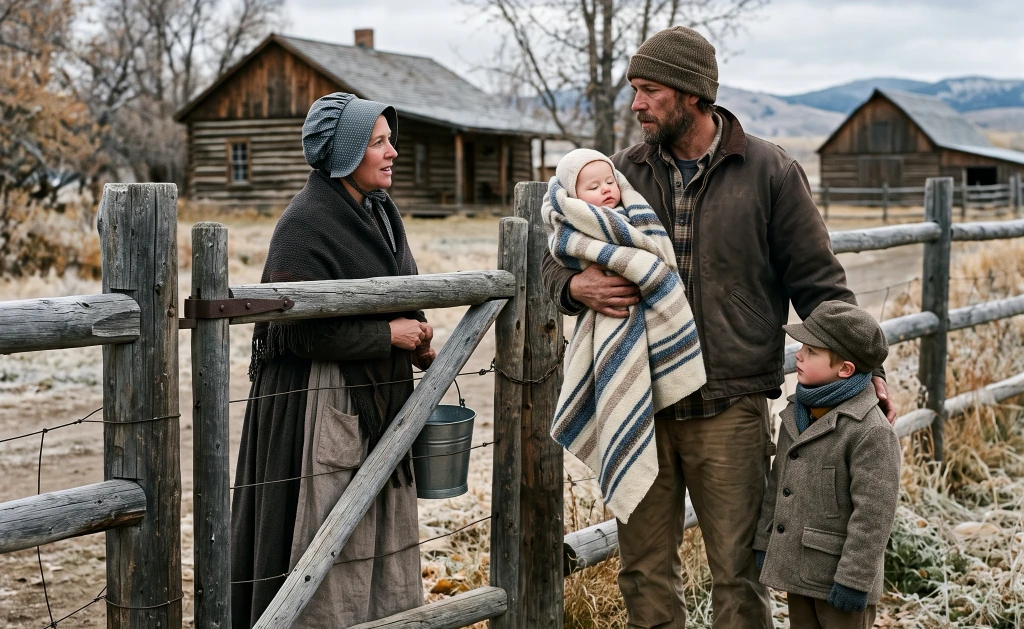
Six weeks earlier, he had stopped outside Clara’s gate because Lucy had quit crying.
She was ten months old and too light against his shoulder. His son, Sam, leaned against the handcart without asking why they had stopped; at seven, he had already learned not to spend breath on questions his father couldn’t answer. Daniel eased the handle down. Beneath their blankets lay his tools and a roll of old canvas, everything he had managed to keep.
Beyond the gate, a woman was breaking ice in a stock trough with a hammer. September wasn’t over, but this high corner of Wyoming Territory was already freezing at night. Daniel watched her turn the hammer sideways to spare the wood beneath the ice, and understood that she would notice careless work.
“Looking for somebody?” she asked.
“Work.” He shifted Lucy higher. “I repair wagons and buildings. Pumps, too.”
The woman looked past him at Sam, then at the patched shoulders of his coat. “The big outfits hire down toward the railroad.”
He knew. Until Anna died after Lucy’s birth, he had gone wherever the railroad supply crews needed him. Afterward, three ranches had turned him away: one would take the worker without the children, another had given them a single night’s lodging, and the last had offered to find a different family for the baby.
“We need to stay together,” he said.
She rested the hammer on the trough. “What are you asking for?”
“Milk for them. A place out of the weather.” He glanced at the barn, its broad doors facing the wind, and the dark hay crowded against the earth. “There’s work here I could do before winter. Enough to earn it.”
Her mouth tightened. “You found all that from the road?”
“Some. I’d have to look at your water line.”
Lucy moved her head against his neck, searching. The woman came through the gate and held out her arms, waiting until he loosened his grip. He hadn’t realized how hard he was holding the child.
“I’m Clara Bennett. Bring your boy inside.”
He tried to lift the cart again. Clara stopped him with a look at his empty hands, which were shaking now that they had nothing to carry. “It can wait by the step.”
In the kitchen she warmed milk while Daniel sat Lucy on his knee. Sam stood beside his chair until she pulled it out for him; then he ate the stew she set down with such care that Daniel had to turn away. He himself said he wasn’t hungry, and Clara put a bowl in front of him anyway.
The first mouthful hurt going down. For most of the previous day they had lived on thin porridge and the last of their cornbread. Daniel had watched Sam put half his share into his pocket after being promised more food tomorrow.
Now the boy did it again.
Clara reached across the table, and Daniel braced for her to tell him not to steal. Instead she set another piece beside his bowl and went back to the stove.
When Daniel raised Lucy’s cup, his hand trembled badly enough to spill a little on her blanket. Clara steadied it from below. Neither of them remarked on that, or on the wet mark his own thumb left beside the rim.
They exchanged their histories over supper in pieces. He was thirty-nine; Anna had been gone since the winter Lucy was born. Clara’s husband, Thomas, had died three winters earlier when a logging wagon slipped off an icy road. She had kept Willow Creek Ranch, though the loss of nine cattle the previous winter was still written against her in the feed account.
“You run it yourself?” Daniel asked.
“You’re sitting in the office.” She tapped the ledger beside the bread. “Kitchen when there’s company.”
Later she opened the old foreman’s room. Daniel carried their blankets and canvas up to its storage loft while she brought down a cradle with one rail still rough beneath his fingers. Thomas had made it, she told him, and stopped there. Daniel looked at the unused little bed and didn’t ask why it had never been finished.
Lucy slept before he had taken off his boots.
Sam curled beside the cradle with his pocket turned toward the wall, and Daniel left the bread where it was. He lay awake listening to the cattle shift in the barn, counting the things he could repair without buying lumber.
Before sunrise he borrowed a shovel. He tied a scrap of wool by the barn entrance and watched the draft carry it inward; beneath the hay he found sour, damp earth. The pump line held water after use, and the chinking between the house logs had opened along the seams.
Clara came out as he was studying the old willow row. Along the fence, bent grass still showed where last winter’s drifts had lain. He asked her where she’d had to dig, and she pointed toward the barn doors.
“Thomas planted those trees,” she said.
Daniel pulled his hand away from a dead branch. “They help when the wind comes up the valley. I’m looking at what happens when it comes from the other side.”
She watched the wool draw straight through the doorway. After a while she asked how much time he needed, and he told her six weeks, if the weather allowed it. The water mattered most; then the hay, a screen across the open yard, a sheltered turn into the barn, and the house seams.
“I’ll give you a week,” she said. “Show me something I can use.”
They got the wet hay off the ground that morning while the sun softened the earth for digging. Daniel built a low crib from discarded pine rails and left air spaces through the stack. Sam checked the gaps with a wooden gauge, announcing each one until Clara told him she could hear perfectly well from her end.
By afternoon they had opened the water trench. Daniel’s shovel struck pipe sooner than it should have, but Clara shook her head when he marked the length of the whole run. There weren’t enough hours or hands; he shortened his marks to the stretch between the well and the cows and began there.
Ruth Ellis arrived with goat’s milk and two loaves that evening. She lived farther along Cottonwood Basin and apparently knew who had stopped at every gate in it. “Wade Hollis has been asking about you,” she told Clara.
Daniel kept his eyes on his bowl. Ruth noticed Sam’s bulging pocket and asked whether one loaf would do. Clara took both from her basket.
His purchasing list was short. Most of what he needed lay behind the shed: pine poles, old rails, brush, and willow he could cut along the creek. On the third day an L of stakes crossed the northwest yard, set well clear of the doors, with a shorter arm sheltering the path to the house.
Daniel and Sam were setting a post when Wade Hollis rode up. Clara had refused his offer for the ranch after Thomas died, Ruth had said. Now he looked over the stakes as though checking something he expected eventually to own.
“Mercer’s willow wall,” he said. “You’ll bank snow right against that barn.”
“Set it wrong, I will.” Daniel lowered the post driver. “That’s why I’m leaving room.”
Hollis nudged a stake with his boot, then turned to Clara. “Since when do you let a man off the road decide how you’re going to winter?”
To read the rest of the story – CLICK the NEXT button 👇👇👇