


The cardboard sign hung from baling twine around the old dog’s neck: FORTY DOLLARS BY NOON. AFTER THAT, MY PROBLEM ENDS. The man holding the other end of the rope had written the last sentence twice, pressing hard enough to tear the cardboard.
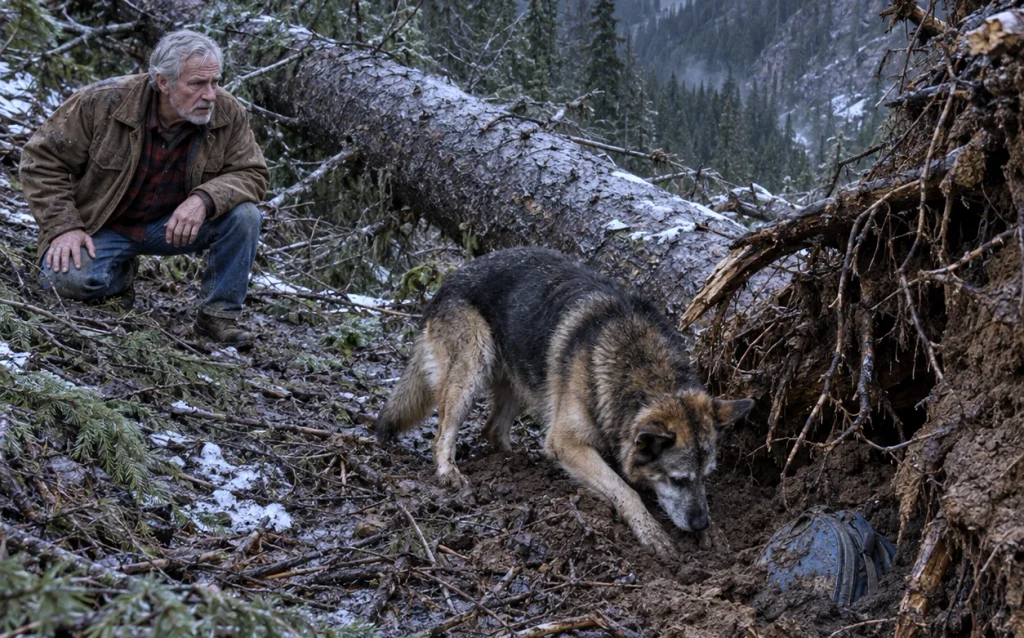
I had come to the Pine Creek livestock exchange for layer feed and a used well pump, not another mouth to keep alive. But the dog sat beside a rusted loading rail as if the shouting men, bawling calves, and March sleet belonged to a world he had already left. He was some weather-beaten mix of German shepherd and something larger, gray along the muzzle, raw beneath his collar, and thin enough that every breath showed under his coat.
The seller saw me looking. “You want him, old-timer? He eats more than he earns.”
“What happens at noon?”
He shrugged toward the wooded gully beyond the stock pens. “What the sign says.”
The dog raised his eyes to mine. They were amber, clear, and steady—not pleading. That made it worse. My wife, Nora, used to say I could walk past any trouble that had words for itself, but put a voiceless thing in front of me and common sense packed a bag.
I asked where the animal had come from. The seller said a timber hand had traded him for gas money outside Libby, then changed his story and claimed the dog had wandered into an equipment yard. He knew nothing about vaccinations, age, or name. Each answer arrived faster than the question, and none required him to look at the dog.
I took two twenties from the envelope that held the rest of my grocery money. “Untie him.”
The man laughed, then stopped when he realized I was serious. “Don’t come hunting me when he dies in your truck.”
“If he dies in my truck, at least he won’t die watching you.”
The old dog stood when the rope changed hands. His back legs trembled, yet he moved to my left side and matched my pace without pulling. That was the first thing about him I should have understood.
At the truck he waited for a command I did not know. I opened the passenger door and tapped the seat; he climbed in only after I stepped aside, turning once so his paws would not crush the paper sack of groceries. A ruined animal can still remember good training, but the sight of such manners beneath that rotten rope made the back of my neck burn.
My place lay eleven miles past Alder Creek, Montana, where the county road narrowed to gravel and the mail carrier turned around in bad weather. Forty acres of tired pasture, a chicken house, a barn with more patches than original boards, and a small log home Nora and I had meant to repair when we got around to it. She had been gone four winters. The repairs had waited with me.
The dog rode upright in my old pickup, watching the dark spruce slide past the window. When I turned onto Black Hollow Road, he lifted his head sharply. His nose worked against the glass, and a low sound moved through his chest before he forced himself quiet.
“Something out there?” I asked.
One ear tipped toward me. The rest of him stayed aimed at the trees.
At home I cut away the baling twine and the cracked leather collar beneath it. The skin was scarred but not freshly infected. He tolerated warm water, half a bowl of chicken and rice, and my hands checking his paws. When I spread an old wool coat beside the kitchen stove, he remained on the mudroom threshold until I stepped back and said, “You’re allowed.”
The veterinarian in Alder Creek agreed to see him the following afternoon. She warned me by phone not to feed too much at once and asked whether I could manage an elderly large-breed dog. I looked at the leaking faucet, the stack of Nora’s unopened garden catalogs, and the feed bill under my hand, then said yes before prudence could answer for me.
Only then did he lie down.
“You need a name,” I told him. The blue-black ridge beyond my window gave me one. “Blue. That’ll do until you object.”
He closed his eyes, which I took for consent.
That evening I heard another animal breathe in my house for the first time since Nora’s hospice bed had been carried away. I left the mudroom door open, pretended it was for the heat, and sat at the kitchen table repairing a hinge that did not need repairing. Twice I looked over and found Blue awake, studying me as if he had been assigned to a post and had not yet decided whether I was part of the ground or part of the danger.
Sometime before dawn, his nails clicked across the floor. I surfaced from sleep but heard no bark, no crash, nothing that told an old man to hurry. By the time I pulled on my jeans and reached the kitchen, the outer mudroom door stood six inches open.
The wool coat was empty.
I called from the porch until my throat hurt. Sleet ticked against the stovepipe; the chicken yard lay untouched. Large paw prints crossed the soft ground behind the barn, passed through a gap in the west fence, and entered the abandoned logging cut that led toward Black Hollow.
I told myself the dog had chosen the woods. An animal that old had earned the right to choose where he went, and a man who had paid forty dollars for one night of company had no claim beyond it. Then I noticed that the tracks were deep at the toes and spaced in a running stride. Blue had not wandered. He had left with purpose.
I put on my canvas coat, took a walking stick, and followed.
The cut climbed through lodgepole pine and dropped into older timber where wet branches knitted above my head. Blue’s prints held to no game trail I could see. They crossed a shallow creek, circled a wall of wind-thrown roots, and ended beneath a spruce that had come down years earlier.
He was digging there.
Dirt flew behind him in dark fans. Age had vanished from his body; his forelegs struck the ground with a rhythm too practiced to be frenzy. I caught his shoulder and called his new name, but he twisted free without snapping at me, plunged his muzzle into the hole, and dragged out a strip of blue nylon.
“Easy,” I said. “Let me see.”
He backed away, panting, while I worked the object loose. It was a child’s backpack, faded nearly gray, its zipper furred with rust. A cartoon moose still smiled from the front pocket. Inside the clear plastic name sleeve, protected by mud and time, block letters remained legible: JONAH BELL — GRADE 2.
My knees settled into the wet earth before I decided to kneel.
Seven years earlier, seven-year-old Jonah Bell had vanished during an elementary-school nature outing on the eastern edge of Black Hollow. Search teams came from three counties. Helicopters combed the ridges; volunteers walked creek beds shoulder to shoulder; his mother appeared on television until grief made her voice almost soundless. After four weeks, Sheriff Ross Kline announced that Jonah had most likely fallen into a flooded sinkhole and could not be recovered.
The county accepted a death without a body because there was nowhere else to put its sorrow.
Blue pawed once at the hole. A sleeve showed beneath the backpack—yellow rain shell, child-sized, packed under sod instead of scattered by weather. Whatever had happened here, the forest had not tucked these things beneath roots and covered them.
I rose with the backpack held against my chest. “How did you know?”
The dog did not sniff the earth again. He faced the descending timber beyond the fallen spruce, toward a limestone cut locals called Black Hollow, and waited until I looked the same way. Then he took three deliberate steps into the trees and glanced back at me once, as if asking whether I meant to leave the boy there a second time.
To read the rest of the story – CLICK the NEXT button 👇👇👇