


After twenty minutes on the rubber floor, Rafael Cruz needed a hand getting up. Dr. Samuel Reed took his elbow while Rafael kept the bottle upright. The calf had allowed its warm smell close enough to investigate, then dragged himself backward until the wall stopped him. Now the milk was cooling in Rafael’s hands. Toby stayed folded into the corner, his short trunk tucked against his chest. When Samuel shifted his weight, the little elephant tightened all over again.
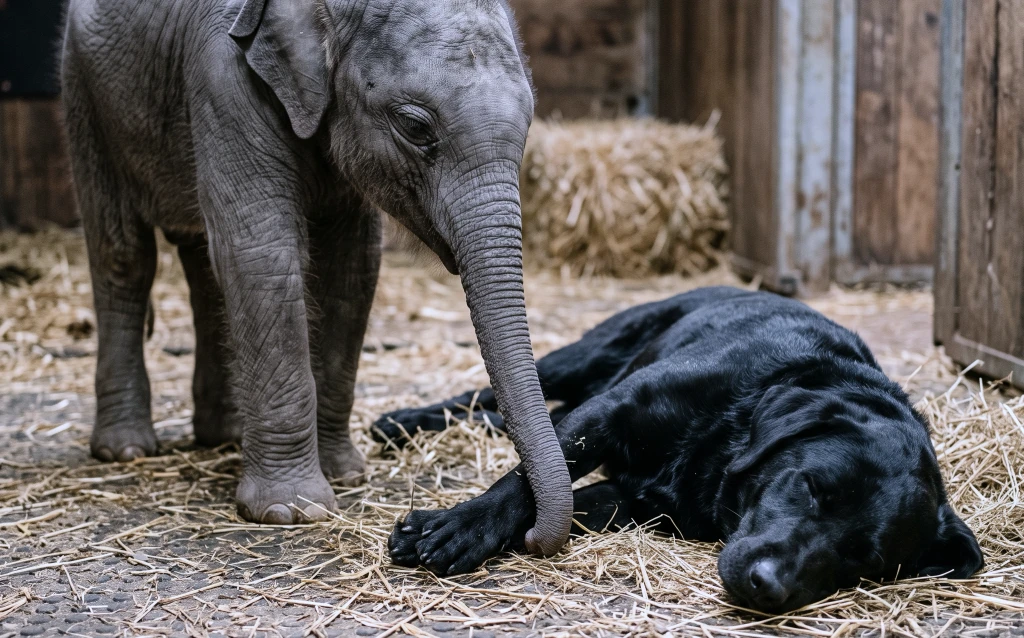
Jo Ellis stood beyond the rail with formula dried white on her sleeve. She had tried bringing Pearl to the adjoining fence that morning, hoping the fifty-year-old matriarch’s low calls might reach him. Wren, the two-year-old youngster, had done no better; outside the treatment wing, the other elephants went on calling without an answer from Toby.
Jo ruled out another tube feeding before anyone suggested one. Samuel had already stopped the second attempt when the restraint frightened Toby beyond what he could justify. They could continue the fluids and temporary nutrition; getting a bottle into him willingly remained the thing they had not managed.
Samuel had read the Gulf Coast roadside zoo records that arrived with Toby five days earlier. Only three weeks old now, the calf had survived his mother. Starvation had wasted her body; untreated disease left her joints barely working. She collapsed during the seizure and was dead that night. U.S. Fish and Wildlife Service officers brought him to Cedar Brake, outside Kerrville.
Even the footsteps Toby knew could send him shrinking back. Samuel let him hear each approach before he came near; treatment had brought the infection in both eyes under control, but there was no sight to recover from the damage done while it went untreated.
Marian Price was waiting in her office with the day’s weights. Arranging the sanctuary’s night coverage had meant keeping somebody beside Toby since his arrival, and now she needed to know what those hours were accomplishing. She asked about the kidney results while Samuel looked over the figures.
“Worse,” he told her. “And he’s lost more weight.”
“Then we have to consider euthanasia, Sam. I can’t keep asking what else we can do without asking what he’s going through.”
At fifty-two, Samuel had ended care for animals he had wanted badly to save. He understood why Marian was bringing it to him now. Before he answered, Jo came in and sat down beside him.
“The compressor came on this morning,” he said. “Toby turned his left ear toward it. He was interested. We come near him and he braces, but that sound made him listen.”
“You’ve got a sound,” Jo said. “We’ve still tried different bottles, different formulas, Pearl and Wren. Where do we go from that?”
“Let me work on making an approach mean something else to him. Fourteen days would be the outside limit.” He made himself finish the proposal. “We assess him every day. If he keeps declining despite the support, or we can’t control his suffering, we stop before that.”
Jo consented to the daily reassessment, and Marian agreed they could continue on those terms. Samuel had his permission, with the latest loss still visible on the sheet between them.
“Come down this way a minute. I want you to see him.” Beth Lawson met Samuel inside the county shelter that evening and led him to a run at the back. The place stood beside Cedar Brake’s gates and shared its veterinary help; Samuel usually looked in on a recovering dog before heading home.
The other dogs were making plenty of noise. Here, a black Labrador mix occupied a canvas cot with his forepaws dangling from it, lifting only his head for Beth. One beat of his tail answered her arrival.
“Hank. About two,” she told Samuel. “His owner’s sister brought him down from Montana.”
Samuel lowered himself by the kennel to look at a pale line on the left shoulder. It was cleanly healed, with pink skin showing through the black coat. Samuel put him at perhaps eighty pounds. There was no attempt to come closer, though the wound was no longer keeping him down.
Beth’s account came from Wade Colter’s sister. Wade was the outfitter Hank had followed behind pack strings in the Montana mountains. While they were searching for a missing mule, the dog and his owner had reached a kill with a grizzly still beside it.
“Hank tried to draw the bear away from Wade,” Beth said. Samuel glanced at the scar again. She let him look before she told him Wade had died there.
Samuel asked when help had reached them. “The next morning,” Beth said. “He was still lying across Wade’s chest.” She described the rangers facing a dog who couldn’t stand but kept fighting their approach; they had to sedate him before treating him. Once Hank could leave their care, Wade’s sister tried taking him home to San Antonio. Her long work hours and apartment left her unable to give him what he needed.
“She wanted him with her,” Beth said. “Brought his records when she came here. And his bowl. She cried when she put it down.”
Samuel found the dish where Beth indicated it. The food hadn’t been touched.
“How are you getting anything into him?”
“My hand. That’s how she fed him, too. He takes a little if you stay with him, and then he’s back on that cot.”
Samuel stayed by the wire. In Toby’s room they had tried to keep an approach from ending in another retreat, while over here a person willing to sit through a meal could still reach this dog. He looked from the untouched dish to Hank, aware of how much he did not know about putting them together.
“Tomorrow morning,” he said to Beth. “Could you have his leash ready?”
Marian refused the next morning. Jo described a bark sending Toby blindly into a wall, with Hank beneath the frightened calf’s feet. Samuel could offer no certainty about the dog; he began with how they would get the animals apart.
“We use the padded observation room. Give each of them his own exit, and keep Rafael at the door. If either one’s distress increases, we separate them immediately. Anyone watching can call it.”
“You’d bring him right up to Toby?”
“He chooses where he goes. We don’t force an approach.”
Marian still required veterinary emergency help to be immediately available. Samuel accepted that condition, then joined her and Jo over Hank’s intake checks and the shelter’s transfer requirements. When they had finished, she allowed one session.
Rafael took out the trough and cleared away exposed hard edges. The handlers used a padded cart to bring Toby from treatment, since he could not walk that far, and settled him in hay against the rubber wall. Samuel kept Hank in the hall until Rafael gave the signal; then he released the leash clip.
Hank’s first few feet into the room were spent nosing the mat. He stopped well short of Toby, looked away and yawned before easing down on his side. Samuel watched from the door control, unwilling to take a yawn as assurance of anything.
Hank lowered his chin and sighed. Toby’s two quick breaths had subsided; through the glass Samuel could see Jo and Marian watching the space the dog had left between himself and the corner.
Nearly an hour passed before the thin whine reached him. Samuel looked from Hank to Toby’s ears, which had turned toward the sound. As the calf’s breathing slowed, his trunk lost its tight curl and rested on the hay.
Hank began closing the gap in short movements, pulling with his elbows and keeping his belly low. Samuel waited through each pause. At last the left foreleg extended onto the rubber within Toby’s reach; above it the calf’s trunk searched, missing the fur on its first sweep.
Toby found it on his second try. Then he snatched his trunk away and held it folded tightly beneath his chin.
To read the rest of the story – CLICK the NEXT button 👇👇👇