


I let Mateo make one more offer before I shook my head. Jonah’s trunk followed the smell from the loosened bottle cap. It stopped short of the nipple. Then he shoved himself backward, and the rubber padding behind him took his weight.
“I can wait, Dr. Reed.”
Mateo Ruiz had been on that knee for twenty minutes. Waiting had cost the formula its warmth and brought the calf no closer to swallowing it. I signaled him out, watching him use a hand on his leg to get up.
Beth Ellis caught me beside the rail. “Please don’t tell me we’re putting another tube in him.”
I had stopped the latest of our two attempts when Jonah’s fear became more than restraint could justify. Both had cost him strength he could scarcely spare. For now, fluids and temporary nutrition would have to sustain him. I told Beth to leave the tube alone that day.
Jonah had been alive for three weeks and in our care for five days. Cedar Bend, outside Comfort in Kendall County, received him from federal wildlife officers closing a Gulf Coast roadside zoo. The records described his mother collapsing during the seizure, weakened by starvation and untreated joint disease; by nightfall she was dead. The infection we found in her orphan had gone untreated long enough to take his sight.
Treating the infection had spared him further damage. Nothing I could do would make those eyes see. Footsteps made him brace, although an ear would still turn toward the compressor when it started outside.
I could hear the resident herd from the treatment wing. Somewhere out in those pastures were Dottie, fifty years old, and Sadie, just two. Beth had already tried bringing their calls within reach of Jonah. He wanted neither the matriarch’s company nor the youngster’s; he backed away from both.
Marianne Cole had Jonah’s records spread across her desk when I arrived. As operations director, she had found the staff to cover his nights. Now she was waiting for me to explain where that care was taking him.
“Thomas, look at this before you ask me for anything.”
Her finger marked another loss on the weight sheet. When she asked about his kidneys, I had to tell her those results were worse as well.
“Then euthanasia belongs in the discussion,” she said. “If we keep going, what are we asking him to endure?”
At fifty-two, I knew why she was asking. I sat beside Beth and told Marianne about the ear turning toward the compressor. Jonah still sought sounds. What he got from us, each time we approached, was another procedure.
“Give me fourteen days to change that.”
Beth spread her hands. “Another bottle? More formula changes? Thomas, even the elephants couldn’t reach him.”
“I can’t promise fourteen more days, only fourteen at most. We’ll make the decision again each morning. Continued decline or suffering we can’t relieve ends the trial sooner.”
Beth gave her assent. Marianne picked up a pen and ruled off the weight entry; the space below would be ours to fill tomorrow.
The county shelter shared our veterinary help, so my route home often included a recovering dog beside Cedar Bend’s gates. That evening Gail Turner stopped hosing a run to ask if I’d eaten. I hadn’t. She put away the hose and took me past the barking.
“This one’s Tucker.”
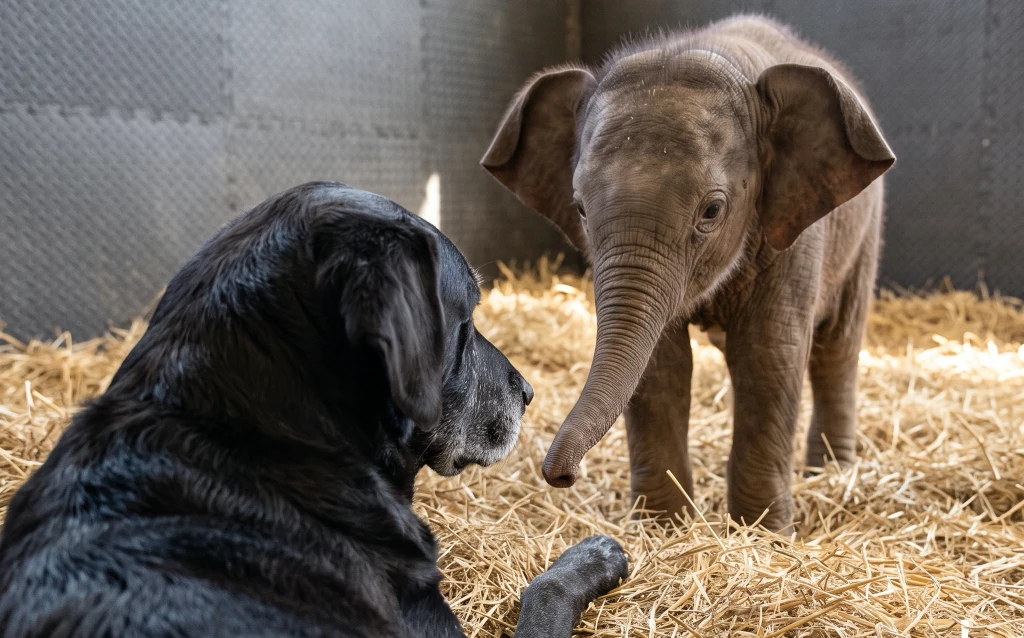
Gail stopped beside a cot occupied by a black Labrador mix. His eyes stayed with her; one tap of his tail was all the greeting he offered. There was a scar on the left shoulder, well healed beneath the hair. I looked from that to the untouched dinner at his feet.
“How old?”
“About two. His owner’s sister brought him from Wyoming.”
He looked close to eighty pounds. I lowered myself beside the kennel while Gail gave me the account that had arrived with him.
“Caleb Porter was an outfitter up there,” Gail said. “Pack animals, mountain trips. One of the mules went missing, and he took Tucker to look.” A grizzly was feeding on a kill when they reached it. Tucker tried to pull its attention from his owner, Gail told me, then stopped speaking.
“Caleb died,” she said.
By the time rangers reached Caleb the next morning, the wounded dog had placed himself across his chest. Tucker resisted them even though his strength was gone; he couldn’t get up. Sedation was necessary before anyone could help him.
“His sister took the dog home to Austin,” Gail continued. “She tried. Her hours, that apartment—she couldn’t give him what he needed. You should have seen her putting his bowl down here. Crying, with all his records under her arm.”
“He ate for her?”
“When she held it. He’ll take a little from my hand, too. Then he’s finished with everything.”
I stayed beside the untouched dish. That afternoon, Mateo had waited with food while another animal backed away. I asked Gail to have his lead ready in the morning.
Marianne refused the idea at first. Beth imagined a bark driving Jonah into a wall, or the dog trapped beneath him. I asked for one supervised meeting. Either animal could keep its distance, and either woman could call it off.
“Can you promise he won’t bark?” Beth asked.
“I can’t. You can stop the session yourself. So can Marianne.”
Before Marianne agreed, we checked the shelter’s intake record and transfer requirements. The observation room had padding and separate exits. Staff would cover the door, veterinary help would be ready, and growing distress would mean immediate separation.
Jonah needed a padded cart to reach us. While the handlers prepared it, Mateo made the room safe, removing the trough and cushioning hard edges. They settled the calf onto hay. He pushed toward the rubber wall as soon as they let him go.
I held Tucker on Gail’s lead until Mateo finished checking. Beth and Marianne watched through the glass as I unclipped it. The dog could now leave my side whenever he chose.
The calf’s breathing quickened, but only briefly. Tucker investigated the rubber under his nose, turned his head away, and yawned. Several feet from Jonah he folded onto his side, put down his chin, and sighed.
The yawn might have signaled uneasiness. I watched for any change that would make us stop. Nearly an hour of waiting ended with a thin whine from Tucker.
Jonah turned his ears. The trunk held against his chest began to descend into the hay. Tucker advanced on his elbows in two short movements, pausing between them, then offered his left foreleg into the empty space.
At the contact, Jonah jerked his trunk back. I looked to Tucker, ready for him to pull away too, but the paw never moved. A tap from his tail brought the calf’s ears toward the sound. The next exploring reach found the fur again and came to rest across the toes.
The toes flexed. Jonah stayed.
Beth had lowered her hand from her mouth. I watched Jonah breathing easily, his trunk still draped across the paw, while Tucker rested with his chin down. Neither needed anything from me just then. I stood quietly and let that part of the visit last.
At eighty minutes, I shifted my feet. Tucker answered with a chuff and got up. His paw slid out from beneath Jonah’s trunk.
To read the rest of the story – CLICK the NEXT button 👇👇👇