


Ranger could find any danger, anywhere. It was the best sentence in Emma Ellis’s report, and she had just read it to a picture of her father that wasn’t moving. On the laptop, his mouth stayed open. Emma waited with her finger beneath the sentence while her mother leaned across the kitchen table to check the connection. Dad was at a field site several hours north of Vista; sometimes they got his voice without his face, which Emma preferred to having his face without him.
“I heard the part about any danger,” he said when the picture caught up. “We need to change that.”
Emma looked at the blue folder she’d made for Monday. She was eight, and she had already copied that sentence in her best printing.
“Even if I say almost any?”
“He searches for things he’s trained to find. That’s what you can put down.”
She drew a line through the sentence. Under it she wrote about Ranger being four and working with Dad for three years. The word detection had a purple circle around it. She knew she wasn’t supposed to list details Dad couldn’t discuss, but the word itself was harder to keep in her head.
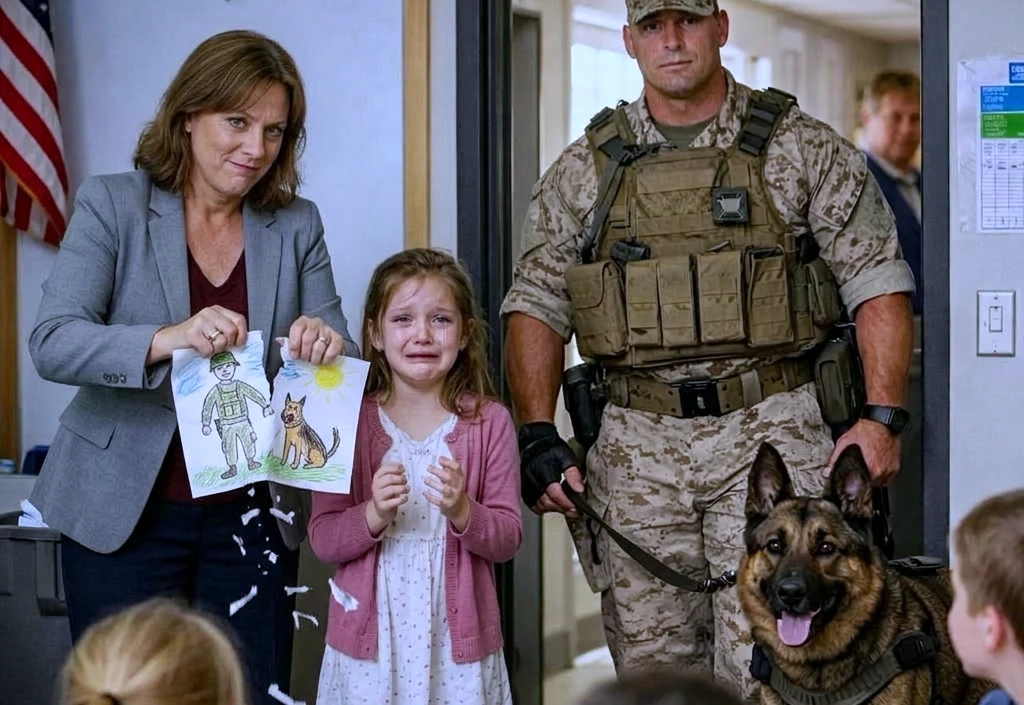
She held her drawing up to the camera. Ranger stood on Dad’s left, with a black muzzle and a white mark above his right ear. Dad said she’d put his old training scar on the correct side, then asked to hear her opening again.
“My dad, Staff…”
The next word went away. His picture was moving this time; she could see him breathe. He let her look down at her card and find Sergeant without saying it for her.
There was a shelf in Room 3B where the folder could wait flat. Ms. Voss showed Emma on Monday morning, after Emma practiced her opening. At Sycamore Ridge Elementary, the day felt easier before the desks had children in them.
The teacher moved a cart out of Emma’s path and worked the blind until sunlight no longer fell across the pages. Emma recognized that kind of help. Faced with an entire math sheet once, she had cried; Ms. Voss had hidden most of it beneath another sheet, leaving only a row to do. Emma could still make a hard page smaller that way.
For this assignment there were three things to get right. A real person; words the student had written; information someone could check. Emma copied Ms. Voss’s explanation beside the scoring boxes: checking meant that the work mattered enough to take seriously. The finished projects would be displayed in the hall for Family Learning Night.
By Emma’s turn, two reports hung on the line: an aunt who repaired elevators and a grandfather who had played in a Navy band. The teacher had asked both students about their sources before clipping up their work. Emma had a source page, too.
Lily smiled when Emma brought the drawing to the whiteboard tray. Emma settled her gaze on the green bead in Lily’s braid; it was easier than choosing among twenty-two faces. She started before she could forget the rank again.
“My hero is Staff Sergeant Matt Ellis. That’s my dad. He’s a Marine, and he works with a Belgian Malinois called Ranger.”
The difficult word came out correctly. Emma went on to the things Dad watched: how Ranger held his head, whether his breathing changed, what his pace could tell a handler. The dog didn’t choose their destination, and Dad had to do more than wait for him to bark.
She reached the part about how they communicated before Ms. Voss stopped her.
“What does that mean? How are they communicating?”
“Dad learns Ranger,” Emma said. “He can’t ask him, because Ranger can’t say it. So he has to look at what Ranger does with his body.”
She hadn’t read any of that. A few classmates nodded, and Emma loosened her grip on the cards. Then the teacher asked whether she had written the report herself.
“Yes. Dad helped me fix facts.”
“Show me what you used to support them.”
Emma opened the folder to her interview citation. She checked the instructions while Ms. Voss waited: name a source, but nothing about a letter or photograph. She pointed to Staff Sergeant Ellis on the last page.
“I asked him on the computer. This is who I asked.”
“And the assignment you describe is what he told you he does?”
Emma wasn’t sure which part to repeat. “He works with Ranger. When Dad isn’t with him, Ranger’s at the unit kennels.”
Her folder passed into the teacher’s hands. The drawing came under inspection first, then the interview page, then the account Emma had printed. Without it, she had only the little cards to hold. Ms. Voss said the language was advanced and an outside reader couldn’t check the military claims from what Emma had supplied.
“This is going into a public display,” she added.
“Dad can answer. You could call him.”
That seemed like the next step. Emma waited to be asked how to reach him; the pencil lying across the rubric hadn’t filled in any boxes yet. Instead, the teacher picked up her red pen.
“The standard applies to you as well. We cannot negotiate it in the middle of a presentation.”
Emma watched NOT VERIFIED spread across her title page. Ms. Voss pressed hard enough to make grooves beneath the ink. Then she set the folder on her desk and called the next student forward.
On the way back, Emma looked for Lily’s bead. Lily had lowered her head, hiding it. Emma sat down with the cards and tried to keep their edges together while another report began without hers having ended.
Two numbers needed reversing on her math sheet later. Ms. Voss helped her put them right, patiently, without making her feel foolish about them. Emma could follow the numbers. She couldn’t follow how this was the same day, with the same teacher, as the red words.
At dismissal she got the folder back, carrying a yellow instruction to revise what couldn’t be verified. Her lunch box and sweatshirt hid it inside her backpack. She tugged the bent zipper pull until nothing blue could be seen.
Mom was still in her grocery-shift cardigan at the duplex, bent over her work schedule. Emma covered the schedule with the folder.
“The red first, Mom. Read that first.”
Rachel’s hands went flat against the counter. Emma waited while Mom looked away from the red words to check the assignment, then the interview citation and the disputed sentences. Each page got read. None went aside just because another looked more official.
“Your writing, Dad’s facts?” Rachel asked.
Emma nodded.
“Then I need her to tell me what she’s asking for. We aren’t replacing facts we know are true.”
Before dinner, Emma watched a message leave through the school portal. Mom offered three ways to help: a phone call, a meeting, or appropriate confirmation from Matt’s unit. SENT appeared beside the time. Emma could see that there was an answer waiting for the question Ms. Voss had asked.
Mom offered to get fresh paper. Emma kept the folder as it was and set it beside her backpack for Tuesday.
But on Tuesday, after announcements, Ms. Voss’s explanation began with Wednesday: that was when the hallway display had to be finished. She called Emma forward with the folder already in her hand. The work was unchanged, she said, so yesterday’s problem was unchanged, too.
“Mom sent you something.”
“I saw the notification. Parent correspondence is for outside teaching time.”
Emma stopped near the whiteboard. Ms. Voss turned the marked page toward the children and said they had all heard the report; they all needed to hear its correction. Emma looked at the teacher’s desk, where she expected the folder to go again.
Ms. Voss walked past it. At the far end of the board, she let the folder fall into the wastebasket. A corner caught on the rim, keeping a little of the blue above the discarded spelling pages and pencil shavings.
For a moment Emma watched that corner. Then the teacher’s hand came down on it. The cover folded against the liner and sank into the scraps, leaving only a blue triangle showing. Ms. Voss stepped away, and Emma was still at the front with nothing in her hands.
“Now face your classmates, Emma. You need to apologize for giving them a story you couldn’t prove.”
To read the rest of the story – CLICK the NEXT button 👇👇👇