


The three heifers came into the ring after the feeder steers and before most of the buyers had finished folding their sale sheets. Each was black from poll to tail except for a broad white band around her middle. Ellen Hartley wrote their weights on her yellow legal pad: 462, 488, and 439 pounds. Around her, men who bought cattle by the truckload kept their hands in their coat pockets.
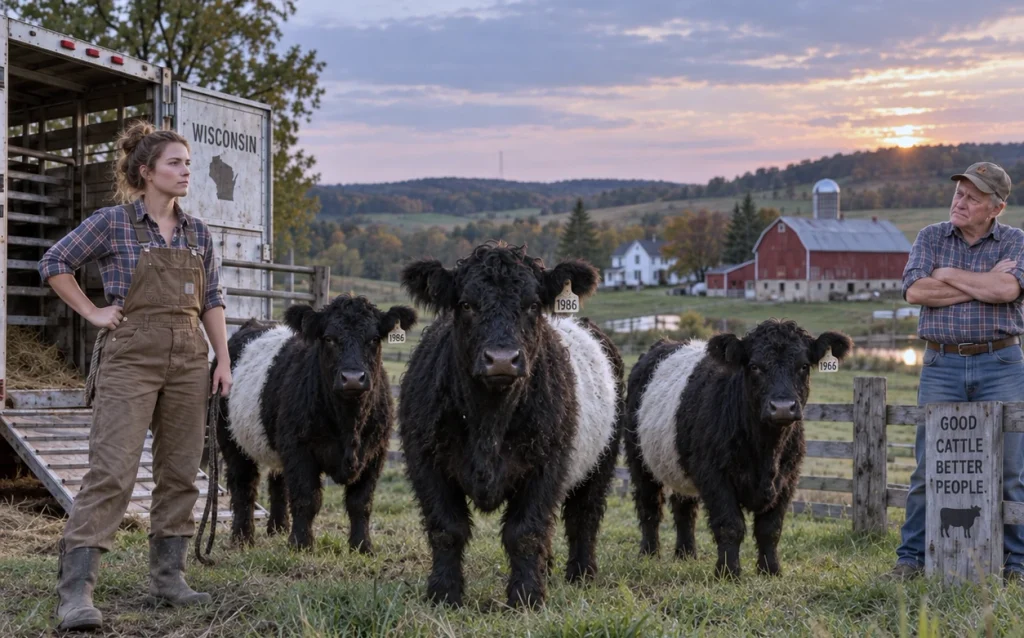
The animals had already crossed the sawdust once without drawing a bid.
Now a yardman turned them back through the gate while the October light weakened at the high windows. Their coats were dusty and their ribs carried less flesh than buyers liked, yet none fought the narrow alley or kicked at the pressure behind her.
The auctioneer tried forty cents a pound, then thirty-five. At thirty-two, he looked over the rail as if asking whether anyone intended to save him from the embarrassment. Ellen raised her bidder card. The hammer came down at $444.48 for all three, and a man two rows behind her said, not quite softly enough, “Well, somebody likes ornaments.”
Ellen was twenty-eight. She had brought $600 in an envelope and no plan for explaining the purchase to Tom beyond the notes on her lap. By dusk, the heifers were standing in a borrowed stock trailer behind his pickup, their white belts flashing between the slats as he drove them home through the October hills of western Wisconsin.
Twelve years later, the same hand would enter $246,870 on an annual gross-revenue line. The breed would be the same and the acreage no richer. The difference would begin with what Ellen chose to measure after those three heifers came home.
Tom glanced at the sale slip at a stop sign, then at the trailer in the mirror. “You bought the only cattle nobody wanted.”
“I bought the only ones I came back to look at,” Ellen said. Tom folded the slip and tucked it above the visor. He did not agree with the distinction, but he drove carefully enough that the trailer barely rocked.
The Hartleys’ ninety-four acres lay south of Maple Run. Ellen’s father had milked forty-two Holsteins there until his knees forced the 1981 herd sale; now swallows nested in the stanchion barn. Tom worked for the county highway department. Ellen covered three mornings a week at Driftless Veterinary Service and kept eight beef cows because empty pasture felt abandoned. They had two children, an unreliable pickup, and $31,600 left on the mortgage.
Three semesters of animal science had taught Ellen enough to read a ration sheet, but Harold Jensen had taught her how to look. The old Hereford breeder lived six miles away and never judged a cow from the side nearest the crowd. He studied toes, hocks, muzzle, ribs, and udder, then moved behind her to see whether the structure held together.
“Buyers fall in love with the end that enters the ring first,” he had told Ellen when she was fourteen. “The working end gets the last word.”
At Pine Creek Livestock Exchange, the belts drew every eye. Ellen had watched the feet. The heifers were undersized beside the broad, heavy cattle local feedlots preferred, but they stood square and followed the yardman without panic. On her pad she had written three observations: moderate cows; sound feet; quiet minds. The numbers already in their ears—17, 18, and 19—became their names.
She did not mistake calmness for proof. Sale cattle could be tired, and sound feet on sale day did not guarantee sound feet at eight years. What she had purchased was a set of questions cheap enough to keep asking. The notebook would have to tell her whether the answers held.
Their first winter cost more than their purchase. The perimeter fence required posts, wire, staples, and two used gates, and a neighbor charged $96 to haul round bales after the Hartleys’ hay equipment had gone with the dairy herd. Every thirty days Ellen looped a heart-girth tape around each heifer and recorded the estimate. The tape was crude. Using it the same way each time made it useful.
By April, 17 had gained 168 pounds, 18 had gained 154, and 19 had gained 161.
After December they had lived on hay, mineral, water, and what emerged on the south slopes after the snow retreated. Ellen had expected their condition to slip. It had not.
That spring she put all eleven females together and walked the pasture every Sunday with her pad. She noted grass height and body condition, which cows stayed near water, and which ventured onto the steep margins the old dairy herd had ignored. The belted heifers climbed into the roughest corners. Number 18 spent June along the north fence, stripping coarse grass and burdock leaves from ground Ellen had considered nearly useless.
She wrote: They have not been told which acres are poor.
In 1988, Ellen paid a Minnesota breeder $75 per cow to expose all three to his registered Belted Galloway bull.
Each settled. On March 9, 1989, she entered the barn at 5:40 a.m. and found a dry, sixty-one-pound calf already standing beside 17. Number 18 delivered a fifty-eight-pound heifer eleven days later. Number 19 followed on April 2 with a sixty-three-pound bull calf. Ellen had pulled none of them.
Three easy births did not make a scientific trial, so she resisted making them into one. She recorded date, sex, birth weight, weather, the dam’s condition, and when the calf was first seen nursing. At roughly seven months, the calves weighed 512, 486, and 501 pounds. None would have stopped conversation at the sale barn. Their dams’ size made the figures worth another look.
A 1,250-pound cow could wean a 600-pound calf and command admiration. A 950-pound cow weaning 500 pounds might produce fewer sale pounds but convert a greater share of the body Ellen had fed all year. She began calculating calf weight as a percentage of estimated mature cow weight. Beneath the column, she reminded herself to count the feed behind the calf, not merely the calf.
The conventional market rewarded a different calculation. In the fall of 1989, Ellen sent her first two belted steers through the same auction. Buyers discounted them against the neighboring black commercial calves. One man called them cute, kindly enough, and Ellen heard the boundary he had drawn: cute cattle did not fit his feedlot, so their efficiency on her hills had no price in his system.
For the next several months she wondered whether she had confused usefulness with value. Then, one February morning in 1990, the veterinarian leaned out of his office while Ellen was filing charts and pointed toward the ringing telephone.
“There’s a man on line two who wants to know whether you’ll sell him two of those little black cows with the white belts.”
To read the rest of the story – CLICK the NEXT button 👇👇👇