


January had locked most of Coldwater River under a white, load-bearing skin, but Graham Holloway knew the dark seams. He knew where springs worried the ice from below and where a south-facing bank could soften by noon even at twelve degrees. Knowing all that, he took the shortcut anyway. The marked trail around the bend added two miles, and nobody at Bear Hollow knew how often his “one shortcut” had become the route.
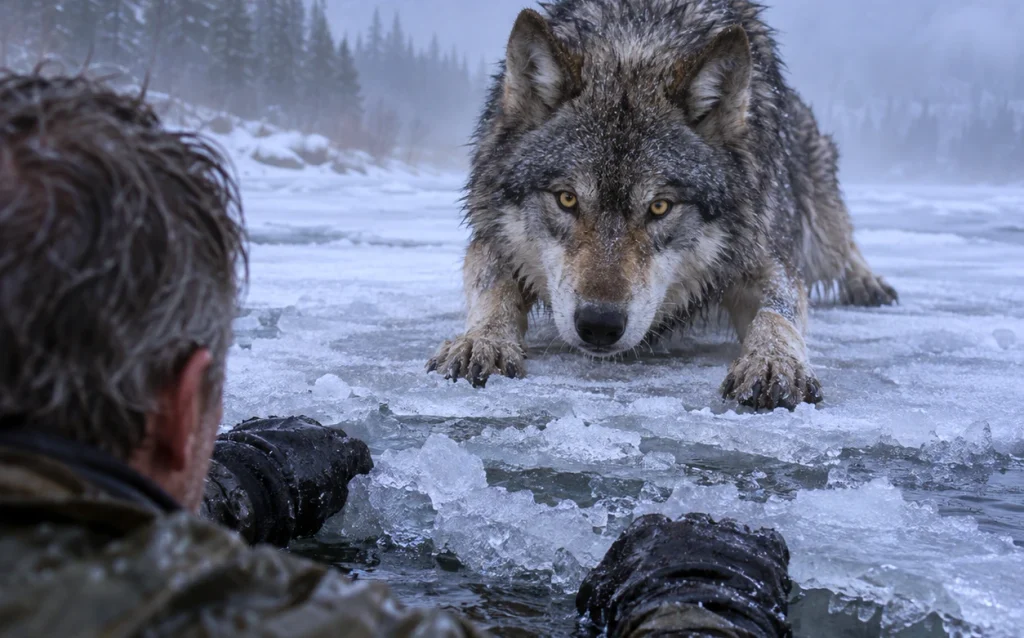
The first crack traveled under his boots like a branch breaking in another room.
Graham stopped, eased the freight sled rope from his shoulder, and tested the ice with the ash pole he carried for exactly this mistake. Fifty yards ahead, beside an opening no wider than a kitchen table, something dark moved once and went still.
At first he thought deer. Then the head rolled against the rim, and he saw the long muzzle, the small ears pressed flat, the grizzled ruff of an adult wolf. Its forelegs clung to the edge while the rest of it hung in black water; ice had formed where the wet guard hairs met the lip of the hole.
Every useful thought told Graham to back away. A wolf was not a misplaced dog, and people around Aspen Crossing had lost sheep that winter. Yet leaving an animal frozen to its own grave seemed less like hunting than refusing to look at what was in front of him.
“You picked a poor place to make my conscience inconvenient,” he said.
He slid the rifle off his shoulder and laid it on the sled, then paid out the rope and tied one end around a spruce at the bank. Flat on his belly, weight spread, he pushed the pole ahead and crawled. Water pulsed in the opening, lifting the wolf’s body and letting it fall, while the ice complained under Graham’s elbows.
The wolf’s eyes stayed shut.
Graham could not tell whether it breathed until he saw a faint bubble gather at one nostril, and that small proof committed him more completely than any promise. He worked his hunting knife between ice and fur, shaving the rim away in chips while cold water climbed through his gloves.
“Don’t wake up ambitious,” he murmured. “That’s all I ask.”
When the last frozen tuft came free, the animal slipped lower. Graham caught both forelegs, rolled onto one hip, and hauled until the chest cleared the water. The wolf weighed near eighty pounds dry and far more soaked; for one terrible second the ice sagged, but the rope held Graham as he dragged the body onto firmer gray ice.
He pressed two fingers behind the foreleg and found a slow, uncertain beat. The wolf’s eyelid moved when Graham shone his pocket light across the eye. “Still here,” he said, breathing hard. “Now we have to make that useful.”
He shouldered the animal only long enough to stagger off the river, then lowered it onto the trapline sled. He lashed the legs loosely so they would not trail, covered the great wet body with his canvas tarp, and leaned into the rope. The two miles to Bear Hollow rose steadily through timber, and meltwater from the canvas glazed the runners blue.
Nell, Storm, and Boone caught the scent before Graham reached the gate. The three husky mixes erupted against their kennel fence, hackles high and voices frantic, until he barked them quiet. Even then they stood shoulder to shoulder, staring as Graham hauled a natural enemy through the yard and into the mudroom.
Inside, he kept the room warm rather than hot and cut away the stiffest ice without rubbing the skin. He layered dry wool over the animal’s trunk, set warmed water bottles outside the blankets, and waited.
Near midnight, the wolf opened yellow eyes, showed every tooth he owned, and tried to rise; his front end came up, but his hindquarters folded beneath him.
Graham backed out of reach. “Good. Be mad. Mad takes energy.” He slid a pan of venison trimmings close with a stove poker, and after a long minute the wolf ate without taking his gaze off him.
Gray was what Graham called him because naming something temporarily felt less dishonest than pretending it had not entered his life. For the next weeks, care became a set of guarded tasks: meat and water within reach, bedding changed with a plywood shield between them, the door cracked for clean air. Gray gained weight and could brace on his forelegs, but his back feet dragged or turned under when he tried to stand.
The cabin had held Holloways for three generations and, lately, too much quiet. Graham’s father and grandfather had hunted there under a rule neither man had bothered to embroider: take what the household needs, waste nothing, and do not confuse power with permission. Saving a wolf fit nowhere in that rule, yet killing a helpless one did not fit either.
He thought of the sawmill closing nine years earlier, when Alex was five and every promise Graham made sounded thinner than the last. Tessa had taught third grade in Missoula and tried longer than he deserved to make two incompatible lives share one roof. When she finally said she could not raise their son on seasonal money and the chance Graham might fail to come home from the mountains, she was not punishing him; she was naming the load she could no longer carry.
He had left her the small house in town and returned to Bear Hollow. Alex came for summers and some holidays, while winter visits were rarer because Tessa knew what forty below could do to a road, a truck, or a careless man. She lived now with Mark, who sent Graham useful weather links and never acted as if being kind required replacing anybody.
In February, Deputy Sam Keller arrived after dark with snow packed around his cuffs. He accepted coffee, declined food, and watched Gray through the mudroom doorway before saying three sheep had been killed near Aspen Crossing. No one could tie the losses to this animal, but rumors were faster than evidence, and Dean Bragg, the district game warden, had already heard Graham was keeping a wolf.
“Private possession gives him room to make trouble,” Keller said. “There’s an active predator-control authorization east of the river. Bragg could call the animal evidence, confiscate him, or decide removal means a bullet.”
Graham set down his cup. “You come to report me or warn me?”
Keller rubbed a thumb along the chipped rim of his mug. “I came for coffee. If anybody asks, it wasn’t very good.” He added that Bragg still claimed Graham trapped across district boundaries, though every tag and map Graham owned said otherwise, then left without making a call.
By late March, Gray could hold himself upright for several breaths, though one hind leg trembled and the other often failed him. The dogs no longer spent their days shouting through the wall; Nell would even lie outside the mudroom door, nose aligned with the gap, as if tolerance were another job Graham had assigned her. He planned to release Gray when the snow withdrew from North Fork Ridge, assuming strength returned before secrecy ran out.
Alex arrived for spring break in a bus that overheated outside Aspen Crossing. At fourteen he had become all wrists, serious gray eyes, and the Holloway chin, and he hugged Graham hard before complaining that the driver had refused to let him walk the last six miles. “Smart driver,” Graham said, taking his duffel. “Disappointing for the family reputation.”
The joke died when Alex stepped into the cabin and saw Gray beside the stove. The wolf lifted his head and sampled the new scent, muscles tight under his coat, but he did not bare his teeth. Alex stopped without being told, turned slightly instead of facing him square, and waited with a patience Graham had not known the boy possessed.
“He’s real,” Alex whispered.
“Inconveniently.” Graham explained the river, the weeks of feeding, and the hind legs that still would not bear him. Gray kept watching Alex, then let his chin settle on his forepaws, an allowance he had offered no other visitor.
Alex crouched several feet away. “Physical therapy can help dogs after an injury. Massage, supported standing, range-of-motion work. I looked it up for Mom’s old Lab.”
Graham studied Gray’s ears, the angle of his shoulders, the quiet readiness in his mouth. Then he looked at his son’s open hands. “Question is, will he let you work on that hind leg?”
To read the rest of the story – CLICK the NEXT button 👇👇👇