


The sound at Walter Mercer’s back door was too heavy for a fox and too uneven for a branch. It came once, stopped, then dragged across the porch boards with a scrape of metal. Walter set down his cold tea and listened with the part of himself that had spent forty years noticing what animals could not say.
At sixty-eight, he knew every ordinary noise around his place in Alder Creek. Snow slipping from the roof had a soft rush. A whitetail nosing beneath the bird feeder made quick, hollow taps. This was a slow pull, a pause, and three faint scratches against the wood.
Walter took his rifle from the rack, opened the back door two inches, and felt the January air cut through his flannel shirt. Something gray lay beneath the porch light. For a moment he saw only the shoulders and assumed a large dog had crawled up from the county road.
Then the animal raised its head.
The wolf’s face was wide even after hunger had hollowed it. Ice feathered the fur below his muzzle, and his ribs showed under a coat that should have hidden them. A steel foothold trap clamped his left foreleg above the paw. Its short chain trailed across the boards, bringing with it a clot of frozen earth.
Walter lowered the rifle without putting it down. The wolf watched the movement. There was no snarl, no flattening of the ears—only a shallow breath that trembled through the animal’s body.
“You came a long way with that on you,” Walter said.
He had treated cattle that could break a man’s ribs by shifting at the wrong moment and frightened shepherd dogs that bit through leather gloves. Weak did not mean safe. Wild certainly did not mean grateful. Walter kept the door between them while he studied the wolf’s eyes, gums, breathing, and the dark swelling around the trap.
The animal was dangerously thin, perhaps fifty-five pounds when a male his size should have weighed much more. The wound needed imaging, antibiotics, and a wildlife veterinarian. What Walter could offer in the next hour was only release from the steel, warmth, fluid, and the chance not to die on a porch.
The rifle felt heavier as he considered the other kind of mercy. One clean shot would end what the cold and infection had begun. He had made that decision for animals before, always after looking for every honest alternative.
“Is that what you walked here for?” he asked. “For me to finish it?”
The wolf tried to lift his chest, failed, and lowered his muzzle until it rested on the boards beside Walter’s boots.
The trap chain went still.
Walter leaned the rifle inside the doorway. He brought out a wool blanket and approached from the animal’s uninjured side, speaking in the low, practical voice he had once used in calving barns. The wolf’s eyes followed him, but the head did not rise. Walter covered the wasted body, slid one arm beneath the chest and the other beneath the hips, and lifted.
There was far too little weight in his arms.
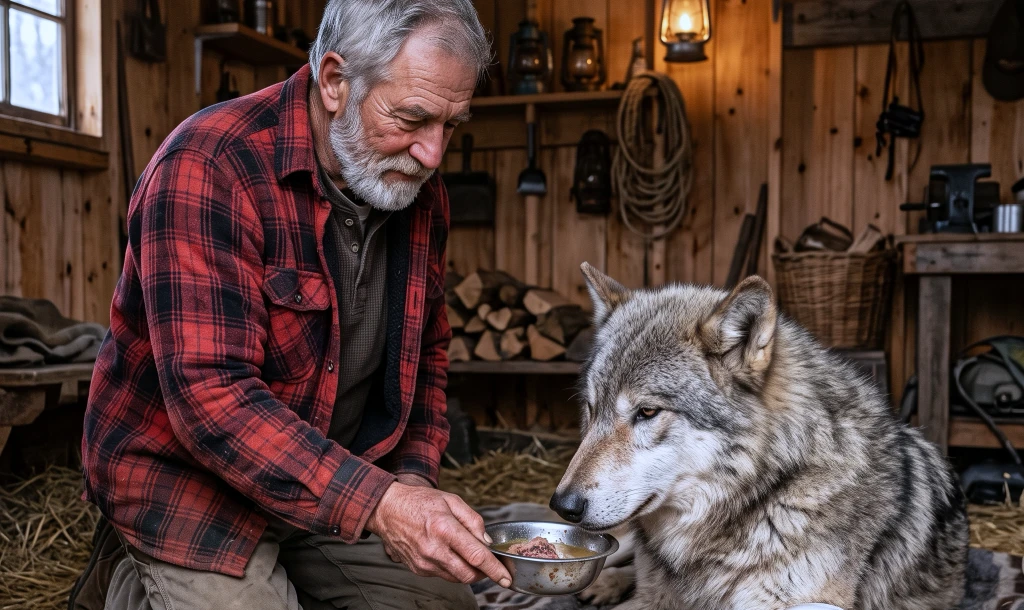
The heated work shed stood twenty yards beyond the house. By the time Walter laid the wolf on an old stock coat over clean straw, his own knees were shaking. He closed the door, turned on the hanging lamp, and saw that the metal jaws had crushed tissue without cutting through the entire leg. That was the first decent piece of luck either of them had been given.
Walter found bolt cutters, saline, gauze, and the padded splint left in his retired veterinary kit. He did not pretend the kit made him a doctor. It made him a man who could stop bleeding, recognize shock, and avoid doing more harm while an animal decided whether to live.
“I have to open it,” he said. “You can object. I’d rather you didn’t.”
The cutters bit into one spring. The wolf jerked once and made a sound so low Walter felt it through the floor before he heard it. He waited until the animal’s breathing eased, shifted the tool, and pressed again. The trap opened with a hard click and fell onto the packed dirt.
Walter flushed the wound, covered it loosely, and stabilized the leg. He offered warm water first, then a few spoonfuls of unsalted broth. The wolf drank without lifting his body, his tongue moving slowly against the bowl.
That motion brought back Ellen in the last weeks of her illness: one hand around a teacup, both of Walter’s hands steadying it because hers no longer could. She had died eleven months earlier after forty-five years of marriage. Since then, the house had kept every object and lost its shape.
Walter moved the bowl away before the wolf could take too much. “That’s enough for now.”
The wolf touched his rough tongue to the side of Walter’s wrist. It could have been salt, broth, or simple investigation. Walter did not give the gesture a name. He sat there anyway until the animal slept.
Near midnight, he stepped outside to bring in more firewood and saw a light in Ruth Clay’s kitchen across the narrow lane. Her curtain shifted. Ruth had been widowed longer than Walter and considered sleep an unreliable use of nighttime.
By breakfast, she was waiting beside her mailbox in a quilted coat.
“Your shed light burned until after two,” she called. “And something cried out.”
“I dropped a tool.”
“A tool with lungs?”
Walter kept walking. “Morning, Ruth.”
He spent the day offering the wolf small amounts of water and food, checking circulation below the bandage, and watching for a change in breathing. By evening the animal could hold his head up. Walter began calling him Gray because a name was easier than addressing a pair of amber eyes.
On the third feeding, tires crunched into his drive. A sheriff’s SUV stopped behind a county truck, followed by a mud-splashed sedan with BLACKTAIL WEEKLY printed on the door. Deputy Noah Reed climbed out first. Simon Wolfe, the county’s contracted predator-control officer, came behind him in camouflage, and reporter Aaron Pike emerged with a phone already in his hand.
“Ruth called dispatch,” Noah said, almost apologetically. “She thinks you’ve got something wild in the shed.”
“Ruth thinks the moon changes her television channels.”
“She also sent a recording.” Noah glanced toward the shed. “May we look?”
Refusing would buy Walter perhaps ten minutes and cost him every ounce of credibility. He opened the shed himself. Gray lay in the shadow behind the workbench, quiet until Aaron’s phone light swept across his face.
Noah stopped in the doorway. Aaron lowered the phone without being asked. Wolfe stepped closer than either of them.
“Back up,” Walter said. “He’s injured and cornered.”
Wolfe stared at the bandaged leg, then at the rusty trap on the floor. “Where’d you find him?”
“He found me.”
“Must’ve dragged himself down from the north side of Miller Creek.”
Walter looked at the frozen dirt still caught in the chain. Snow had fallen all night, filling the wolf’s tracks before dawn. Walter had told no one which direction the animal had come from—or that there had been a creek smell beneath the iron and blood.
“Then how did you know the trap was on the north side of Miller Creek?”
To read the rest of the story – CLICK the NEXT button 👇👇👇