


The German shepherd in Evan Cole’s headlights would not leave the snowy shoulder. Something dark lay between his paws, and dawn was still an hour away. The shape at the edge of Evan Cole’s headlights did not move when the cruiser slowed. At first he took it for a deer caught between the road and the black wall of spruce, but then the animal lifted a narrow, familiar head. A German shepherd stood on the snowy shoulder, facing him.
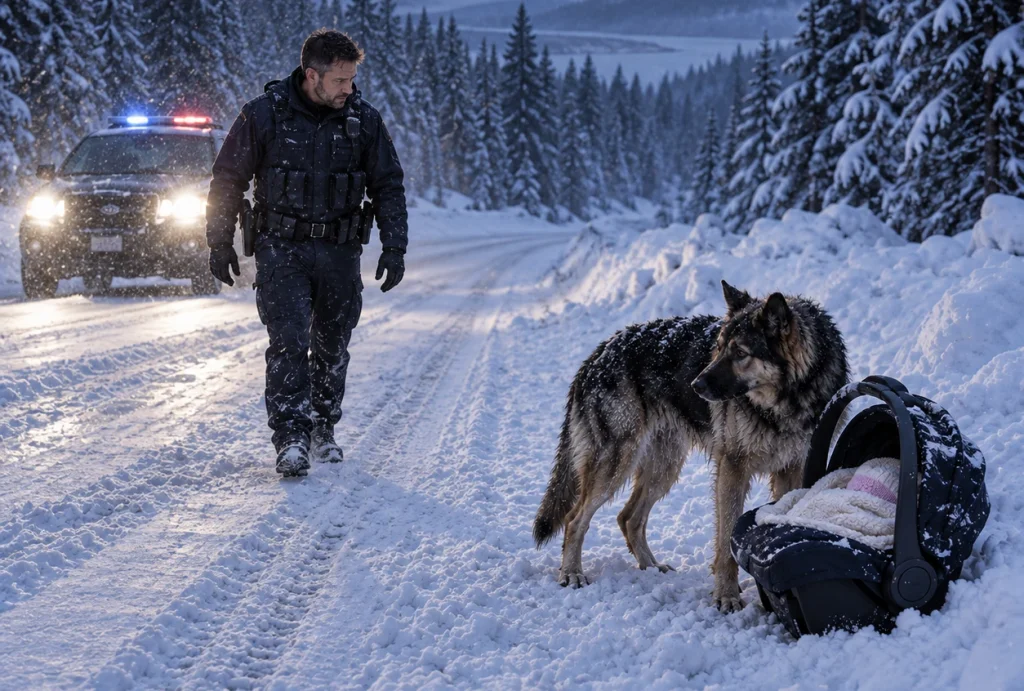
It was 5:40 on a late-November morning, three hours after the season’s first hard storm crossed western Maine. County Road 16 was blue with predawn, its center line buried and its ditches softened into white troughs. At thirty-nine, Evan had spent fourteen years in uniform, long enough to distrust an empty road after a storm. Most of his shift had gone to checking limbs and tire tracks for vehicles hidden in ditches.
He eased the Pinehaven police cruiser onto the shoulder. The shepherd was large, black and tan, and young enough that no gray showed around its muzzle, but its ribs made shallow bars beneath its winter coat. Ice feathered the fur on its belly. It trembled without taking its eyes from the cruiser.
Something dark lay between its front paws.
Evan radioed his location and stepped out. The cold found the gap above his collar at once, and snow came over the tops of his boots as he crossed the shoulder. The dog shifted sideways, placing its body between him and the navy bundle.
“Easy,” Evan said. “I see you.”
The shepherd did not lunge. A low sound gathered in its throat and failed almost as soon as it began, less a threat than the last working part of a warning. When Evan stopped, the dog stopped. When he angled one step to the left, it matched him, hind legs shaking.
That was when the bundle moved.
The motion beneath the layers was no more than a lift and settling. The dog bent its head toward it, then looked at Evan again. Urgency was not invitation. The animal seemed trapped between two duties: keep the stranger away and make him understand.
Evan crouched, turning one shoulder so he would appear smaller. His right glove was wet from brushing snow off the cruiser, so he pulled it free with his teeth and held out the back of his bare hand. The shepherd watched for a long moment before leaning forward just far enough to take in his scent.
“That’s all,” Evan murmured. “You decide.”
The dog’s breath warmed his knuckles. Its warning stopped. It did not move aside, but when Evan reached for a corner of navy fleece, it allowed his hand to pass.
Beneath the fleece were a cream blanket, a faded pink one, and a knitted cap pulled over a few wisps of brown hair. A newborn’s face rested inside them. Her lips parted on a breath so faint that Evan had to lower his cheek near her mouth to feel it.
For one heartbeat he forgot the radio, the road, and the cold burning his ungloved fingers. Then training returned. He touched the side of her neck, saw the slight rise beneath the blankets, and opened only enough fabric to make sure nothing obstructed her breathing. Her skin was frighteningly cool. One tiny fist lay near her chin, the fingers barely curled.
“Pinehaven, Cole.” He kept his voice level for dispatch. “I have a live newborn exposed to the cold. Send EMS and notify North Country Regional. I’m closer to the hospital than the ambulance is to me. I’m transporting now.”
The reply sharpened as the dispatcher repeated the call. Beneath the blankets, Evan found the molded shell and raised handle of a rear-facing infant car-seat carrier, its fabric canopy pulled low against the snow. A cold plastic bottle lay alongside it, wrapped in a white burp cloth embroidered with a single blue L. Whoever had brought the baby there had packed her against the weather and left milk that no child could reach alone. Every careful detail opened another question.
The shepherd pressed its flank against the carrier while Evan raised the carry handle. The dog had kept the snow from filling the hollow around the child. When Evan lifted her, it rose too, nearly stumbling before it caught itself.
“Come on, then.”
It followed so close across the shoulder that its shoulder struck his knee. Evan set the carrier rear-facing on the back bench, passed the vehicle belt through the labeled guides, locked it, and tested the installation with both hands. Then he checked the baby’s face again. When he turned, the shepherd was standing behind him, looking past his hip.
Leaving the dog for the responding crew would have been the ordinary choice. Evan started to close the door, but the shepherd pushed its nose into the narrowing space, reaching toward the child.
Evan reopened the door, then raised the rear hatch. He clipped on a transport lead and guided the shepherd into the enclosed cargo bay behind the cruiser’s rigid mesh partition, separate from the carrier but able to see it. The dog planted its front paws wide against the rubber floor and lowered its muzzle toward the divider. Heated air poured through the vents. Its eyes half closed for a second, then opened when the baby made a thin, rasping sound.
Evan drove with both hands fixed on the wheel. The nine-minute trip to North Country Regional felt longer than any pursuit he could remember. He kept the cruiser below the speed at which packed snow might take control, called out each intersection to dispatch, and checked the rearview mirror whenever the road straightened. The shepherd never once looked out the window.
Two nurses and an emergency physician were waiting under the ambulance canopy. When Evan swung the passenger-side rear door wide, the dog surged against the mesh behind the carrier. Its lips stayed down while its whole body tightened.
“Let me go first,” Evan told them.
He touched the dog’s neck and found a collar under the wet fur. “They’re helping her. Same as me.”
Whether the shepherd understood his tone or had simply used the last of its resistance on the road, it let Evan lift the carrier. After the medical team rolled the baby inside, he brought the dog from the cargo bay on the transport lead. The shepherd followed through the sliding doors but stopped at the treatment-room threshold and watched the carrier disappear.
Dr. Hannah Brooks took charge. She was forty-six, compact and quick, with dark hair clipped close at the nape and a habit of becoming quieter as everyone around her became louder. Evan remained in the corridor while her team replaced the snow-damp layers with warm blankets, took the infant’s temperature, listened to her breathing, tested her blood sugar, and assessed hydration.
The charge nurse obtained a temporary administrative exception. Under security supervision, staff dried the shepherd, cleaned its paws, and placed it, leashed, in a washable nonclinical family room beside treatment. A nurse brought water and kibble. The dog drank as if swallowing hurt, ate several mouthfuls, then abandoned the food when a newborn’s cry carried through the adjoining door.
It sat against the wall nearest the sound.
After twenty minutes, Hannah came out. “Her temperature was dangerously low, and she needs fluid, but you reached her in time. She’s breathing strongly, warming steadily, and showing no obvious injury. We’ll watch her closely.”
Evan let out air he had not known he was holding. “The dog kept her warm.”
“The layers helped, and so did he.” Hannah looked down at the shepherd’s iced coat and shaking legs. “That dog was out there for hours.”
The dog ignored both of them, its ears trained on the room.
Evan crouched beside it and worked two fingers beneath the soaked collar. A scratched metal tag had turned inward against the animal’s neck. He rotated it carefully until the engraving caught the fluorescent light.
One name remained legible on the worn steel: WHITAKER.
To read the rest of the story – CLICK the NEXT button 👇👇👇