


At 2:17 in the morning in Kettering, Ohio, Leah Bennett counted her son’s breaths against the green pulse of the monitor and tried not to count the spaces between them. Owen lay on his back in the crib, eight months old and nearly motionless beneath a cotton sleep sack, while the little machine by his bed marked each breath with a soft rise and fall.
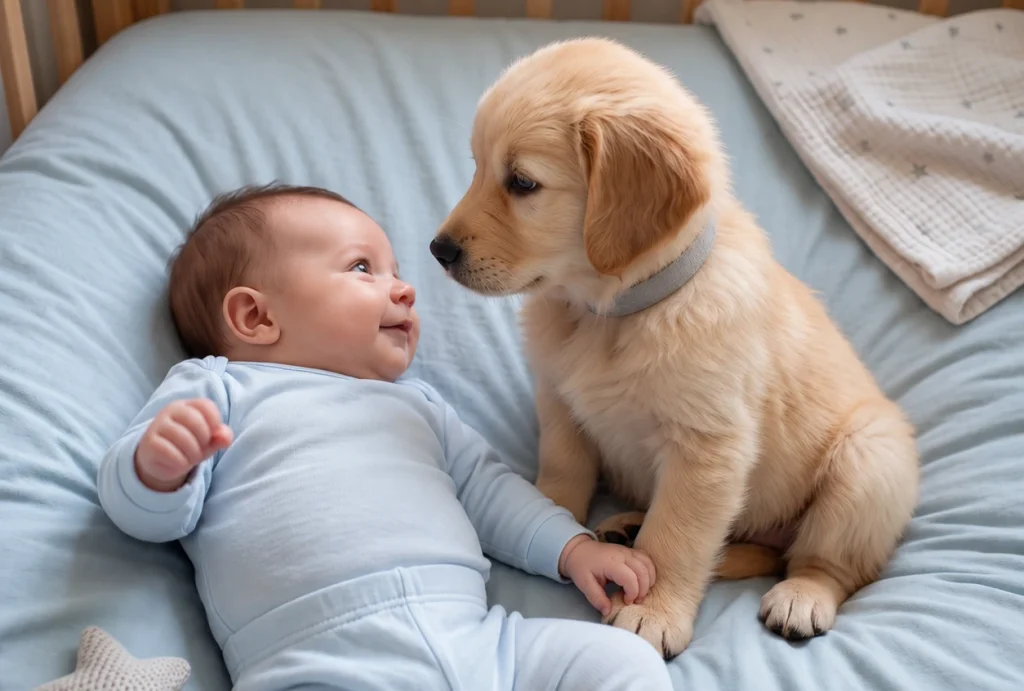
The pediatric neurologist had warned her that a cold could become an emergency for a baby with infantile-onset spinal muscular atrophy. He had also told her that treatment had changed what families could hope for, though no honest doctor could promise which muscles Owen would gain or keep. Leah remembered the warning more clearly than the hope.
Behind the nursery gate, a puppy made one low, questioning sound.
Scout had been in the house for nine hours. He was a ten-week-old golden retriever with a white smudge under his chin, feet too large for the rest of him, and a shelter record that described him as “small for litter, healthy, cautious.” Leah had circled the last word when she signed the adoption papers.
She had gone to the shelter only to deliver blankets from a neighborhood collection. Scout had been sitting apart from his louder littermates, watching a volunteer roll a cart down the aisle. When Leah played a short video of Owen cooing, his head tilted toward the phone and stayed there. She knew that response proved nothing, but she also knew she had not seen Owen hold anyone’s attention in her own face for weeks without thinking first about what the moment might cost.
For those few seconds, wanting something had felt simpler than evaluating it.
Daniel had not wanted a dog. He had wanted a night nurse, a newer suction machine, and six uninterrupted hours of sleep for his wife. What they could afford was none of those things, and what Leah had brought home was a puppy who had vomited once in the minivan and then fallen asleep with his head on Owen’s folded stroller blanket.
“Lee,” Daniel said from the recliner, not quite awake. “The gate.”
Scout put both front paws on it and stared through the bars. He did not bark again. His nose worked rapidly, sorting the room’s smells: warm formula, detergent, plastic tubing, the faint medicinal sweetness that seemed to cling to Owen’s equipment.
Leah rose to carry him back to the kitchen. Her knees cracked, and the movement woke Owen enough to make him fuss. The sound was thin and breathy, but it tightened every muscle in her body.
She lifted Scout. Instead of wriggling, he leaned toward the crib, ears tipped forward.
“You are not helping,” Daniel murmured.
“Neither are you, from over there.”
He sat up, wounded but too tired to argue. For six months they had been speaking to each other across Owen’s crib as if it were a wide piece of water. Daniel asked what needed fixing; Leah heard him asking why she had failed to fix it already. Leah said she could manage; Daniel heard that there was no place for him in the managing.
Owen’s fussing sharpened. Leah checked the monitor, then the position of his head and the line of his shoulders. She had done the same sequence so many times that her hands moved before thought.
Scout touched his nose to her wrist.
“Kitchen,” she told him, though her voice softened on the word.
He looked at Owen again. The puppy’s body went still in her arms, not frightened, simply attentive. Leah had seen that same attention at the county shelter that afternoon when a metal bowl clattered three kennels away and every other puppy rushed the gate. Scout had turned toward the sound, considered it, and stayed beside her shoe.
She lowered him to the nursery rug.
Daniel stood. “Leah.”
“I know. Just for a second.”
Scout approached the crib in an uncertain curve, stopping twice to glance back at her. He could not see over the rail. When Owen made another strained little cry, Scout sat down beneath it and tipped his head.
The crying stopped long enough for all three adults in the room—two human, one canine—to listen.
Then Owen whimpered again. Scout rose, placed one paw against the crib’s lower slat, and made the softest answering whine.
Leah felt something loosen in her chest. It was not a miracle. It was not even useful. It was simply the first sound in weeks that had entered the nursery without asking her to measure, suction, log, or fear something.
She sat on the rug beside him. “That’s Owen,” she whispered. “He’s the reason nobody sleeps here.”
Daniel came around the crib and sat across from her. His hair stood up at one side, and a crease from the recliner marked his cheek. For the first time that night, he looked less like the man assigned to hold the household together and more like the husband who used to make her laugh in grocery-store aisles.
“The dog snores,” he said. “I heard him in the car.”
“Then he’ll fit right in.”
Scout folded himself against the crib slats. Owen’s hand lay near the edge of the mattress, palm half closed. The puppy sniffed through the gap, sneezed, and sat back in apparent offense.
Daniel almost smiled.
The moment lasted less than a minute. Owen’s face pinched again, and Leah reached for him, but Scout was already on his feet. He pressed his muzzle between two slats and breathed against Owen’s hand.
Owen quieted.
Leah watched the monitor. His breathing did not become stronger, and nothing about his diagnosis changed. What changed was the strain in his face. His brow smoothed, and his fingers opened a fraction toward the warm breath at the rail.
Daniel crouched closer. “Is he asleep?”
“Not yet.”
They stayed on the floor until Owen drifted off. Scout stayed too, chin on his paws, waking whenever Owen stirred and settling when he settled. At three, Daniel carried the puppy to his crate, and Leah made him promise to latch the nursery gate.
At 3:11, she woke to a scrape on the hardwood.
The gate stood open. Daniel, moving on instinct and no sleep, had latched it without catching the bolt. Scout had pushed through and was now balanced on his hind legs beside the crib.
Leah crossed the room quickly, ready to pull him away. Before she reached him, Scout’s front paw slipped between the slats and landed beside Owen’s hand.
The puppy’s toes twitched in sleepiness. Owen’s index finger moved.
Leah stopped so abruptly that the floor seemed to tilt beneath her. She waited, telling herself she had seen a reflex, a shadow, anything except what she wanted to see.
Scout shifted his paw. Owen’s finger bent again and rested against the fur between the puppy’s toes.
“Daniel,” Leah said, and her voice came out almost soundless.
He woke at once. Months of alarms had trained both of them to surface without confusion. He came to the crib, following the direction of her hand.
Scout gave a tiny sigh and began to withdraw his paw.
Owen’s fingers tightened just enough to keep it there.
Daniel stared at the small hand resting over the golden paw. “Did he just do that?”
To read the rest of the story – CLICK the NEXT button 👇👇👇